Best Book for Relationships (2026): 5 Top Guides Compared
Five relationship books compared by edition date, page count and guidance style, from communication frameworks to research-based marriage principles.

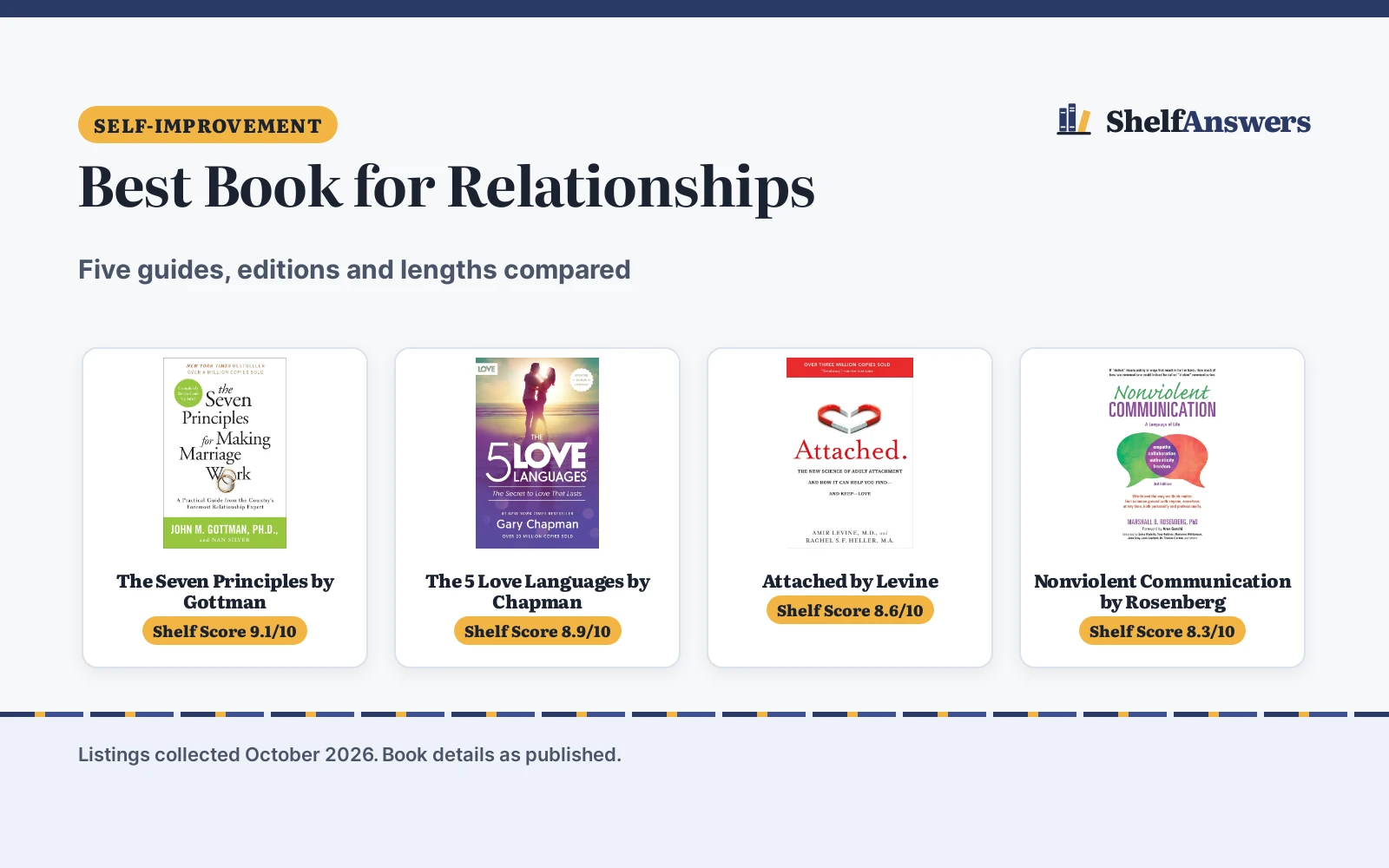
At a glance
Top picks
As an Amazon Associate I earn from qualifying purchases. How we score
When conversations stall at the kitchen table or a partnership feels stuck in recurring patterns, finding the best book for relationships can provide a practical framework to rebuild understanding. This guide is for couples, newlyweds and individuals seeking clearer communication, healthier boundaries or deeper emotional connection. We compared five published relationship books by their edition dates, print lengths, frameworks and target audiences so you can choose the approach that matches your situation.
ShelfAnswers earns a commission when you buy through links on this page, at no extra cost to you. As an Amazon Associate I earn from qualifying purchases. Affiliate disclosure.
Quick picks
- Best Overall The Seven Principles by Gottman: Research-backed principles and practical exercises for resolving marital conflict Check price
- Best for Couples The 5 Love Languages by Chapman: Clear five-part framework with a 2024 fourth edition to improve daily connection Check price
- Best for Attachment Styles Attached by Levine: Guides readers through anxious, avoidant and secure adult attachment patterns Check price
- Best for Communication Nonviolent Communication by Rosenberg: Practical four-part framework for honest expression and active listening Check price
- Best for Dating Independence Why Men Love Bitches by Argov: Dating guide with Attraction Principles and real-life relationship scenarios Check price
Compare the picks
| Book | Shelf Score | Author | Pages | Published |
|---|---|---|---|---|
| The Seven Principles by Gottman | 9.1/10 | John Gottman PhD, Nan Silver | 321 | May 5, 2015 |
| The 5 Love Languages by Chapman | 8.9/10 | Gary Chapman | 224 | June 1, 2024 |
| Attached by Levine | 8.6/10 | Amir Levine, Rachel Heller | 304 | January 5, 2012 |
| Nonviolent Communication by Rosenberg | 8.3/10 | Marshall B. Rosenberg PhD | 264 | September 1, 2015 |
| Why Men Love Bitches by Argov | 7.3/10 | Sherry Argov | 255 | October 1, 2002 |
Book details as published on each listing, collected 15 October 2026.
The picks
| # | Product | Shelf Score | Buy |
|---|---|---|---|
| 1 |  The Seven Principles by Gottman The Seven Principles by Gottman | 9.1/10 | Buy |
| 2 |  The 5 Love Languages by Chapman The 5 Love Languages by Chapman | 8.9/10 | Buy |
| 3 |  Attached by Levine Attached by Levine | 8.6/10 | Buy |
| 4 |  Nonviolent Communication by Rosenberg Nonviolent Communication by Rosenberg | 8.3/10 | Buy |
| 5 |  Why Men Love Bitches by Argov Why Men Love Bitches by Argov | 7.3/10 | Buy |
The Seven Principles by Gottman
A research-based guide to marriage habits, conflict resolution strategies and emotional intimacy.
Pros
- Covers seven practical principles based on years of couple research
- Includes exercises and research updates from the Gottman Institute
- Offers strategies for resolving recurring problems across sex, money and family
- 321 pages, providing the most in-depth relationship guidance here
Cons
- Focused specifically on marriage rather than early dating
- Published May 5, 2015, so it is an updated reprint rather than a brand-new release
- No reading age or grade level is listed
- 321 pages requires a longer reading commitment than shorter guides
Detailed Review
The description presents John Gottman's study of couples over a period of years, observing habits that make or break a marriage to establish seven guiding principles. It provides strategies to collaborate on conflict, create shared common ground and address issues such as money, family and intimacy. The listing gives 321 pages, an updated edition, and a publication date of May 5, 2015. No reading age or grade level is stated.
Who it's for: couples, spouses and partners looking for structured exercises and research-grounded habits to resolve conflict and strengthen intimacy. Who should skip it: readers in the earliest stages of dating or those looking for a quick single-afternoon overview.
Its Shelf Score of 9.1/10 comes from fit 33/35, contents and edition 22/25, value 22/25 and reading age or level not scored (no reading age or level stated).
Book Details
| Author | John Gottman PhD, Nan Silver |
|---|---|
| Publisher | Harmony/Rodale/Convergent |
| Print length | 321 pages |
| Published | May 5, 2015 |
| Edition | Updated |
Details as published on the retailer listing, collected 15 October 2026. Editions and formats change; check the listing before you buy.
Reading Age and Edition
What this listing states. No reading age, grade level or skill level is stated, so that criterion is not scored. Books carry no warranty, so warranty is not part of the score. See How We Pick.
Check the edition and format. Covers, editions and formats change. Match the edition or ISBN your reader, class or club needs on the listing.
Listed reading ages and grade levels are a guide, not advice about a particular reader. Editions and formats change, so check the listing before you buy. See our Reading Age Disclaimer.
The 5 Love Languages by Chapman
A practical guide explaining five distinct ways partners express and receive love.
Pros
- Clear framework centered on five distinct love languages
- Fourth Edition published June 1, 2024, the newest release in this list
- Applies to newlyweds, long-term partners, family members and close friends
- Relatable real-life examples and practical identification steps
Cons
- 224 pages is relatively short for exploring complex partnership dynamics
- No reading age or grade level is listed
- Focuses on one core framework rather than varied clinical methods
- A fourth edition where the listing does not detail differences from earlier versions
Detailed Review
The description outlines Gary Chapman's framework that people express and receive love in five distinct ways: Words of Affirmation, Quality Time, Receiving Gifts, Acts of Service, and Physical Touch. It uses real-life examples to help readers identify their primary language and reduce misunderstandings. The listing gives 224 pages, a Fourth Edition designation, and a publication date of June 1, 2024. No reading age or grade level is stated.
Who it's for: newlyweds, long-term couples and partners who want a straightforward, shared vocabulary to understand how each person feels appreciated. Who should skip it: readers looking for deep psychological attachment analysis or extensive clinical relationship research.
Its Shelf Score of 8.9/10 comes from fit 32/35, contents and edition 22/25, value 21/25 and reading age or level not scored (no reading age or level stated).
Book Details
| Author | Gary Chapman |
|---|---|
| Publisher | Northfield Publishing |
| Print length | 224 pages |
| Published | June 1, 2024 |
| Edition | Fourth Edition |
Details as published on the retailer listing, collected 15 October 2026. Editions and formats change; check the listing before you buy.
Reading Age and Edition
What this listing states. No reading age, grade level or skill level is stated, so that criterion is not scored. Books carry no warranty, so warranty is not part of the score. See How We Pick.
Check the edition and format. Covers, editions and formats change. Match the edition or ISBN your reader, class or club needs on the listing.
Listed reading ages and grade levels are a guide, not advice about a particular reader. Editions and formats change, so check the listing before you buy. See our Reading Age Disclaimer.
Attached by Levine
An exploration of adult attachment theory explaining how anxious, avoidant and secure styles shape love.
Pros
- Grounds relationship patterns in adult attachment science
- Defines three distinct relationship styles: anxious, avoidant and secure
- Includes road maps to determine personal and partner attachment styles
- 304 pages with thorough psychological analysis
Cons
- Reprint edition published January 5, 2012, more than a decade old
- Focuses heavily on dating and attachment categories rather than marital routines
- No reading age or grade level is listed
- Author line lists Amir Levine and Rachel Heller while brand shows only Levine
Detailed Review
The description applies John Bowlby's 1950s attachment research to adult romantic bonds, dividing relationship behavior into anxious, avoidant and secure styles. It offers guidance to help readers identify attachment habits in themselves and their partners to navigate intimacy. The listing gives 304 pages, a reprint edition, and a publication date of January 5, 2012. The author line lists Amir Levine and Rachel Heller, though the brand field names only Levine. No reading age or grade level is stated.
Who it's for: individuals navigating dating or recurring relationship friction who want to understand intimacy habits through attachment styles. Who should skip it: couples looking for step-by-step communication scripts or readers wanting a newly published guide.
Its Shelf Score of 8.6/10 comes from fit 30/35, contents and edition 21/25, value 21/25 and reading age or level not scored (no reading age or level stated).
Book Details
| Author | Amir Levine, Rachel Heller |
|---|---|
| Publisher | Tarcher |
| Print length | 304 pages |
| Published | January 5, 2012 |
| Edition | Reprint |
Details as published on the retailer listing, collected 15 October 2026. Editions and formats change; check the listing before you buy.
Reading Age and Edition
What this listing states. No reading age, grade level or skill level is stated, so that criterion is not scored. Books carry no warranty, so warranty is not part of the score. See How We Pick.
Check the edition and format. Covers, editions and formats change. Match the edition or ISBN your reader, class or club needs on the listing.
Listed reading ages and grade levels are a guide, not advice about a particular reader. Editions and formats change, so check the listing before you buy. See our Reading Age Disclaimer.
Nonviolent Communication by Rosenberg
A four-part communication framework focused on empathy, honest expression and active listening.
Pros
- Structured four-part framework: consciousness, language, communication and means of influence
- Teaches conflict resolution skills applicable at home, work and community
- Practical tools for active listening and hearing needs behind criticism
- Third Edition published September 1, 2015 with 264 pages
Cons
- Broader communication focus rather than exclusive romantic relationship advice
- Published September 1, 2015, without newer edition updates listed
- No reading age or grade level is listed
- Requires disciplined daily practice rather than quick conversational shortcuts
Detailed Review
The description outlines Marshall B. Rosenberg's framework for replacing blame and defensiveness with empathy, clear requests and active listening. It integrates four components: consciousness, language, communication and means of influence, helping individuals hear needs behind anger and express themselves honestly. The listing gives 264 pages, a Third Edition release, and a publication date of September 1, 2015. The spec table repeats the words 'Third Edition' twice. No reading age or grade level is stated.
Who it's for: partners, parents and professionals who want a structured method to de-escalate heated arguments and communicate needs without blame. Who should skip it: readers seeking romantic dating tips or marriage-specific rituals.
Its Shelf Score of 8.3/10 comes from fit 29/35, contents and edition 21/25, value 20/25 and reading age or level not scored (no reading age or level stated).
Book Details
| Author | Marshall B. Rosenberg PhD |
|---|---|
| Publisher | PuddleDancer Press |
| Print length | 264 pages |
| Published | September 1, 2015 |
| Edition | Third Edition |
Details as published on the retailer listing, collected 15 October 2026. Editions and formats change; check the listing before you buy.
Reading Age and Edition
What this listing states. No reading age, grade level or skill level is stated, so that criterion is not scored. Books carry no warranty, so warranty is not part of the score. See How We Pick.
Check the edition and format. Covers, editions and formats change. Match the edition or ISBN your reader, class or club needs on the listing.
Listed reading ages and grade levels are a guide, not advice about a particular reader. Editions and formats change, so check the listing before you buy. See our Reading Age Disclaimer.
Why Men Love Bitches by Argov
A dating guide emphasizing independence, personal boundaries and self-respect in romantic relationships.
Pros
- Clear emphasis on personal boundaries, self-respect and emotional independence
- Includes Attraction Principles to clarify relationship dynamics
- Features 'she says/he thinks' comparison tables and real-life scenarios
- 255 pages of direct dating advice
Cons
- Published October 1, 2002, making it the oldest release in this list
- Specifically targeted to women dating men rather than all relationship types
- 6th edition where the listing notes no recent updates since 2002
- No reading age or grade level is listed
Detailed Review
The description presents Sherry Argov's perspective on why standing up for oneself creates healthier dating dynamics than routine self-sacrifice. It includes real-life scenarios, comparison tables and defined Attraction Principles to encourage women to maintain independence. The listing gives 255 pages, a 6th edition release, and a publication date of October 1, 2002. No reading age or grade level is stated.
Who it's for: women seeking direct dating guidance on maintaining personal boundaries, confidence and independence in early relationships. Who should skip it: established couples seeking shared marriage exercises or readers looking for gender-neutral relationship advice.
Its Shelf Score of 7.3/10 comes from fit 26/35, contents and edition 18/25, value 19/25 and reading age or level not scored (no reading age or level stated).
Book Details
| Author | Sherry Argov |
|---|---|
| Publisher | Adams Media |
| Print length | 255 pages |
| Published | October 1, 2002 |
| Edition | 6th ed. |
Details as published on the retailer listing, collected 15 October 2026. Editions and formats change; check the listing before you buy.
Reading Age and Edition
What this listing states. No reading age, grade level or skill level is stated, so that criterion is not scored. Books carry no warranty, so warranty is not part of the score. See How We Pick.
Check the edition and format. Covers, editions and formats change. Match the edition or ISBN your reader, class or club needs on the listing.
Listed reading ages and grade levels are a guide, not advice about a particular reader. Editions and formats change, so check the listing before you buy. See our Reading Age Disclaimer.
As an Amazon Associate I earn from qualifying purchases.
How we scored them
The Shelf Score weighs fit for building healthier relationships, contents and edition, value, and the listed reading age or level where one is given. None of the five listings state a reading age or grade level, which is standard for adult relationship and communication titles. Publication dates range from October 1, 2002 to June 1, 2024, and newer editions with updated exercises score higher on contents and fit. How we pick explains the weights.
| Book | Shelf Score | Fit /35 | Contents /25 | Value /25 | Age/level /10 |
|---|---|---|---|---|---|
| The Seven Principles by Gottman | 9.1 | 33 | 22 | 22 | n/a |
| The 5 Love Languages by Chapman | 8.9 | 32 | 22 | 21 | n/a |
| Attached by Levine | 8.6 | 30 | 21 | 21 | n/a |
| Nonviolent Communication by Rosenberg | 8.3 | 29 | 21 | 20 | n/a |
| Why Men Love Bitches by Argov | 7.3 | 26 | 18 | 19 | n/a |
Scores run from 0 to 10. Reading age or level counts on a list where at least one listing gives one, and a book whose listing gives none then scores zero on it. Where no listing gives one, the score is taken over the other 85 points. Books carry no warranty, so warranty is not scored.
How to choose the best book for relationships
Identify the relationship stage and goal
Every relationship book approaches connection from a specific perspective. The Seven Principles by Gottman focuses on married couples and long-term partners working through conflict and shared routines. In contrast, Why Men Love Bitches by Argov is directed at women navigating early dating and independence. Attached by Levine examines attachment styles to explain intimacy anxieties, while The 5 Love Languages by Chapman provides a shared vocabulary for daily appreciation.
Communication frameworks versus habit research
Choosing between conversational tools and behavioral principles depends on how you prefer to learn. Nonviolent Communication by Rosenberg teaches a structured four-part method centered on consciousness, language, communication and means of influence to de-escalate tension. Readers wanting clinical observations of couple behavior will find research-backed exercises in Gottman’s guide. Those interested in cognitive patterns behind emotional reactions may also browse our guide to the best book for psychology.
Check the publication date and edition
| Book | Edition | Pages | Published |
|---|---|---|---|
| The Seven Principles | Updated | 321 | May 5, 2015 |
| The 5 Love Languages | Fourth Edition | 224 | June 1, 2024 |
| Attached | Reprint | 304 | January 5, 2012 |
| Nonviolent Communication | Third Edition | 264 | September 1, 2015 |
| Why Men Love Bitches | 6th ed. | 255 | October 1, 2002 |
Relationship guides evolve as authors revise exercises and update examples. The 5 Love Languages is a Fourth Edition published June 1, 2024, whereas Why Men Love Bitches was published October 1, 2002. Building consistent relationship routines also requires individual commitment, similar to the habits outlined in the best book for discipline.
Before you buy
- Check the publication date and edition on the listing, as releases range from 2002 to 2024.
- Confirm whether the book focuses on marriage, dating or general interpersonal communication before ordering.
- Look at page counts: options range from 224 pages for a focused framework up to 321 pages for extensive exercises.
- Note that none of these listings publish an age range or grade level recommendation.
Frequently Asked Questions
What is the best book for relationships for married couples?
The Seven Principles for Making Marriage Work by John Gottman PhD and Nan Silver is designed specifically for couples and spouses. The 321-page updated edition includes exercises and research from the Gottman Institute to help partners resolve conflict and build intimacy.
Which relationship book is best for understanding communication patterns?
Nonviolent Communication by Marshall B. Rosenberg PhD presents a practical four-part framework focused on consciousness, language, communication and means of influence. The 264-page third edition teaches partners and individuals how to express feelings honestly and listen with empathy.
What is the newest relationship book on this list?
The 5 Love Languages by Gary Chapman is the newest release here, published on June 1, 2024 as a 224-page Fourth Edition. It explains how partners express and receive love through five specific languages.
How does Attached explain relationship problems?
Attached by Amir Levine and Rachel Heller uses adult attachment science to divide relationship behavior into three styles: anxious, avoidant and secure. The 304-page guide helps readers identify their personal style and understand their partner’s need for closeness.
Is Why Men Love Bitches suitable for long-term marriage advice?
The listing describes Why Men Love Bitches as a 255-page dating guide focused on boundaries and independence for women dating men. Couples seeking marriage-specific exercises will find more relevant tools in The Seven Principles for Making Marriage Work.
Related lists
See every self-improvement list and all nonfiction lists. Also see our best books for managers. Also see our best book for leadership. Also see our best book for entrepreneurs.
More lists: browse business books, history and biography books and reading guides.