Best Book for Leadership (2026): 4 Top Picks Compared
Four leadership books compared by publication date, page count and format, from actionable coaching questions to team dysfunction models and daily discipline.

On this page
When stepping into a new management role or guiding a struggling team through organizational change, finding the best book for leadership comes down to whether you need broad purpose, team alignment, coaching habits or personal discipline. This comparison is built for managers, department heads and team leaders who want practical frameworks rather than vague workplace motivation. We compared four books by publication date, print length, edition details and published descriptions to help you select the right title for your team.
ShelfAnswers earns a commission when you buy through links on this page, at no extra cost to you. As an Amazon Associate I earn from qualifying purchases. Affiliate disclosure.
Quick picks
- Best Overall Start with Why by Sinek: The Golden Circle framework provides a timeless model for inspiring team purpose Check price
- Best for Team Dynamics The Five Dysfunctions by Lencioni: A realistic fable and five-step diagnostic guide to eliminate executive dysfunction Check price
- Best for Daily Coaching The Coaching Habit by Stanier: Seven practical questions that transform everyday conversations into coaching habits Check price
- Best for Personal Discipline Make Your Bed by McRaven: Ten succinct lessons from Navy SEAL training on resilience and daily habits Check price
Compare the picks
| Book | Shelf Score | Author | Pages | Published |
|---|---|---|---|---|
| Start with Why by Sinek | 8.2/10 | Simon Sinek | 256 | December 27, 2011 |
| The Five Dysfunctions by Lencioni | 7.8/10 | Patrick M. Lencioni | 256 | April 11, 2002 |
| The Coaching Habit by Stanier | 8.5/10 | Michael Bungay Stanier | 264 | February 29, 2016 |
| Make Your Bed by McRaven | 6.8/10 | Admiral William H. McRaven | 144 | April 4, 2017 |
Book details as published on each listing, collected 15 October 2026.
The picks
| # | Product | Shelf Score | Buy |
|---|---|---|---|
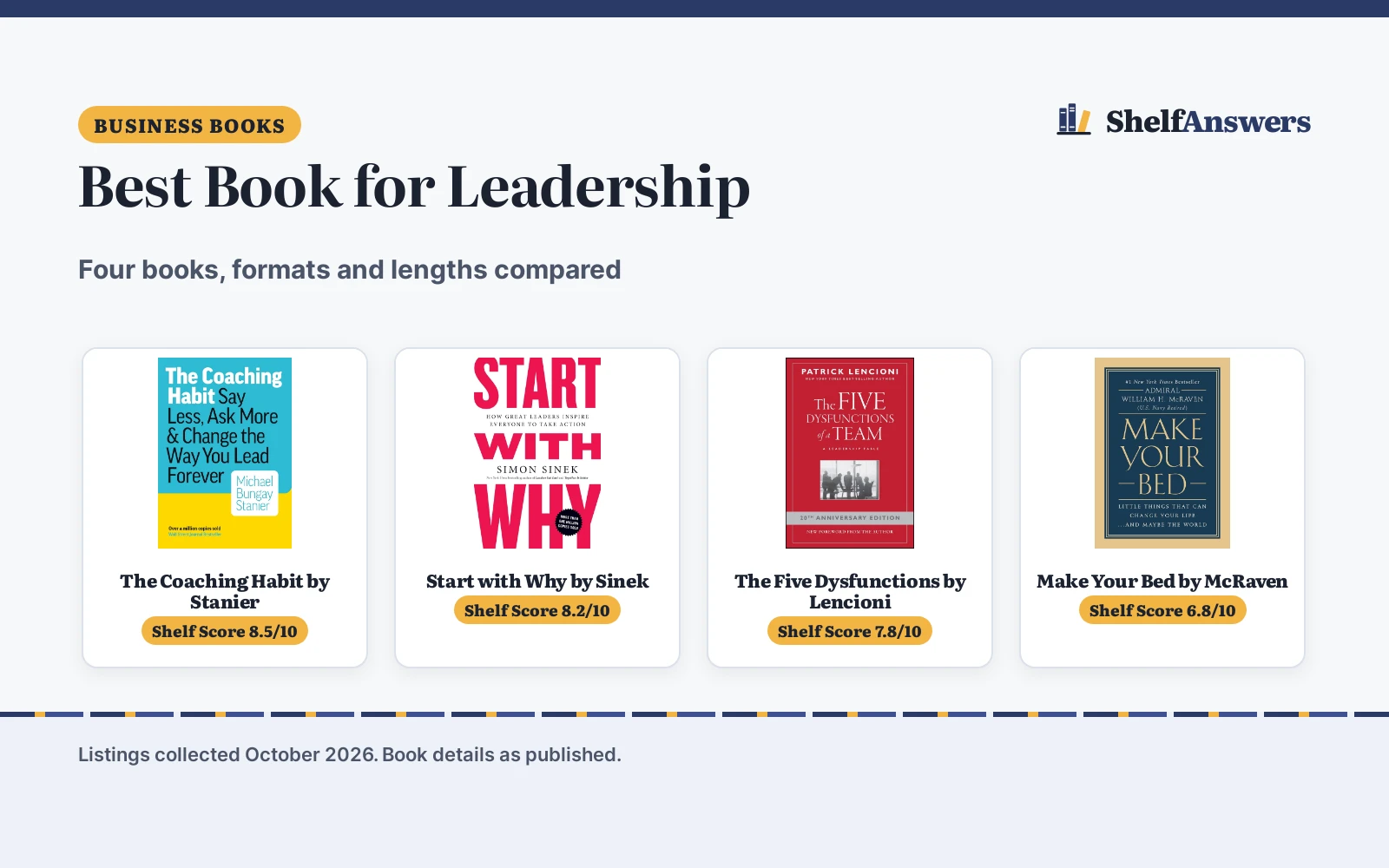
| 1 |  The Coaching Habit by Stanier The Coaching Habit by Stanier | 8.5/10 | Buy |
| 2 |  Start with Why by Sinek Start with Why by Sinek | 8.2/10 | Buy |
| 3 |  The Five Dysfunctions by Lencioni The Five Dysfunctions by Lencioni | 7.8/10 | Buy |
| 4 |  Make Your Bed by McRaven Make Your Bed by McRaven | 6.8/10 | Buy |
The Coaching Habit by Stanier
A practical managerial guide outlining seven core questions to transform daily supervisory conversations into productive coaching habits.
Pros
- Outlines seven specific coaching questions designed for busy managers
- Lists an explicit reading age of 18 years and up
- Draws on research in neuroscience and behavioral economics with interactive tools
- 264 pages provides practical advice structured for quick daily application
Cons
- Published February 29, 2016, so check for newer editions before purchasing
- Focuses strictly on coaching dialogue rather than broad corporate strategy
- Requires behavioral practice to turn questions into natural conversational habits
- Spec table contains minor formatting glitches with duplicate publication entries
Detailed Review
The description presents an informal coaching approach for managers based on seven core questions, blending neuroscience and behavioral economics to help leaders support their teams without micromanaging. The listing gives a print length of 264 pages, a publication date of February 29, 2016, Page Two as publisher, a 1st edition, and a reading age of 18 years and up.
Who it's for: a manager who spends too much time answering questions and wants a structured framework to coach team members toward autonomy. Who should skip it: a reader seeking senior executive guidance on corporate finance, governance or organizational restructuring.
Its Shelf Score of 8.5/10 comes from fit 30/35, contents and edition 21/25, value 21/25 and reading age or level 8/10.
Book Details
| Author | Michael Bungay Stanier |
|---|---|
| Publisher | Page Two |
| Print length | 264 pages |
| Published | February 29, 2016 |
| Reading age | 18 years and up |
Details as published on the retailer listing, collected 15 October 2026. Editions and formats change; check the listing before you buy.
Reading Age and Edition
What this listing states. Reading age 18 years and up, so reading age or level scores 8 of 10. Books carry no warranty, so warranty is not part of the score. See How We Pick.
Check the edition and format. Covers, editions and formats change. Match the edition or ISBN your reader, class or club needs on the listing.
Listed reading ages and grade levels are a guide, not advice about a particular reader. Editions and formats change, so check the listing before you buy. See our Reading Age Disclaimer.
Start with Why by Sinek
A leadership framework exploring how influential leaders inspire action by focusing on organizational purpose.
Pros
- Introduces The Golden Circle framework for organizational leadership
- 256 pages with real-world case studies of influential leaders
- Focuses on long-term employee and customer inspiration rather than short-term tactics
- Provides clear guidance on communicating purpose across teams
Cons
- Published December 27, 2011, making it an older reprint edition
- No reading age or grade level is listed
- Focuses on foundational philosophy rather than step-by-step daily managerial routines
- Draws heavily on well-known historical examples rather than tactical exercises
Detailed Review
The listing describes a leadership guide focused on understanding the core purpose behind organizations, using the Golden Circle framework to explain why certain leaders and movements inspire lasting loyalty. The listing gives a print length of 256 pages, an edition noted as Reprint, and a publication date of December 27, 2011, with Portfolio listed as the publisher.
Who it's for: an executive, manager or founder who wants to define organizational mission and inspire team commitment. Who should skip it: a manager looking for immediate day-to-day conversation scripts or tactical administrative templates.
Its Shelf Score of 8.2/10 comes from fit 33/35, contents and edition 22/25, value 22/25 and reading age or level 0/10.
Book Details
| Author | Simon Sinek |
|---|---|
| Publisher | Portfolio |
| Print length | 256 pages |
| Published | December 27, 2011 |
| Edition | Reprint |
Details as published on the retailer listing, collected 15 October 2026. Editions and formats change; check the listing before you buy.
Reading Age and Edition
What this listing states. No reading age, grade level or skill level is stated, so that criterion is not scored. Books carry no warranty, so warranty is not part of the score. See How We Pick.
Check the edition and format. Covers, editions and formats change. Match the edition or ISBN your reader, class or club needs on the listing.
Listed reading ages and grade levels are a guide, not advice about a particular reader. Editions and formats change, so check the listing before you buy. See our Reading Age Disclaimer.
The Five Dysfunctions by Lencioni
A realistic business narrative illustrating the five behavioral pitfalls that derail teams, paired with a practical diagnostic model.
Pros
- Combines an engaging narrative fable with an actionable diagnostic framework
- Identifies five distinct behavioral tendencies that cause team breakdown
- Includes a step-by-step guide for overcoming dysfunctions and aligning executive teams
- 256 pages offers a thorough exploration of organizational dynamics without excessive length
Cons
- Published April 11, 2002, though the title references a 20th Anniversary Edition
- Listing contradicts itself by labeling the 20th Anniversary Edition as a 1st edition
- No reading age or grade level is listed
- Fable format may not suit readers who prefer a concise reference handbook
Detailed Review
The description frames this book as a realistic business fable following CEO Kathryn Petersen at DecisionTech as she diagnoses team conflict and introduces a model addressing five behavioral dysfunctions. The listing gives a print length of 256 pages and Jossey-Bass as the publisher, but contains a contradiction: the title notes a 20th Anniversary Edition, while the spec table lists the edition as 1st with an original publication date of April 11, 2002.
Who it's for: a team leader or executive struggling with interpersonal friction, mistrust or lack of accountability among direct reports. Who should skip it: an individual contributor seeking a tactical manual on personal productivity rather than group dynamics.
Its Shelf Score of 7.8/10 comes from fit 32/35, contents and edition 21/25, value 21/25 and reading age or level 0/10.
Book Details
| Author | Patrick M. Lencioni |
|---|---|
| Publisher | Jossey-Bass |
| Print length | 256 pages |
| Published | April 11, 2002 |
| Edition | 1st |
Details as published on the retailer listing, collected 15 October 2026. Editions and formats change; check the listing before you buy.
Reading Age and Edition
What this listing states. No reading age, grade level or skill level is stated, so that criterion is not scored. Books carry no warranty, so warranty is not part of the score. See How We Pick.
Check the edition and format. Covers, editions and formats change. Match the edition or ISBN your reader, class or club needs on the listing.
Listed reading ages and grade levels are a guide, not advice about a particular reader. Editions and formats change, so check the listing before you buy. See our Reading Age Disclaimer.
Make Your Bed by McRaven
Ten foundational leadership principles drawn from Navy SEAL training and military service, emphasizing discipline and personal accountability.
Pros
- Concise 144 pages makes it quick to read and easy to revisit
- Ten clear principles drawn from Navy SEAL training and Naval career experiences
- Accessible advice focusing on personal discipline, humility and resilience
- Structured around actionable daily habits starting with making one's bed
Cons
- At 144 pages, it offers less detailed organizational framework than longer guides
- Published April 4, 2017, and lacks specific managerial case studies
- No reading age or grade level is listed
- Grounded primarily in military anecdotes that may not translate directly to corporate settings
Detailed Review
The description outlines ten core principles learned during Navy SEAL training, expanding on a commencement address delivered at the University of Texas at Austin on May 17, 2014, to illustrate how small personal habits foster perseverance. The listing gives a print length of 144 pages, a publication date of April 4, 2017, Grand Central Publishing as the publisher, and a 1st edition.
Who it's for: a newly appointed leader or graduate looking for straightforward, inspirational advice on personal discipline and resilience. Who should skip it: a mid-level manager needing detailed frameworks on delegation, team conflict resolution or strategic planning.
Its Shelf Score of 6.8/10 comes from fit 27/35, contents and edition 19/25, value 19/25 and reading age or level 0/10.
Book Details
| Author | Admiral William H. McRaven |
|---|---|
| Publisher | Grand Central Publishing |
| Print length | 144 pages |
| Published | April 4, 2017 |
| Edition | 1st |
Details as published on the retailer listing, collected 15 October 2026. Editions and formats change; check the listing before you buy.
Reading Age and Edition
What this listing states. No reading age, grade level or skill level is stated, so that criterion is not scored. Books carry no warranty, so warranty is not part of the score. See How We Pick.
Check the edition and format. Covers, editions and formats change. Match the edition or ISBN your reader, class or club needs on the listing.
Listed reading ages and grade levels are a guide, not advice about a particular reader. Editions and formats change, so check the listing before you buy. See our Reading Age Disclaimer.
As an Amazon Associate I earn from qualifying purchases.
How we scored them
The Shelf Score weighs fit for leadership guidance, contents and edition, value, and the listed reading age where one is given. One of the four listings gives a reading age, which is 18 years and up. Page counts and edition details come from each listing, and books with actionable frameworks score higher on contents. How we pick explains the weights.
| Book | Shelf Score | Fit /35 | Contents /25 | Value /25 | Age/level /10 |
|---|---|---|---|---|---|
| The Coaching Habit by Stanier | 8.5 | 30 | 21 | 21 | 8 |
| Start with Why by Sinek | 8.2 | 33 | 22 | 22 | 0 |
| The Five Dysfunctions by Lencioni | 7.8 | 32 | 21 | 21 | 0 |
| Make Your Bed by McRaven | 6.8 | 27 | 19 | 19 | 0 |
Scores run from 0 to 10. Reading age or level counts on a list where at least one listing gives one, and a book whose listing gives none then scores zero on it. Where no listing gives one, the score is taken over the other 85 points. Books carry no warranty, so warranty is not scored.
How to choose the best book for leadership
Organizational vision or tactical execution
Some leadership texts address company-wide alignment, while others focus on direct interpersonal skills. Simon Sinek explores high-level purpose and the Golden Circle framework in Start with Why, making it well suited for executives setting organizational vision. For day-to-day managerial conversations, Michael Bungay Stanier offers seven direct questions in The Coaching Habit to develop team members without micromanaging. Leaders building a business venture may also want to explore our guide to the best book for entrepreneurs.
Diagnosing team dynamics
When team members struggle with mistrust or accountability, a narrative framework can make root problems easier to identify. Patrick Lencioni uses an organizational fable in The Five Dysfunctions of a Team to illustrate five common pitfalls before presenting a diagnostic guide. This approach suits department heads who manage established teams facing conflict, whereas individual contributors may find more personal relevance in Admiral William H. McRaven’s ten daily principles in Make Your Bed.
Book length and reading time
| Book | Print length | Author |
|---|---|---|
| Start with Why | 256 pages | Simon Sinek |
| The Five Dysfunctions of a Team | 256 pages | Patrick M. Lencioni |
| The Coaching Habit | 264 pages | Michael Bungay Stanier |
| Make Your Bed | 144 pages | Admiral William H. McRaven |
A 144-page volume like Make Your Bed can be finished in a single sitting, while 256-page and 264-page titles like Start with Why, The Five Dysfunctions of a Team and The Coaching Habit provide deeper frameworks for ongoing study. Readers comparing wider management strategies can explore our guide to business books.
Before you buy
- Check the publication date and edition details on the listing, such as whether a title is a first edition or a later reprint.
- Look for listed reading ages, such as the 18 years and up mark on The Coaching Habit, to ensure the content matches an adult readership.
- Verify whether the format is a standalone leadership fable, a question-based coaching handbook or an expanded commencement speech.
- Review print lengths, which range from 144 pages to 264 pages across these four titles, to fit your available reading schedule.
Frequently Asked Questions
What is the best book for leadership for a new manager?
The Coaching Habit by Michael Bungay Stanier offers seven practical questions designed for busy managers looking to guide team conversations. Its 264 pages focus on practical everyday habits that help managers develop team autonomy without micromanaging.
Which leadership book is best for improving executive teamwork?
The Five Dysfunctions of a Team by Patrick M. Lencioni focuses specifically on team dynamics. The 256-page book combines a realistic organizational fable with a diagnostic model to address common behavioral pitfalls in executive teams.
How long is Make Your Bed by Admiral William H. McRaven?
The listing gives a print length of 144 pages for Make Your Bed, published by Grand Central Publishing on April 4, 2017. It expands on ten principles originally shared in a 2014 University of Texas commencement address.
Does Start with Why include actionable organizational models?
Yes, Simon Sinek introduces the Golden Circle framework across 256 pages to explain how leaders inspire loyalty and action. The listing notes it as a reprint edition published on December 27, 2011 by Portfolio.
Related lists
See every Business and Money list and all nonfiction lists. Also see our best book for entrepreneurs. Also see our best book for economics. Also see our best books for managers. Also see our best book for investing.
More lists: browse self-improvement books, history and biography books and reading guides.