Best Book for Psychology (2026): 5 Top Picks Compared
Five psychology books compared by page count, subject focus, publication date and edition, from trauma research and cognitive biases to mindset growth.

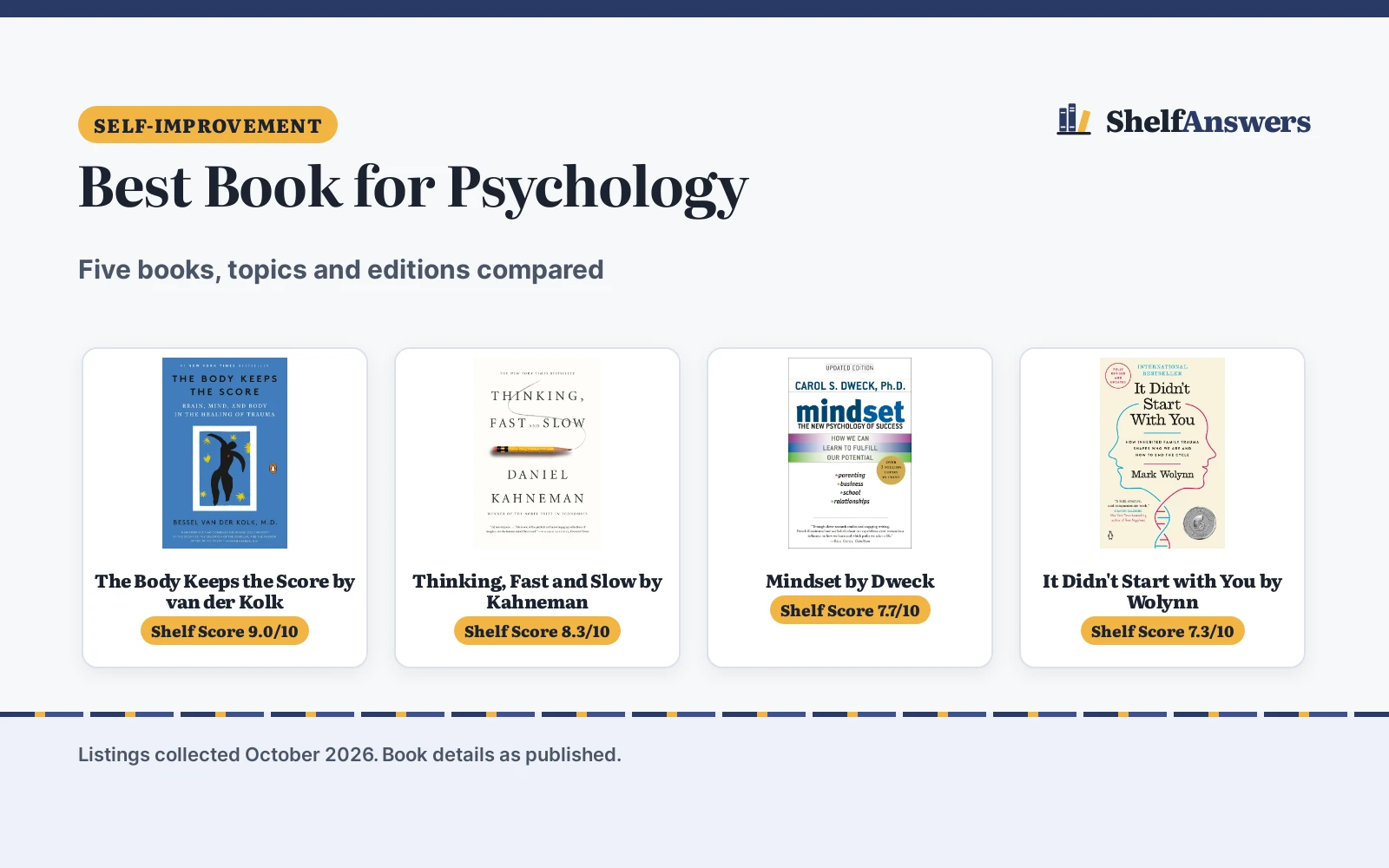
At a glance
Top picks
As an Amazon Associate I earn from qualifying purchases. How we score
Whether you are heading into your first college seminar or building a personal reading list at home, finding the best book for psychology begins with understanding what kind of questions you want answered. We compared five psychology titles by page count, publication date, listed subject focus and author background as published on their Amazon listings. Our comparison looks at how each volume serves readers seeking practical behavioral observations, cognitive research or trauma recovery.
ShelfAnswers earns a commission when you buy through links on this page, at no extra cost to you. As an Amazon Associate I earn from qualifying purchases. Affiliate disclosure.
Quick picks
- Best Overall The Body Keeps the Score by van der Kolk: A thorough 464-page clinical study on trauma recovery and brain neuroplasticity Check price
- Best for Cognitive Science Thinking, Fast and Slow by Kahneman: Explores the two systems of human thought and cognitive biases across 512 pages Check price
- Best for Personal Growth Mindset by Dweck: An accessible 320-page guide comparing fixed and growth mindsets for achievement Check price
- Best for Family Patterns It Didn’t Start with You by Wolynn: Examines generational emotional patterns and genograms across 288 pages Check price
- Best for Social Observation Read People Like a Book by King: Focuses on body language cues, human nature and interpersonal habits in 278 pages Check price
Compare the picks
| Book | Shelf Score | Author | Pages | Published |
|---|---|---|---|---|
| The Body Keeps the Score by van der Kolk | 9.0/10 | Bessel van der Kolk M.D. | 464 | September 8, 2015 |
| Thinking, Fast and Slow by Kahneman | 8.3/10 | Daniel Kahneman | 512 | April 2, 2013 |
| Mindset by Dweck | 7.7/10 | Carol S. Dweck | 320 | December 26, 2007 |
| It Didn’t Start with You by Wolynn | 7.3/10 | Mark Wolynn | 288 | April 25, 2017 |
| Read People Like a Book by King | 6.6/10 | Patrick King | 278 | December 10, 2020 |
Book details as published on each listing, collected 15 October 2026.
The picks
| # | Product | Shelf Score | Buy |
|---|---|---|---|
| 1 |  The Body Keeps the Score by van der Kolk The Body Keeps the Score by van der Kolk | 9.0/10 | Buy |
| 2 |  Thinking, Fast and Slow by Kahneman Thinking, Fast and Slow by Kahneman | 8.3/10 | Buy |
| 3 |  Mindset by Dweck Mindset by Dweck | 7.7/10 | Buy |
| 4 |  It Didn't Start with You by Wolynn It Didn't Start with You by Wolynn | 7.3/10 | Buy |
| 5 |  Read People Like a Book by King Read People Like a Book by King | 6.6/10 | Buy |
The Body Keeps the Score by van der Kolk
A clinical study of how traumatic stress alters the human brain and body, with practical pathways toward recovery.
Pros
- Detailed examination of trauma recovery covering neurofeedback, meditation, drama and yoga
- Extensive 464-page guide drawing on three decades of clinical research
- Explains how traumatic stress alters brain function and bodily responses
- Clear reading age of 18 years and up stated on the listing
Cons
- Description details sensitive themes including combat trauma, domestic violence and abuse
- Reprint edition published September 8, 2015, with no newer revision listed
- 464 pages may be dense for readers seeking a brief introduction
- Focuses specifically on trauma rather than broad introductory psychology
Detailed Review
The description outlines how traumatic stress physically alters the brain and body, impacting self-control, trust and emotional engagement while proposing recovery methods such as neurofeedback, meditation and yoga. The listing gives a print length of 464 pages, a publication date of September 8, 2015 for this reprint edition, and a listed reading age of 18 years and up. The description mentions combat trauma, domestic violence, alcoholism and abuse, so readers seeking gentle material should take note.
Who it's for: an adult reader or student looking for an in-depth scientific study of trauma and neuroplasticity. Who should skip it: anyone sensitive to clinical discussions of physical violence and abuse, or looking for a light overview of general psychology.
Its Shelf Score of 9.0/10 comes from fit 33/35, contents and edition 22/25, value 22/25 and reading age or level 8/10.
Book Details
| Author | Bessel van der Kolk M.D. |
|---|---|
| Publisher | Penguin Books |
| Print length | 464 pages |
| Published | September 8, 2015 |
| Reading age | 18 years and up |
Details as published on the retailer listing, collected 15 October 2026. Editions and formats change; check the listing before you buy.
Reading Age and Edition
What this listing states. Reading age of 18 years and up, so reading age or level scores 8 of 10. Books carry no warranty, so warranty is not part of the score. See How We Pick.
Check the edition and format. Covers, editions and formats change. Match the edition or ISBN your reader, class or club needs on the listing.
Listed reading ages and grade levels are a guide, not advice about a particular reader. Editions and formats change, so check the listing before you buy. See our Reading Age Disclaimer.
Thinking, Fast and Slow by Kahneman
An exploration of human judgment and choice, contrasting fast intuitive impulses with slow deliberate reasoning.
Pros
- Comprehensive 512-page exploration of cognitive biases and decision-making systems
- Clear framework dividing thought into fast intuitive and slow deliberative systems
- Examines judgment errors across corporate planning, financial choices and personal life
- First edition from publisher Farrar, Straus and Giroux
Cons
- 512 pages represents a substantial reading commitment
- Published April 2, 2013, making it an older edition
- No reading age or grade level is stated on the listing
- Concentrates on cognitive biases rather than clinical or emotional psychology
Detailed Review
The description examines human cognition through two distinct modes of thought, separating rapid emotional intuitions from slower, more deliberate logical analysis. It explores how cognitive biases affect corporate strategies, financial forecasting and personal choices across 512 pages. The listing indicates a publication date of April 2, 2013 from publisher Farrar, Straus and Giroux, but provides no reading age or grade level.
Who it's for: readers who want a comprehensive, research-based breakdown of cognitive biases and decision-making systems. Who should skip it: readers wanting a quick, informal guide or those looking specifically for clinical and emotional counseling advice.
Its Shelf Score of 8.3/10 comes from fit 33/35, contents and edition 24/25, value 22/25 and reading age or level 0/10.
Book Details
| Author | Daniel Kahneman |
|---|---|
| Publisher | Farrar, Straus and Giroux |
| Print length | 512 pages |
| Published | April 2, 2013 |
| Edition | First |
Details as published on the retailer listing, collected 15 October 2026. Editions and formats change; check the listing before you buy.
Reading Age and Edition
What this listing states. No reading age, grade level or skill level is stated, so that criterion is not scored. Books carry no warranty, so warranty is not part of the score. See How We Pick.
Check the edition and format. Covers, editions and formats change. Match the edition or ISBN your reader, class or club needs on the listing.
Listed reading ages and grade levels are a guide, not advice about a particular reader. Editions and formats change, so check the listing before you buy. See our Reading Age Disclaimer.
Mindset by Dweck
An examination of how beliefs about personal abilities shape achievement across academics, athletics and work.
Pros
- Explains the distinction between fixed and growth mindsets across 320 pages
- Addresses the concept of false growth mindset in this updated trade edition
- Applies psychological concepts to parenting, teaching, sports and business management
- Compact 320-page length provides an accessible introduction to behavioral change
Cons
- Published December 26, 2007, the oldest publication date among these picks
- No reading age or grade level is stated on the listing
- Focuses primarily on belief systems rather than broader psychological theories
- Listing does not state whether further revised editions exist
Detailed Review
The description investigates how human achievement across academics, sports and business is shaped by whether individuals view their abilities as fixed or capable of growth. It covers the concept of a false growth mindset and applies motivational ideas to organizational culture. The listing states a print length of 320 pages and a publication date of December 26, 2007 for the Ballantine Books trade paperback edition, with no reading age or grade level stated.
Who it's for: educators, managers, parents and students interested in the psychology of motivation and skill development. Who should skip it: readers seeking an advanced textbook on neurobiology or broad experimental psychology.
Its Shelf Score of 7.7/10 comes from fit 30/35, contents and edition 22/25, value 20/25 and reading age or level 0/10.
Book Details
| Author | Carol S. Dweck |
|---|---|
| Publisher | Ballantine Books |
| Print length | 320 pages |
| Published | December 26, 2007 |
| Edition | Ballantine Books Trade Pbk. Ed. |
Details as published on the retailer listing, collected 15 October 2026. Editions and formats change; check the listing before you buy.
Reading Age and Edition
What this listing states. No reading age, grade level or skill level is stated, so that criterion is not scored. Books carry no warranty, so warranty is not part of the score. See How We Pick.
Check the edition and format. Covers, editions and formats change. Match the edition or ISBN your reader, class or club needs on the listing.
Listed reading ages and grade levels are a guide, not advice about a particular reader. Editions and formats change, so check the listing before you buy. See our Reading Age Disclaimer.
It Didn't Start with You by Wolynn
A guide examining how ancestral and familial trauma shapes emotional health, paired with practical self-inventories.
Pros
- Covers intergenerational trauma, genograms and the Core Language Approach
- Includes diagnostic self-inventories to uncover family emotional patterns
- Manageable length of 288 pages from Penguin Life
- Builds on published research from neuroscientists and trauma specialists
Cons
- Listing description mentions a 2025 revision while the spec table lists an April 25, 2017 publication date
- No reading age or grade level is stated on the listing
- Addresses sensitive topics including chronic pain, phobias, anxiety and depression
- Companion workbook mentioned in the description is sold separately
Detailed Review
The description explores how trauma experienced by parents and grandparents can influence descendants through genetic expression, language patterns and physical symptoms. It introduces the Core Language Approach, family genograms and diagnostic self-inventories to resolve inherited emotional distress. The listing gives 288 pages and a spec table publication date of April 25, 2017, though the description text notes a 2025 revision. The description explicitly mentions depression, anxiety, chronic pain and phobias, and notes that a companion workbook is sold separately.
Who it's for: readers seeking to understand family behavioral patterns, intergenerational emotional ties and therapeutic self-inventories. Who should skip it: readers looking for general laboratory psychology or those who want a stand-alone guide that does not reference a separate workbook.
Its Shelf Score of 7.3/10 comes from fit 29/35, contents and edition 20/25, value 20/25 and reading age or level 0/10.
Book Details
| Author | Mark Wolynn |
|---|---|
| Publisher | Penguin Life |
| Print length | 288 pages |
| Published | April 25, 2017 |
| Edition | Reprint |
Details as published on the retailer listing, collected 15 October 2026. Editions and formats change; check the listing before you buy.
Reading Age and Edition
What this listing states. No reading age, grade level or skill level is stated, so that criterion is not scored. Books carry no warranty, so warranty is not part of the score. See How We Pick.
Check the edition and format. Covers, editions and formats change. Match the edition or ISBN your reader, class or club needs on the listing.
Listed reading ages and grade levels are a guide, not advice about a particular reader. Editions and formats change, so check the listing before you buy. See our Reading Age Disclaimer.
Read People Like a Book by King
A practical overview of human behavior, body language cues and personality patterns for everyday social interactions.
Pros
- Accessible 278-page guide focusing on body language cues and social observation
- Published December 10, 2020, offering a relatively recent publication date
- Covers practical topics including eye contact habits and lie detection limits
- Shortest book among these picks, making it easy to finish quickly
Cons
- Listing states it is independently published rather than released by an academic press
- Marked as Book 1 of 45 in a long series
- No reading age or grade level is stated on the listing
- Focuses on social tactics rather than rigorous experimental psychology research
Detailed Review
The description presents everyday observational methods for analyzing body language, facial cues and behavioral habits to understand personal motivations and social interactions. It discusses the limitations of lie detection and techniques for observing subtle physical signals across 278 pages. The listing shows a publication date of December 10, 2020 as an independently published release, marking it as Book 1 of 45 in a series, with no reading age or grade level provided.
Who it's for: readers seeking an informal, practical introduction to observing body language and interpersonal communication. Who should skip it: students or researchers looking for peer-reviewed academic literature or comprehensive clinical psychology.
Its Shelf Score of 6.6/10 comes from fit 26/35, contents and edition 19/25, value 19/25 and reading age or level 0/10.
Book Details
| Author | Patrick King |
|---|---|
| Publisher | Independently published |
| Print length | 278 pages |
| Published | December 10, 2020 |
| Series | Book 1 of 45 |
Details as published on the retailer listing, collected 15 October 2026. Editions and formats change; check the listing before you buy.
Reading Age and Edition
What this listing states. No reading age, grade level or skill level is stated, so that criterion is not scored. Books carry no warranty, so warranty is not part of the score. See How We Pick.
Check the edition and format. Covers, editions and formats change. Match the edition or ISBN your reader, class or club needs on the listing.
Listed reading ages and grade levels are a guide, not advice about a particular reader. Editions and formats change, so check the listing before you buy. See our Reading Age Disclaimer.
As an Amazon Associate I earn from qualifying purchases.
How we scored them
The Shelf Score weighs fit for the psychology reader, contents and edition, value, and the listed reading age or level where one is given. Only one of the five listings provides an audience level, with The Body Keeps the Score stating a reading age of 18 years and up. Page lengths range from 278 pages to 512 pages, and publication dates range from 2007 to 2020. How we pick explains the weights.
| Book | Shelf Score | Fit /35 | Contents /25 | Value /25 | Age/level /10 |
|---|---|---|---|---|---|
| The Body Keeps the Score by van der Kolk | 9.0 | 33 | 22 | 22 | 8 |
| Thinking, Fast and Slow by Kahneman | 8.3 | 33 | 24 | 22 | 0 |
| Mindset by Dweck | 7.7 | 30 | 22 | 20 | 0 |
| It Didn’t Start with You by Wolynn | 7.3 | 29 | 20 | 20 | 0 |
| Read People Like a Book by King | 6.6 | 26 | 19 | 19 | 0 |
Scores run from 0 to 10. Reading age or level counts on a list where at least one listing gives one, and a book whose listing gives none then scores zero on it. Where no listing gives one, the score is taken over the other 85 points. Books carry no warranty, so warranty is not scored.
How to choose the best book for psychology
Match the subfield to your reading goal
Psychology covers diverse disciplines, from clinical neuroscience to everyday social observation. Readers looking for practical personal development often explore our wider selection of self-improvement books, while students preparing for behavioral science coursework benefit from Daniel Kahneman’s foundational breakdown of intuitive and deliberative cognitive systems. If your goal centers on emotional healing and the physiology of stress, Bessel van der Kolk’s research on trauma offers a focused clinical lens.
Consider book length and depth
Page count reflects the depth and reading time required for each work. A longer volume allows for detailed case histories and extensive experimental documentation, while shorter guides focus on rapid takeaways.
| Book | Pages | Primary Focus |
|---|---|---|
| Thinking, Fast and Slow | 512 | Cognitive biases and decision systems |
| The Body Keeps the Score | 464 | Trauma recovery and neuroplasticity |
| Mindset | 320 | Fixed vs. growth mindset |
| It Didn’t Start with You | 288 | Inherited family emotional patterns |
| Read People Like a Book | 278 | Interpersonal cues and body language |
Working through substantial titles like Kahneman’s 512-page study or van der Kolk’s 464-page work takes steady focus. Readers looking to build structured study routines can pair their reading with our guide to the best book for discipline to stay on track.
Standalone studies versus book series
Most major psychology books are published as self-contained works by academic or trade presses. Four of our five picks are standalone volumes, while Patrick King’s title is listed as Book 1 of 45 in an independently published series. Standalone works provide comprehensive overviews without requiring companion purchases, though Mark Wolynn’s listing notes a companion workbook sold separately. Because Kahneman’s analysis of cognitive heuristics also shaped modern behavioral finance, readers exploring market decisions may also want to browse our guide to the best book for economics.
Before you buy
- Check whether the title is part of an ongoing series or a standalone work: Patrick King’s listing indicates Book 1 of 45, whereas the other titles are standalone volumes.
- Review the publication date and edition details: Mindset lists a 2007 trade paperback edition, while Thinking, Fast and Slow is a 2013 first edition and The Body Keeps the Score is a 2015 reprint.
- Look for stated companion materials: Mark Wolynn’s listing notes that The Official It Didn’t Start with You Workbook is sold separately.
- Check audience and content notes: The Body Keeps the Score lists a reading age of 18 years and up and includes clinical discussions of combat trauma and abuse.
Frequently Asked Questions
What is the best book for psychology beginners?
Carol S. Dweck’s Mindset offers an accessible starting point at 320 pages, focusing on how fixed and growth mindsets influence personal success. Readers wanting a broader look at cognitive biases and thought systems can turn to Daniel Kahneman’s Thinking, Fast and Slow, which covers two systems of thought across 512 pages.
What reading age is listed for The Body Keeps the Score?
The listing for The Body Keeps the Score by Bessel van der Kolk states a reading age of 18 years and up. The description notes clinical discussions of trauma, combat aftermath, domestic violence and abuse, making it appropriate for adult readers.
Is Read People Like a Book part of a series?
Yes. The listing indicates that Read People Like a Book by Patrick King is Book 1 of 45 in the How to be More Likable and Charismatic series. It is independently published and spans 278 pages.
Does It Didn’t Start with You include a workbook?
The listing description mentions The Official It Didn’t Start with You Workbook as a companion volume, but indicates it is sold separately. The main book by Mark Wolynn spans 288 pages and includes diagnostic self-inventories and genogram guidance.
How long are these popular psychology books?
The five titles range from 278 pages in Patrick King’s Read People Like a Book to 512 pages in Daniel Kahneman’s Thinking, Fast and Slow. Bessel van der Kolk’s The Body Keeps the Score spans 464 pages, Carol S. Dweck’s Mindset has 320 pages, and Mark Wolynn’s It Didn’t Start with You is 288 pages.
Related lists
See every Self-Improvement list and all Nonfiction lists. Also see our best book for relationships.
More lists: explore our guides to the best book for leadership, the best books for managers, the best book for entrepreneurs, and the best book for investing.