Best Book for Economics (2026): 5 Books Compared
Five economics books compared by page count, edition, publication date and core focus, from comprehensive citizen guides to historical studies of wealth.

On this page
When following news about inflation, government policy or global markets, finding the best book for economics comes down to choosing between a broad overview of core principles and a historical study of how institutions develop. This guide is for readers, students and lifelong learners who want to understand economic decisions without wading through mathematical equations or academic jargon. We compared these titles by page count, publication date, edition details and publisher information as published on their Amazon listings to help you find the right match for your study goals.
ShelfAnswers earns a commission when you buy through links on this page, at no extra cost to you. As an Amazon Associate I earn from qualifying purchases. Affiliate disclosure.
Quick picks
- Best Overall Basic Economics by Sowell: A 704-page citizen’s guide to the entire field without equations or jargon Check price
- Best Concise Introduction Economics in One Lesson by Hazlitt: A 218-page lesson-by-lesson breakdown of economic fallacies and market theory Check price
- Best on Global Prosperity Why Nations Fail by Acemoglu: Fifteen years of research on how institutions shape national wealth across 544 pages Check price
- Best for Macro Trends The Changing World Order by Dalio: Examines 500 years of history, reserve currencies and debt cycles across 576 pages Check price
- Best on Economic Freedom Capitalism and Freedom by Friedman: Classic statement of competitive capitalism and political freedom across 287 pages Check price
Compare the picks
| Book | Shelf Score | Author | Pages | Published |
|---|---|---|---|---|
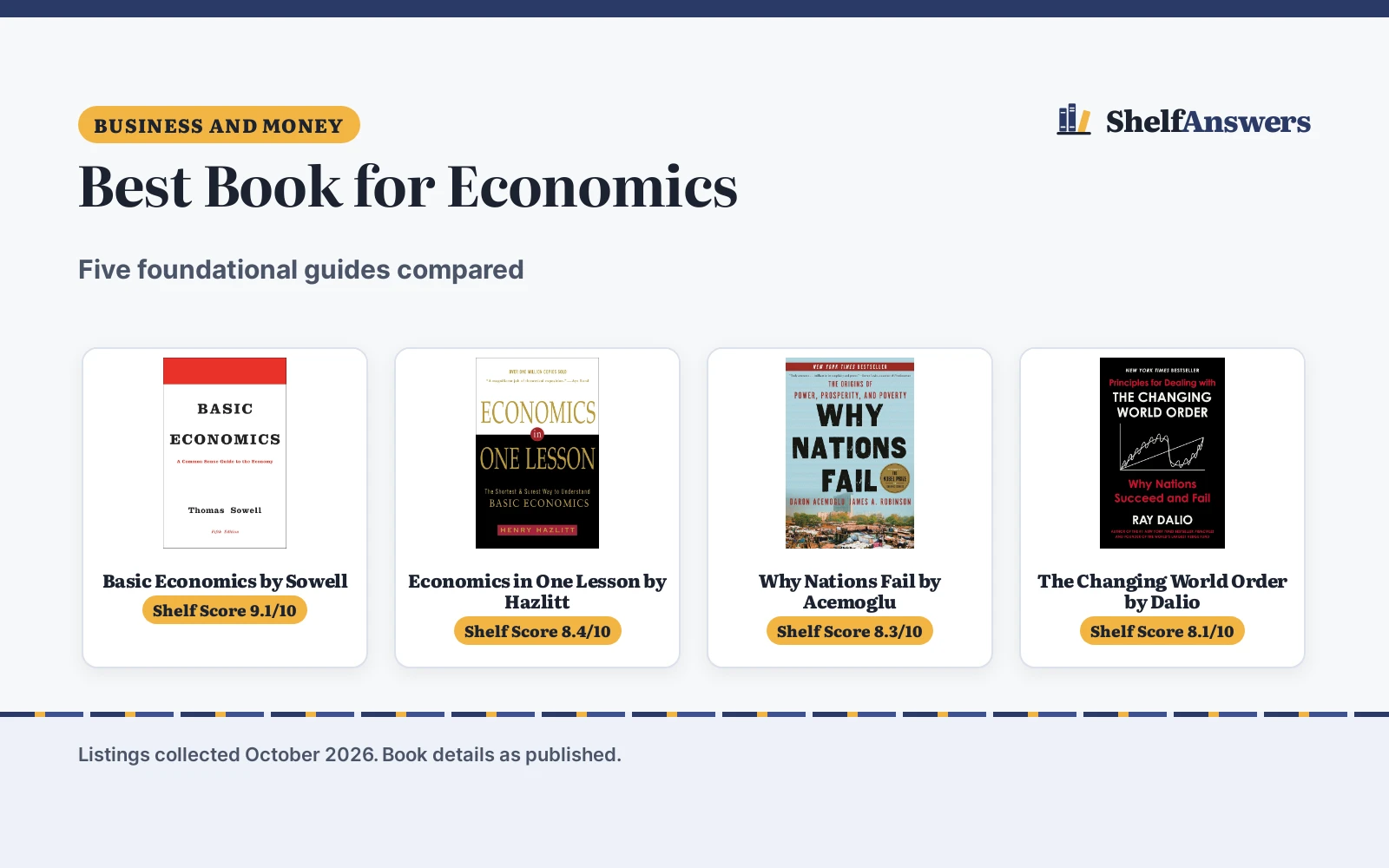
| Basic Economics by Sowell | 9.1/10 | Thomas Sowell | 704 | December 2, 2014 |
| Economics in One Lesson by Hazlitt | 8.4/10 | Henry Hazlitt | 218 | December 14, 1988 |
| Why Nations Fail by Acemoglu | 8.3/10 | Daron Acemoglu, James A. Robinson | 544 | September 17, 2013 |
| The Changing World Order by Dalio | 8.1/10 | Ray Dalio | 576 | November 30, 2021 |
| Capitalism and Freedom by Friedman | 7.7/10 | Milton Friedman, Binyamin Appelbaum | 287 | November 17, 2020 |
Book details as published on each listing, collected 15 October 2026.
The picks
| # | Product | Shelf Score | Buy |
|---|---|---|---|
| 1 |  Basic Economics by Sowell Basic Economics by Sowell | 9.1/10 | Buy |
| 2 |  Economics in One Lesson by Hazlitt Economics in One Lesson by Hazlitt | 8.4/10 | Buy |
| 3 |  Why Nations Fail by Acemoglu Why Nations Fail by Acemoglu | 8.3/10 | Buy |
| 4 |  The Changing World Order by Dalio The Changing World Order by Dalio | 8.1/10 | Buy |
| 5 |  Capitalism and Freedom by Friedman Capitalism and Freedom by Friedman | 7.7/10 | Buy |
Basic Economics by Sowell
A comprehensive guide to economic principles and systems written for the general public in plain English.
Pros
- Covers the entire field of economics without using jargon or equations
- Explains capitalist, socialist and feudal economic systems using historical examples
- Includes 704 pages of explanations from rent control to international balance of payments
- Updated fifth edition published by Basic Books
Cons
- 704 pages is a substantial volume that requires significant reading time
- Published December 2, 2014, and the listing does not mention a newer edition
- No reading age or grade level is stated on the listing
- The spec table splits the publisher name between Basic and Books
Detailed Review
The listing describes this as a citizen's guide to economics, written to explain how economic systems function without relying on technical jargon or mathematical equations. It covers principles from rent control to international balance of payments across capitalist, socialist and feudal systems. The listing states a print length of 704 pages, an edition of 5th, and a publication date of December 2, 2014 from Basic Books, though the spec table splits the publisher name between two separate fields. No reading age or grade level is listed.
Who it's for: a reader who wants a thorough, complete foundation in economic principles explained through real-world incentives and history. Who should skip it: a reader who wants a brief summary or who is looking for mathematical modeling and econometric equations.
Its Shelf Score of 9.1/10 comes from fit 33/35, contents and edition 22/25, value 22/25 and reading age or level not scored (no reading age or level stated).
Book Details
| Author | Thomas Sowell |
|---|---|
| Print length | 704 pages |
| Publisher | Basic Books |
| Publication date | December 2, 2014 |
| Edition | 5th |
Details as published on the retailer listing, collected 15 October 2026. Editions and formats change; check the listing before you buy.
Reading Age and Edition
What this listing states. No reading age, grade level or skill level is stated, so that criterion is not scored. Books carry no warranty, so warranty is not part of the score. See How We Pick.
Check the edition and format. Covers, editions and formats change. Match the edition or ISBN your reader, class or club needs on the listing.
Listed reading ages and grade levels are a guide, not advice about a particular reader. Editions and formats change, so check the listing before you buy. See our Reading Age Disclaimer.
Economics in One Lesson by Hazlitt
A classic introduction to basic economic theory that examines market incentives and common fallacies.
Pros
- Concise print length of 218 pages makes it quick to read and carry
- Focuses on core economic fallacies and the unintended consequences of policies
- Defends free-market principles and individual economic liberty in clear prose
- Draws on foundational Austrian School economic ideas in accessible lessons
Cons
- Published December 14, 1988, based on an original text written in 1946
- Focuses heavily on libertarian and free-market viewpoints rather than multiple schools of thought
- No reading age or grade level is stated on the listing
- Does not include exercises, study questions or a topical index in the spec table
Detailed Review
The description presents this book as a concise guide to basic economic theory that analyzes prevailing economic fallacies and emphasizes free-market solutions. It outlines how economic policies create secondary consequences across society, drawing on ideas from the Austrian School. The listing states a print length of 218 pages, a paperback format, and a publication date of December 14, 1988 from Crown Currency, noting the original text was written in 1946. No reading age or grade level is stated on the listing.
Who it's for: a reader who wants a short, straightforward primer on market mechanisms and the unintended effects of government intervention. Who should skip it: a reader seeking a comprehensive modern textbook or an overview that explores diverse economic traditions.
Its Shelf Score of 8.4/10 comes from fit 30/35, contents and edition 20/25, value 21/25 and reading age or level not scored (no reading age or level stated).
Book Details
| Author | Henry Hazlitt |
|---|---|
| Print length | 218 pages |
| Publisher | Crown Currency |
| Publication date | December 14, 1988 |
| Format | paperback |
Details as published on the retailer listing, collected 15 October 2026. Editions and formats change; check the listing before you buy.
Reading Age and Edition
What this listing states. No reading age, grade level or skill level is stated, so that criterion is not scored. Books carry no warranty, so warranty is not part of the score. See How We Pick.
Check the edition and format. Covers, editions and formats change. Match the edition or ISBN your reader, class or club needs on the listing.
Listed reading ages and grade levels are a guide, not advice about a particular reader. Editions and formats change, so check the listing before you buy. See our Reading Age Disclaimer.
Why Nations Fail by Acemoglu
An investigation into how man-made political and economic institutions drive national prosperity or poverty.
Pros
- Written by 2024 Nobel Prize winners Daron Acemoglu and James Robinson
- Based on fifteen years of original historical and institutional research
- Examines case studies from the Roman Empire to modern North and South Korea across 544 pages
- Rejects simple geographic or cultural theories to focus on political institutions
Cons
- 544 pages is a detailed read that focuses on institutional history rather than basic personal finance
- Published September 17, 2013, with the listing noting it as a reprint edition
- The spec table lists two separate publication date entries under Currency Publication date and Publication date
- No reading age or grade level is stated on the listing
Detailed Review
The description frames this work around the central question of why some nations achieve wealth while others remain impoverished. Authors Daron Acemoglu and James Robinson, noted on the listing as winners of the 2024 Nobel Prize in Economic Sciences, argue that man-made political and economic institutions determine success, comparing historical cases including the Roman Empire, the Soviet Union and the contrasting trajectories of North and South Korea. The listing gives a print length of 544 pages and a publication date of September 17, 2013 from Crown Currency, with duplicate date entries in the spec table. No reading age or grade level is listed.
Who it's for: a reader interested in political economy, global development and the historical forces that build wealthy societies. Who should skip it: a reader who wants a introductory handbook on day-to-day business operations or basic price theory.
Its Shelf Score of 8.3/10 comes from fit 29/35, contents and edition 21/25, value 20/25 and reading age or level not scored (no reading age or level stated).
Book Details
| Author | Daron Acemoglu, James A. Robinson |
|---|---|
| Print length | 544 pages |
| Publisher | Crown Currency |
| Publication date | September 17, 2013 |
| Edition | Reprint |
Details as published on the retailer listing, collected 15 October 2026. Editions and formats change; check the listing before you buy.
Reading Age and Edition
What this listing states. No reading age, grade level or skill level is stated, so that criterion is not scored. Books carry no warranty, so warranty is not part of the score. See How We Pick.
Check the edition and format. Covers, editions and formats change. Match the edition or ISBN your reader, class or club needs on the listing.
Listed reading ages and grade levels are a guide, not advice about a particular reader. Editions and formats change, so check the listing before you buy. See our Reading Age Disclaimer.
The Changing World Order by Dalio
A historical study of major empires, debt cycles and reserve currencies across the past 500 years.
Pros
- Published November 30, 2021, the newest title among the five picks
- Examines historical cycles across the Dutch, British and American empires
- Covers debt cycles, zero interest rates and major reserve currencies across 576 pages
- Part of Ray Dalio's Principles series with practical frameworks for global shifts
Cons
- At 576 pages, it is a dense macroeconomic study tailored to global trends rather than basic microeconomics
- The spec table lists Schuster Publication date alongside the regular publication date
- Focuses on empire-level cycles between 1930 and 1945 rather than introductory consumer economics
- No reading age or grade level is stated on the listing
Detailed Review
The description explains that Ray Dalio examines recurring patterns behind the rise and decline of major world powers over the last 500 years, focusing on debt cycles, political conflict, and reserve currencies across the Dutch, British, and American empires. It highlights conditions Dalio observed involving high debt and currency shifts, comparing them to dynamics seen between 1930 and 1945. The listing gives a print length of 576 pages, an edition of 1st, and a publication date of November 30, 2021 from Avid Reader Press / Simon & Schuster, with the spec table splitting the publisher into a separate Schuster date field. No reading age or grade level is listed.
Who it's for: a reader who wants to understand macroeconomics, debt cycles, reserve currencies and global power shifts. Who should skip it: a beginner looking for a concise introduction to everyday economic definitions or textbook fundamentals.
Its Shelf Score of 8.1/10 comes from fit 28/35, contents and edition 22/25, value 19/25 and reading age or level not scored (no reading age or level stated).
Book Details
| Author | Ray Dalio |
|---|---|
| Print length | 576 pages |
| Publisher | Avid Reader Press / Simon & Schuster |
| Publication date | November 30, 2021 |
| Edition | 1st |
Details as published on the retailer listing, collected 15 October 2026. Editions and formats change; check the listing before you buy.
Reading Age and Edition
What this listing states. No reading age, grade level or skill level is stated, so that criterion is not scored. Books carry no warranty, so warranty is not part of the score. See How We Pick.
Check the edition and format. Covers, editions and formats change. Match the edition or ISBN your reader, class or club needs on the listing.
Listed reading ages and grade levels are a guide, not advice about a particular reader. Editions and formats change, so check the listing before you buy. See our Reading Age Disclaimer.
Capitalism and Freedom by Friedman
A foundational statement of competitive capitalism and its role in achieving political and economic freedom.
Pros
- Includes author prefaces from 1982 and 2002 plus a new foreword by Binyamin Appelbaum
- Concise print length of 287 pages covers key policy topics from licensing to monetary policy
- Presents a clear philosophical argument connecting economic liberty to political freedom
- Published November 17, 2020 by University of Chicago Press
Cons
- Spec table labels this 2020 printing as First edition despite the original text dating to 1962
- Focuses on free-market political philosophy rather than functioning as a general survey textbook
- The spec table splits the publisher name into a Chicago Press date field
- No reading age or grade level is stated on the listing
Detailed Review
The description presents this classic work as an exploration of how competitive capitalism serves as both a device for achieving economic freedom and a prerequisite for political liberty. Originally published in 1962, this edition from University of Chicago Press features prefaces by Milton Friedman from 1982 and 2002 alongside a new foreword by Binyamin Appelbaum. The listing gives a print length of 287 pages and a publication date of November 17, 2020, though the spec table marks it as First edition despite the earlier print history and splits the press name into the date header. No reading age or grade level is stated.
Who it's for: a reader who wants to explore classical liberal economic philosophy and the relationship between state power and individual enterprise. Who should skip it: a reader who needs an introductory primer on basic accounting, economic graphs or neutral textbook overviews.
Its Shelf Score of 7.7/10 comes from fit 27/35, contents and edition 20/25, value 19/25 and reading age or level not scored (no reading age or level stated).
Book Details
| Author | Milton Friedman, Binyamin Appelbaum |
|---|---|
| Print length | 287 pages |
| Publisher | University of Chicago Press |
| Publication date | November 17, 2020 |
| Edition | First |
Details as published on the retailer listing, collected 15 October 2026. Editions and formats change; check the listing before you buy.
Reading Age and Edition
What this listing states. No reading age, grade level or skill level is stated, so that criterion is not scored. Books carry no warranty, so warranty is not part of the score. See How We Pick.
Check the edition and format. Covers, editions and formats change. Match the edition or ISBN your reader, class or club needs on the listing.
Listed reading ages and grade levels are a guide, not advice about a particular reader. Editions and formats change, so check the listing before you buy. See our Reading Age Disclaimer.
As an Amazon Associate I earn from qualifying purchases.
How we scored them
The Shelf Score weighs fit for understanding economic principles, contents and edition, value, and the listed reading age or level where one is given. None of the five listings state a reading age or grade level, so those criteria receive no score. Page counts and publication dates come directly from each listing, and more recent printings or updated editions earn higher marks for current contents. How we pick explains the weights.
| Book | Shelf Score | Fit /35 | Contents /25 | Value /25 | Age/level /10 |
|---|---|---|---|---|---|
| Basic Economics by Sowell | 9.1 | 33 | 22 | 22 | n/a |
| Economics in One Lesson by Hazlitt | 8.4 | 30 | 20 | 21 | n/a |
| Why Nations Fail by Acemoglu | 8.3 | 29 | 21 | 20 | n/a |
| The Changing World Order by Dalio | 8.1 | 28 | 22 | 19 | n/a |
| Capitalism and Freedom by Friedman | 7.7 | 27 | 20 | 19 | n/a |
Scores run from 0 to 10. Reading age or level counts on a list where at least one listing gives one, and a book whose listing gives none then scores zero on it. Where no listing gives one, the score is taken over the other 85 points. Books carry no warranty, so warranty is not scored.
How to choose the best book for economics
Broad overview or focused topic
Decide whether you want an all-in-one introductory survey or a focused exploration of a specific economic theme. Thomas Sowell’s Basic Economics covers the entire discipline across 704 pages, from rent control to international trade, without equations. By contrast, Why Nations Fail by Daron Acemoglu and James Robinson concentrates specifically on how institutional rules shape national wealth and poverty. Readers seeking practical applications for management can also explore our guide to the best book for leadership.
Check the edition and publication year
Economic principles remain durable, but editions differ in their introductory material, prefaces and data updates. The listing for Milton Friedman’s Capitalism and Freedom notes a 2020 printing from University of Chicago Press featuring prefaces from 1982 and 2002 alongside a new foreword by Binyamin Appelbaum, while the original text was published in 1962. Ray Dalio’s Principles for Dealing with the Changing World Order is the most recent title here, published on November 30, 2021. For founders and business builders looking for operational titles, see our guide to the best book for entrepreneurs.
Consider reading length and format
| Book | Pages | Published |
|---|---|---|
| Basic Economics by Sowell | 704 | December 2, 2014 |
| The Changing World Order by Dalio | 576 | November 30, 2021 |
| Why Nations Fail by Acemoglu | 544 | September 17, 2013 |
| Capitalism and Freedom by Friedman | 287 | November 17, 2020 |
| Economics in One Lesson by Hazlitt | 218 | December 14, 1988 |
Print length ranges from 218 pages for Henry Hazlitt’s paperback lesson format to 704 pages for Thomas Sowell’s comprehensive hardcover volume. A shorter volume suits a reader wanting a quick overview before diving deeper, while a 704-page book works well as a reference text. Explore our broader collection of business books for related titles.
Before you buy
- Check the publication date and edition on the listing to see whether you are buying an original printing or a later reissue.
- Review the print length, which ranges from 218 pages to 704 pages among these titles.
- Note that none of these listings publish a reading age or grade level recommendation.
- Verify whether the book is part of a broader set, such as Ray Dalio’s Principles series.
Frequently Asked Questions
Which economics book is best for beginners without a math background?
Thomas Sowell’s Basic Economics is written as a citizen’s guide for readers who want to understand economic systems without jargon or mathematical equations. Across 704 pages, it explains market mechanisms and policy incentives using historical examples.
What is the shortest economics book on this list?
Economics in One Lesson by Henry Hazlitt has a print length of 218 pages, making it the shortest title compared here. The listing shows it was published in paperback by Crown Currency on December 14, 1988.
When was Capitalism and Freedom published?
The description notes that Milton Friedman originally published Capitalism and Freedom in 1962. The University of Chicago Press edition listed here was published on November 17, 2020, and includes author prefaces from 1982 and 2002 alongside a new foreword by Binyamin Appelbaum.
What historical periods does Principles for Dealing with the Changing World Order study?
The description states that Ray Dalio examines cycles of wealth and power across 500 years, studying the Dutch, British, and American empires. It highlights patterns surrounding major reserve currencies, with comparisons to conditions observed between 1930 and 1945.
Related lists
See every Business and Money list and all Nonfiction lists.
More lists: explore our guides to leadership books, books for entrepreneurs, and history and biography books.