Best Book for Investing (2026): 5 Top Guides Compared
Five investing books compared by publication date, print length and strategy, from broad index funds and wealth habits to company research and market basics.

On this page
When you sit down to fund a retirement account or invest a first paycheck, finding the best book for investing comes down to matching your personal financial goals with the right strategy. We compared five guides by publication date, print length, asset allocation guidance and core strategy, looking at index funds, company research and fundamental wealth habits. Whether you want a straightforward roadmap for index funds or a practical walkthrough of brokerage mechanics, choosing the right title helps you start with confidence.
ShelfAnswers earns a commission when you buy through links on this page, at no extra cost to you. As an Amazon Associate I earn from qualifying purchases. Affiliate disclosure.
Quick picks
- Best Overall The Simple Path to Wealth by Collins: A comprehensive roadmap to financial freedom and index investing in 320 pages Check price
- Best for Index Funds The Little Book of Common Sense by Bogle: Core principles of low-cost index investing and asset allocation across 304 pages Check price
- Best for Wealth Building Habits The Millionaire Next Door by Stanley: Identifies seven common wealth-building traits across 272 pages Check price
- Best for Stock Picking One Up On Wall Street by Lynch: Practical guidance on finding tenbaggers and evaluating financial statements Check price
- Best Quick Primer A Beginner’s Guide by Kratter: A 98-page starter guide covering brokerage accounts and trading fundamentals Check price
Compare the picks
| Book | Shelf Score | Author | Pages | Published |
|---|---|---|---|---|
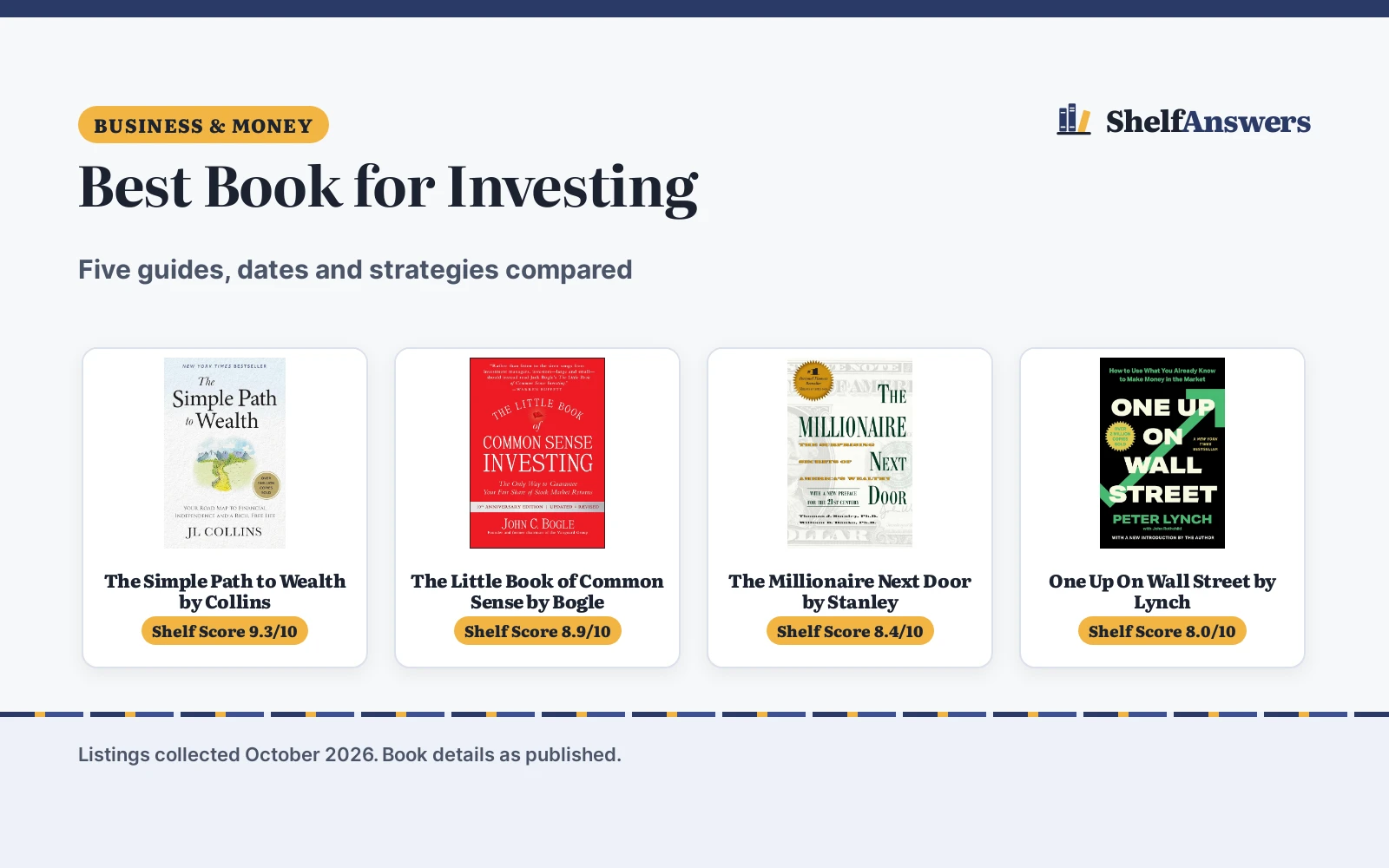
| The Simple Path to Wealth by Collins | 9.3/10 | J L Collins | 320 | May 20, 2025 |
| The Little Book of Common Sense by Bogle | 8.9/10 | John C. Bogle | 304 | October 16, 2017 |
| The Millionaire Next Door by Stanley | 8.4/10 | Thomas J. Stanley Ph.D., William D. Danko Ph.D | 272 | November 16, 2010 |
| One Up On Wall Street by Lynch | 8.0/10 | Peter Lynch | 304 | April 3, 2000 |
| A Beginner’s Guide by Kratter | 7.6/10 | Matthew R. Kratter | 98 | May 21, 2019 |
Book details as published on each listing, collected 15 October 2026.
The picks
| # | Product | Shelf Score | Buy |
|---|---|---|---|
| 1 |  The Simple Path to Wealth by Collins The Simple Path to Wealth by Collins | 9.3/10 | Buy |
| 2 |  The Little Book of Common Sense by Bogle The Little Book of Common Sense by Bogle | 8.9/10 | Buy |
| 3 |  The Millionaire Next Door by Stanley The Millionaire Next Door by Stanley | 8.4/10 | Buy |
| 4 |  One Up On Wall Street by Lynch One Up On Wall Street by Lynch | 8.0/10 | Buy |
| 5 |  A Beginner's Guide by Kratter A Beginner's Guide by Kratter | 7.6/10 | Buy |
The Simple Path to Wealth by Collins
A straightforward guide to financial independence through index investing and debt elimination.
Pros
- Revised edition with updated data, FAQ and tools
- Covers debt elimination and retirement account optimization across 320 pages
- Explains asset allocation for both wealth building and wealth preservation
- Focuses on broad market index investing rather than individual stock picking
Cons
- No reading age or grade level is stated in the listing
- 320 pages requires more study time than shorter introductory guides
- The listing does not provide a workbook or practice exercises
- Not part of a numbered series
Detailed Review
The author outlines a plan for financial freedom based on broad market index investing, debt elimination and asset allocation instead of picking individual stocks. The listing gives a print length of 320 pages, a publication date of May 20, 2025 from Authors Equity, and revised content including updated data and tools, with no reading age or grade level stated.
Who it's for: a reader who wants a clear, long-term index investing roadmap for retirement and wealth building. Who should skip it: a trader looking for active short-term stock trading strategies.
Its Shelf Score of 9.3/10 comes from fit 33/35, contents and edition 24/25, value 22/25 and reading age or level not scored (no reading age or level stated).
Book Details
| Author | J L Collins |
|---|---|
| Publisher | Authors Equity |
| Print length | 320 pages |
| Published | May 20, 2025 |
| Edition | Revised |
Details as published on the retailer listing, collected 15 October 2026. Editions and formats change; check the listing before you buy.
Reading Age and Edition
What this listing states. No reading age, grade level or skill level is stated, so that criterion is not scored. Books carry no warranty, so warranty is not part of the score. See How We Pick.
Check the edition and format. Covers, editions and formats change. Match the edition or ISBN your reader, class or club needs on the listing.
Listed reading ages and grade levels are a guide, not advice about a particular reader. Editions and formats change, so check the listing before you buy. See our Reading Age Disclaimer.
The Little Book of Common Sense by Bogle
A foundational investment guide detailing low-cost index funds and long-term portfolio growth.
Pros
- Tenth anniversary edition with updated data and two added chapters
- Details asset allocation and retirement investing across 304 pages
- Explains compounding returns and the impact of fund costs
- Covers broad index funds tracking the S&P 500
Cons
- Published October 16, 2017, an older edition than 2025 releases
- Focuses exclusively on index funds rather than individual company analysis
- No reading age or grade level is stated in the listing
- Does not include practice exercises or study questions
Detailed Review
The book presents a long-term investment strategy centered on buying and holding low-cost index funds that track broad market benchmarks like the S&P 500. The listing gives a print length of 304 pages, a publication date of October 16, 2017 from Wiley, and two added chapters on asset allocation and retirement, with no reading age or grade level stated.
Who it's for: an investor seeking an evidence-based index fund strategy that minimizes fees and turnover. Who should skip it: a reader who wants to learn how to research and trade individual stocks.
Its Shelf Score of 8.9/10 comes from fit 32/35, contents and edition 22/25, value 21/25 and reading age or level not scored (no reading age or level stated).
Book Details
| Author | John C. Bogle |
|---|---|
| Publisher | Wiley |
| Print length | 304 pages |
| Published | October 16, 2017 |
| Edition | Updated and |
Details as published on the retailer listing, collected 15 October 2026. Editions and formats change; check the listing before you buy.
Reading Age and Edition
What this listing states. No reading age, grade level or skill level is stated, so that criterion is not scored. Books carry no warranty, so warranty is not part of the score. See How We Pick.
Check the edition and format. Covers, editions and formats change. Match the edition or ISBN your reader, class or club needs on the listing.
Listed reading ages and grade levels are a guide, not advice about a particular reader. Editions and formats change, so check the listing before you buy. See our Reading Age Disclaimer.
The Millionaire Next Door by Stanley
A study detailing seven common traits found among people who accumulate wealth.
Pros
- Identifies seven common wealth-accumulating traits based on research
- Includes a foreword for the twenty-first century by Dr. Thomas J. Stanley
- 272 pages focusing on living below means and financial habits
- Reissue edition published by Taylor Trade Publishing
Cons
- Published November 16, 2010, so financial data reflects earlier years
- Focuses on accumulation habits rather than specific portfolio asset allocations
- No reading age or grade level is stated in the listing
- Does not cover online trading platforms or modern brokerage accounts
Detailed Review
The authors examine the spending and saving habits of wealthy individuals, outlining seven common traits that enable long-term wealth accumulation. The listing gives a print length of 272 pages, a publication date of November 16, 2010 from Taylor Trade Publishing, and a foreword for the twenty-first century, with no reading age or grade level stated.
Who it's for: a reader seeking to build wealth through frugality, disciplined budgeting and saving habits. Who should skip it: an investor looking for instructions on stock selection, index funds or portfolio construction.
Its Shelf Score of 8.4/10 comes from fit 29/35, contents and edition 21/25, value 21/25 and reading age or level not scored (no reading age or level stated).
Book Details
| Author | Thomas J. Stanley Ph.D., William D. Danko Ph.D |
|---|---|
| Publisher | Taylor Trade Publishing |
| Print length | 272 pages |
| Published | November 16, 2010 |
| Edition | Reissue |
Details as published on the retailer listing, collected 15 October 2026. Editions and formats change; check the listing before you buy.
Reading Age and Edition
What this listing states. No reading age, grade level or skill level is stated, so that criterion is not scored. Books carry no warranty, so warranty is not part of the score. See How We Pick.
Check the edition and format. Covers, editions and formats change. Match the edition or ISBN your reader, class or club needs on the listing.
Listed reading ages and grade levels are a guide, not advice about a particular reader. Editions and formats change, so check the listing before you buy. See our Reading Age Disclaimer.
One Up On Wall Street by Lynch
A guide explaining how individual investors can spot promising stocks and analyze company statements.
Pros
- Outlines how to evaluate companies encountered in daily life
- Provides guidelines for cyclical, turnaround and fast-growing companies across 304 pages
- Explains how to review corporate financial statements and key numbers
- Offers long-term investment principles from a mutual fund manager
Cons
- Published April 3, 2000, making it the oldest edition in this comparison
- Requires active research into individual corporate financial statements
- No reading age or grade level is stated in the listing
- Does not cover modern low-cost index funds or digital brokerage tools
Detailed Review
The author explains how individual investors can identify investment opportunities in everyday life and evaluate company financial statements for long-term growth. The listing gives a print length of 304 pages, a publication date of April 3, 2000, and a second edition designation, with no reading age or grade level stated.
Who it's for: an active investor interested in researching individual companies and evaluating financial statements. Who should skip it: a passive investor who prefers automated index funds or hands-off portfolio management.
Its Shelf Score of 8.0/10 comes from fit 28/35, contents and edition 20/25, value 20/25 and reading age or level not scored (no reading age or level stated).
Book Details
| Author | Peter Lynch |
|---|---|
| Print length | 304 pages |
| Published | April 3, 2000 |
| Edition | 2nd |
Details as published on the retailer listing, collected 15 October 2026. Editions and formats change; check the listing before you buy.
Reading Age and Edition
What this listing states. No reading age, grade level or skill level is stated, so that criterion is not scored. Books carry no warranty, so warranty is not part of the score. See How We Pick.
Check the edition and format. Covers, editions and formats change. Match the edition or ISBN your reader, class or club needs on the listing.
Listed reading ages and grade levels are a guide, not advice about a particular reader. Editions and formats change, so check the listing before you buy. See our Reading Age Disclaimer.
A Beginner's Guide by Kratter
A concise 98-page starter guide covering brokerage accounts, stock purchases and trading basics.
Pros
- Concise 98-page print length for quick reading
- Covers how to open a brokerage account and purchase a first stock
- Explains pitfalls to avoid when starting in the stock market
- Outlines basic momentum trading and value investing concepts
Cons
- At 98 pages, it offers less depth on portfolio allocation than longer guides
- Includes short-term momentum trading alongside long-term investing
- No reading age or grade level is stated in the listing
- Published May 21, 2019, with no newer edition listed
Detailed Review
The book provides an introductory roadmap for beginners that explains how to open a brokerage account, buy shares and navigate market mechanics. The listing gives a print length of 98 pages, a publication date of May 21, 2019, and a standard edition designation, with no reading age or grade level stated.
Who it's for: a beginner who wants a short primer on the mechanics of opening a brokerage account and buying stock. Who should skip it: an investor seeking an in-depth treatise on asset allocation or index fund strategy.
Its Shelf Score of 7.6/10 comes from fit 27/35, contents and edition 19/25, value 19/25 and reading age or level not scored (no reading age or level stated).
Book Details
| Author | Matthew R. Kratter |
|---|---|
| Print length | 98 pages |
| Published | May 21, 2019 |
| Edition | Standard |
Details as published on the retailer listing, collected 15 October 2026. Editions and formats change; check the listing before you buy.
Reading Age and Edition
What this listing states. No reading age, grade level or skill level is stated, so that criterion is not scored. Books carry no warranty, so warranty is not part of the score. See How We Pick.
Check the edition and format. Covers, editions and formats change. Match the edition or ISBN your reader, class or club needs on the listing.
Listed reading ages and grade levels are a guide, not advice about a particular reader. Editions and formats change, so check the listing before you buy. See our Reading Age Disclaimer.
As an Amazon Associate I earn from qualifying purchases.
How we scored them
The Shelf Score weighs fit for investing, contents and edition, value, and the listed reading age or grade level where one is given. None of the five listings state a reading age or grade level. Publication dates range from April 3, 2000 to May 20, 2025, and guides with updated editions and comprehensive asset allocation strategies score higher on contents. How we pick explains the weights.
| Book | Shelf Score | Fit /35 | Contents /25 | Value /25 | Age/level /10 |
|---|---|---|---|---|---|
| The Simple Path to Wealth by Collins | 9.3 | 33 | 24 | 22 | n/a |
| The Little Book of Common Sense by Bogle | 8.9 | 32 | 22 | 21 | n/a |
| The Millionaire Next Door by Stanley | 8.4 | 29 | 21 | 21 | n/a |
| One Up On Wall Street by Lynch | 8.0 | 28 | 20 | 20 | n/a |
| A Beginner’s Guide by Kratter | 7.6 | 27 | 19 | 19 | n/a |
Scores run from 0 to 10. Reading age or level counts on a list where at least one listing gives one, and a book whose listing gives none then scores zero on it. Where no listing gives one, the score is taken over the other 85 points. Books carry no warranty, so warranty is not scored.
How to choose the best book for investing
Index funds or stock picking
Different investing books teach contrasting philosophies. The Simple Path to Wealth by Collins and The Little Book of Common Sense Investing by Bogle advocate buying and holding broad-market index funds tracking benchmarks like the S&P 500 to minimize management fees. In contrast, One Up On Wall Street by Lynch focuses on researching individual companies and analyzing balance sheets to spot growth opportunities. Readers who also want to study workplace leadership can explore our guide to the best books for managers.
Check the publication date and edition
Financial regulations, tax rules and account options change over time. Collins published a revised edition dated May 20, 2025 with an updated punchlist and tools, while Bogle released a tenth anniversary edition dated October 16, 2017 with added chapters on asset allocation. Older works like Lynch, published April 3, 2000, or Stanley and Danko, published November 16, 2010, offer timeless principles on business analysis and saving habits, but check whether the edition includes a modern foreword or updated information.
Page length and depth
| Book | Print length | Published |
|---|---|---|
| The Simple Path to Wealth | 320 pages | May 20, 2025 |
| The Little Book of Common Sense Investing | 304 pages | October 16, 2017 |
| One Up On Wall Street | 304 pages | April 3, 2000 |
| The Millionaire Next Door | 272 pages | November 16, 2010 |
| A Beginner’s Guide to the Stock Market | 98 pages | May 21, 2019 |
A concise volume like Kratter at 98 pages works well if you want a fast starter guide covering brokerage accounts and basic order execution. Full-length guides between 272 and 320 pages provide detailed discussions on asset allocation and long-term habits. To understand the broader economic forces that shape markets, see our guide to the best book for economics, or read our recommendations for the best book for entrepreneurs.
Before you buy
- Check the publication date and edition on the listing to see whether updated chapters or tools are included.
- Review the print length on the listing to confirm whether the title is a concise primer like Kratter at 98 pages or a longer guide like Collins at 320 pages.
- Determine whether the book focuses on passive index funds, wealth-building habits or individual stock analysis.
- Confirm that the listing states the author and publisher clearly before placing your order.
Frequently Asked Questions
Which investing book is best for complete beginners?
The Simple Path to Wealth by J L Collins offers a comprehensive roadmap to index investing and debt elimination across 320 pages. Beginners who want a shorter introduction to brokerage accounts and market mechanics can start with Matthew R. Kratter’s 98-page guide.
What is the difference between index investing and stock picking?
John C. Bogle’s 304-page guide explains how to buy and hold low-cost index funds that track broad benchmarks like the S&P 500. Peter Lynch’s 304-page book focuses on evaluating individual companies and financial statements to spot tenbaggers.
Are older investing books still relevant?
Classic books provide foundational insights, but check the edition details on the listing. One Up On Wall Street was published April 3, 2000 and The Millionaire Next Door on November 16, 2010, while newer releases like Collins’s revised edition date to May 20, 2025.
Do any of these investing books state a reading age?
None of the five listings specify a reading age or grade level. The titles are written for adult readers looking to manage personal investments and build long-term wealth.
Related lists
See every Business and Money list and all Nonfiction lists. Also see our best book for leadership. Also see our best book for discipline.
More lists: browse self-improvement books, books for managers and books for economics.