Best Vocabulary Workbook for Middle School (2026)
Four vocabulary books for grades 6 to 8 and nearby grades, compared by grade band, page count, publication date and the reading age each listing gives.

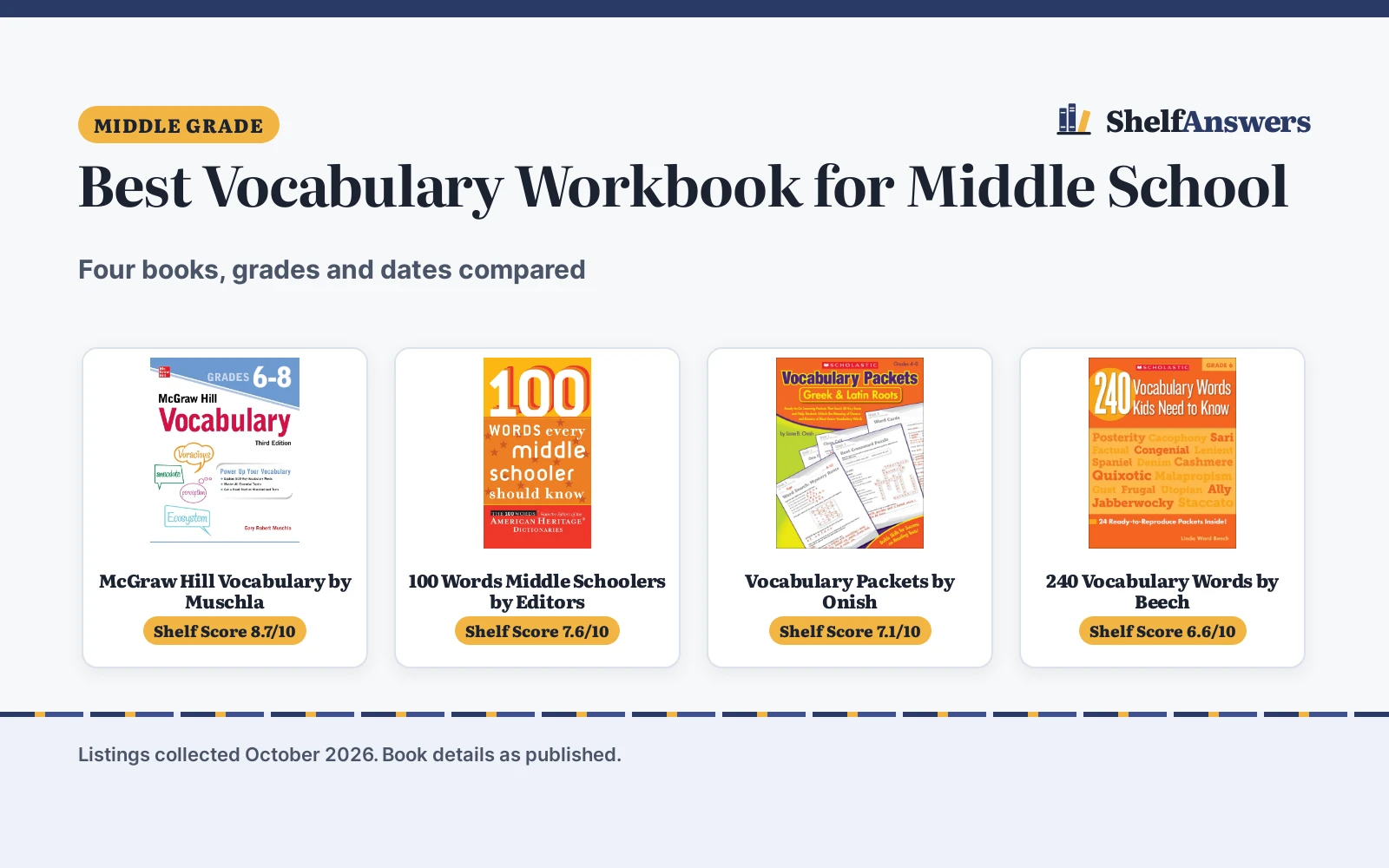
At a glance
Top picks
As an Amazon Associate I earn from qualifying purchases. How we score
Finding the best vocabulary workbook for middle school starts with the reader: a student heading into a new school year, a parent planning a summer word list, or a homeschool family choosing one book for the term. We compared the vocabulary books on this page by what each Amazon listing publishes: grade band, page count, publication date and the description’s account of what is inside, so you can match a book to the reader in front of you.
ShelfAnswers earns a commission when you buy through links on this page, at no extra cost to you. As an Amazon Associate I earn from qualifying purchases. Affiliate disclosure.
Quick picks
- Best Overall McGraw Hill Vocabulary by Muschla: Grades 6 to 8 stated, 50 lessons and a 2022 third edition Check price
- Best Word Bank 100 Words Middle Schoolers by Editors: 100 words, each with a definition, pronunciation and a quotation Check price
- Best Packets for Roots Vocabulary Packets by Onish: Eight activity packets, each covering five Greek and Latin roots Check price
- Best for Reproducible Lessons 240 Vocabulary Words by Beech: 24 reproducible three-page lessons, but the grade signals conflict Check price
Compare the picks
| Book | Shelf Score | Pages | Reading age or grade | Published |
|---|---|---|---|---|
| McGraw Hill Vocabulary by Muschla | 8.7/10 | 240 | Grade 6 to 8 | May 13, 2022 |
| 100 Words Middle Schoolers by Editors | 7.6/10 | 128 | Grades 6 to 8 (description); 1 to 3 (table) | July 7, 2010 |
| Vocabulary Packets by Onish | 7.1/10 | 64 | Grade 4 to 8; reading age 9 to 12 (from customers) | January 1, 2010 |
| 240 Vocabulary Words by Beech | 6.6/10 | 80 | Grade 1 and up (table); Grade 6 (title) | May 1, 2012 |
Book details as published on each listing, collected 15 October 2026.
The picks
| # | Product | Shelf Score | Buy |
|---|---|---|---|
| 1 | 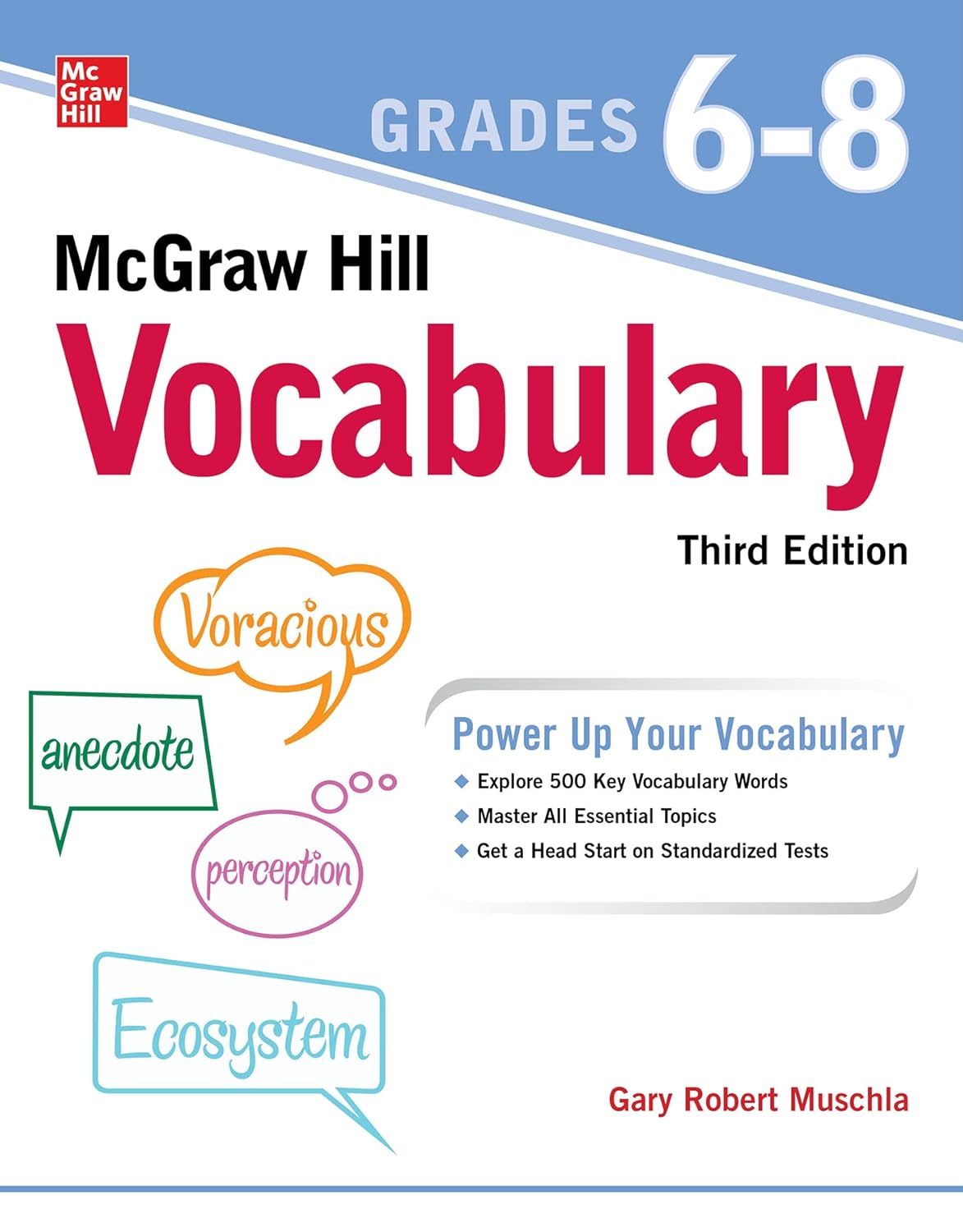 McGraw Hill Vocabulary by Muschla McGraw Hill Vocabulary by Muschla | 8.7/10 | Buy |
| 2 |  100 Words Middle Schoolers by Editors 100 Words Middle Schoolers by Editors | 7.6/10 | Buy |
| 3 |  Vocabulary Packets by Onish Vocabulary Packets by Onish | 7.1/10 | Buy |
| 4 |  240 Vocabulary Words by Beech 240 Vocabulary Words by Beech | 6.6/10 | Buy |
McGraw Hill Vocabulary by Muschla
A puzzle-format vocabulary workbook for grades 6 to 8, with 50 lessons and more than 500 words, according to the listing.
Pros
- Grade band stated in the title and description: grades 6 through 8
- The listing gives 50 lessons covering more than 500 vocabulary words
- Third edition dated May 13, 2022, the most recent date among the four
- 240 pages, with guidance on prefixes, suffixes and compound words
Cons
- No answer key is mentioned in the description
- The listing does not state a reading age, only a grade band
- 240 pages is a long book for a short unit
- No practice tests are stated, so it is vocabulary practice rather than exam simulation
Detailed Review
The description presents a puzzle-format vocabulary workbook for grades 6 through 8, with more than 500 vocabulary words, 50 lessons, guidance on prefixes, suffixes and compound words, and an alphabetical word list at the end. The listing gives 240 pages, grade level 6 to 8 and a publication date of May 13, 2022. Title, description and spec table agree on the grade band.
Who it's for: a student in grades 6 to 8 who wants a long, structured vocabulary workbook with puzzle pages. Who should skip it: a reader who needs a stated reading age, since the listing gives only a grade band, or a student who wants word lists with quotations.
Its Shelf Score of 8.7/10 comes from fit 32/35, contents and edition 22/25, value 21/25 and reading age or level 7/10.
Book Details
| Author | Gary Robert Muschla |
|---|---|
| Print length | 240 pages |
| Grade level | 6 to 8 |
| Published | May 13, 2022 |
| Publisher | McGraw Hill |
Details as published on the retailer listing, collected 15 October 2026. Editions and formats change; check the listing before you buy.
Reading Age and Edition
What this listing states. Grade level 6 to 8, so reading age or level scores 7 of 10. Books carry no warranty, so warranty is not part of the score. See How We Pick.
Check the grade and the answer key. Workbook levels differ between publishers. Confirm the grade level and whether answers are included in the book or sold separately.
Listed reading ages and grade levels are a guide, not advice about a particular reader. Editions and formats change, so check the listing before you buy. See our Reading Age Disclaimer.
100 Words Middle Schoolers by Editors
A word book for grades 6 to 8 that gives a definition, a pronunciation and at least one quotation for each of 100 words.
Pros
- 100 words, each with a definition, a pronunciation and at least one quotation
- Quotations come from classic and contemporary fiction and nonfiction, according to the description
- The description names grades 6 to 8 and ages 11 to 14
- 128 pages, shorter than the 240-page McGraw Hill book
Cons
- Published July 7, 2010, older than the McGraw Hill third edition
- Spec table lists grade level 1 to 3, which conflicts with grades 6 to 8 in the title and description
- The description lists no practice exercises, so it works as word study rather than drills
- The listing does not state a practice format or answer key
Detailed Review
The description says the book teaches 100 words, ranging from verbs to nouns to adjectives, each with a definition, a pronunciation and a quotation from a book middle schoolers are assigned or enjoy. The listing gives 128 pages and a publication date of July 7, 2010. The spec table gives a reading age of 10 to 13 years, not marked as from customers, and a grade level of 1 to 3, while the title and description say grades 6 to 8 and ages 11 to 14. The title and description are trusted over the table, so the grade is stated but contradictory.
Who it's for: a middle schooler who wants to learn 100 words in context and spot them in the books they read. Who should skip it: a student who needs practice exercises, or a buyer who wants a recent edition date, since this listing is dated 2010.
Its Shelf Score of 7.6/10 comes from fit 30/35, contents and edition 19/25, value 19/25 and reading age or level 4/10.
Book Details
| Author | Editors of the American Heritage Dictionaries |
|---|---|
| Print length | 128 pages |
| Reading age | 10 to 13 years (spec table, not marked as from customers) |
| Grade level | 6 to 8 in description; 1 to 3 in spec table |
| Published | July 7, 2010 |
Details as published on the retailer listing, collected 15 October 2026. Editions and formats change; check the listing before you buy.
Reading Age and Edition
What this listing states. Reading age 10 to 13 years and grade level 1 to 3 in the spec table, against grades 6 to 8 in the description, so reading age or level scores 4 of 10. Books carry no warranty, so warranty is not part of the score. See How We Pick.
Check the grade and the answer key. Workbook levels differ between publishers. Confirm the grade level and whether answers are included in the book or sold separately.
Listed reading ages and grade levels are a guide, not advice about a particular reader. Editions and formats change, so check the listing before you buy. See our Reading Age Disclaimer.
Vocabulary Packets by Onish
Eight activity packets that teach five Greek and Latin roots and 15 new words per packet, with crosswords and word searches.
Pros
- Eight packets, each with five Greek and Latin roots and 15 new words
- Crosswords, word searches and other activities give repeated practice
- The description says the packets suit independent work or homework
- 64 pages, the shortest book in this list
Cons
- Activity packets rather than a full vocabulary course
- Edition line reads 12.2.2009 while the publication date is January 1, 2010
- Grade level 4 to 8 conflicts with the table's Grades 4 to 6
- Reading age is marked as from customers, not stated by the publisher
Detailed Review
The description says eight ready-to-go packets help students learn five common Greek and Latin roots and 15 new words in each packet, with crosswords and word searches for repeated practice. The listing gives a reading age of 9 to 12 years, marked as from customers, a grade level of 4 to 8, 64 pages and a publication date of January 1, 2010. The edition line reads 12.2.2009, which is earlier than the publication date, and the spec table also shows grades 4 to 6, so the listing's grade values disagree.
Who it's for: a student who needs practice with Greek and Latin roots in short, separate packets for homework or independent work. Who should skip it: a reader who wants one continuous course, or a buyer who needs a clear edition date.
Its Shelf Score of 7.1/10 comes from fit 24/35, contents and edition 19/25, value 19/25 and reading age or level 5/10.
Book Details
| Author | Liane Onish |
|---|---|
| Print length | 64 pages |
| Grade level | 4 to 8 (table also lists grades 4 to 6) |
| Reading age | 9 to 12 years, from customers |
| Published | January 1, 2010 |
Details as published on the retailer listing, collected 15 October 2026. Editions and formats change; check the listing before you buy.
Reading Age and Edition
What this listing states. Grade level 4 to 8 (the spec table also says grades 4 to 6) and a reading age of 9 to 12 years, marked as from customers, so reading age or level scores 5 of 10. Books carry no warranty, so warranty is not part of the score. See How We Pick.
Check the grade and the answer key. Workbook levels differ between publishers. Confirm the grade level and whether answers are included in the book or sold separately.
Listed reading ages and grade levels are a guide, not advice about a particular reader. Editions and formats change, so check the listing before you buy. See our Reading Age Disclaimer.
240 Vocabulary Words by Beech
24 reproducible, three-page vocabulary lessons covering synonyms, antonyms, compound words and content-area words.
Pros
- 24 reproducible lessons of three pages each, according to the description
- Lessons cover synonyms, antonyms, compound words and content-area words such as science and social studies
- The listing says it is aligned with the Common Core State Standards, a claim from the maker
- 80 pages in a workbook format, shorter than the 240-page McGraw Hill book
Cons
- Title says Grade 6 while the description says the lessons are for 3rd graders
- Spec table lists grade level 1 and up, a wider range than the middle school band
- Published May 1, 2012, older than the McGraw Hill third edition
- Reading age is marked as from customers, not stated by the publisher
Detailed Review
The description says the book has 24 ready-to-reproduce, three-page lessons with research-based activities and multiple encounters with each new word. Lesson topics include synonyms, antonyms, compound words and content-area vocabulary for science and social studies. The listing gives 80 pages, a Workbook edition and a publication date of May 1, 2012, and a reading age of 10 to 13 years, marked as from customers. The title says Grade 6, the description says the lessons are for 3rd graders, and the spec table says grade level 1 and up, so the grade signals conflict.
Who it's for: a teacher or parent who wants reproducible vocabulary pages for a class or home group. Who should skip it: a middle schooler who needs lessons matched to grade 6, since the title, description and table give different grades.
Its Shelf Score of 6.6/10 comes from fit 23/35, contents and edition 18/25, value 19/25 and reading age or level 3/10.
Book Details
| Author | Linda Beech |
|---|---|
| Print length | 80 pages |
| Edition | Workbook |
| Reading age | 10 to 13 years, from customers |
| Published | May 1, 2012 |
Details as published on the retailer listing, collected 15 October 2026. Editions and formats change; check the listing before you buy.
Reading Age and Edition
What this listing states. Grade level 1 and up and a reading age of 10 to 13 years, marked as from customers, while the title says Grade 6, so reading age or level scores 3 of 10. Books carry no warranty, so warranty is not part of the score. See How We Pick.
Check the grade and the answer key. Workbook levels differ between publishers. Confirm the grade level and whether answers are included in the book or sold separately.
Listed reading ages and grade levels are a guide, not advice about a particular reader. Editions and formats change, so check the listing before you buy. See our Reading Age Disclaimer.
As an Amazon Associate I earn from qualifying purchases.
How we scored them
The Shelf Score weighs fit for the reader, contents and edition, value, and the listed reading age or grade where one is given. All four listings give a grade band, three also give a reading age, and two of those reading ages are marked as from customers. Where a title, description and spec table disagree, we trust the title and description and note the conflict in that book’s review. Each weight is explained in the same pick method used across the site.
| Book | Shelf Score | Fit /35 | Contents /25 | Value /25 | Age/level /10 |
|---|---|---|---|---|---|
| McGraw Hill Vocabulary by Muschla | 8.7 | 32 | 22 | 21 | 7 |
| 100 Words Middle Schoolers by Editors | 7.6 | 30 | 19 | 19 | 4 |
| Vocabulary Packets by Onish | 7.1 | 24 | 19 | 19 | 5 |
| 240 Vocabulary Words by Beech | 6.6 | 23 | 18 | 19 | 3 |
Scores run from 0 to 10. Reading age or level counts on a list where at least one listing gives one, and a book whose listing gives none then scores zero on it. Where no listing gives one, the score is taken over the other 85 points. Books carry no warranty, so warranty is not scored.
How to choose the best vocabulary workbook for middle school
Match the grade band on the listing
McGraw Hill Vocabulary Grades 6-8 gives its grade band in the title, and the description says it fits students in grades 6 through 8. The 100 Words book also describes grades 6 to 8, but its spec table lists grades 1 to 3, so the grade is the first thing to confirm. For a reader who also needs reading practice, our reading comprehension workbooks for 6th grade list covers that side of the skill set.
Check lesson count and page count
The McGraw Hill book lists 240 pages, 50 lessons and more than 500 vocabulary words, with an alphabetical word list at the end for quick lookup. The 240 Vocabulary Words book is shorter at 80 pages, built from 24 three-page lessons on synonyms, antonyms and compound words. Vocabulary Packets has 64 pages and eight packets, each with five Greek and Latin roots and 15 new words. The 100 Words book has 128 pages and 100 words, each with a definition, a pronunciation and at least one quotation from a book middle schoolers read.
Check the publication date and edition
Vocabulary workbooks are revised, so the date on the listing matters. McGraw Hill’s book is the third edition, dated May 13, 2022. The 100 Words book is dated July 7, 2010 and lists a 1st edition, and the Vocabulary Packets listing shows January 1, 2010 beside an edition line of 12.2.2009. An older date is a reason to read the rest of the listing closely, not a reason to skip the book outright. The table shows each date side by side.
| Book | Pages | Published | Grade signal |
|---|---|---|---|
| McGraw Hill Vocabulary | 240 | May 13, 2022 | Grades 6 to 8 |
| 100 Words Every Middle Schooler Should Know | 128 | July 7, 2010 | Grades 6 to 8 (description) |
| Vocabulary Packets | 64 | January 1, 2010 | Grades 4 to 8 |
| 240 Vocabulary Words Kids Need to Know | 80 | May 1, 2012 | Grade 1 and up (table) |
Workbook pages or word packets
Vocabulary Packets describes ready-to-go activity packets with crosswords and word searches, suited to independent work or homework. The 240 Vocabulary Words listing describes fully reproducible lesson pages, which suits a teacher who needs copies for a class, and it says its lessons give multiple encounters with each word, which is the maker’s claim. The 100 Words book is a word study with quotations and does not describe practice exercises, so a reader who wants drills will look for one of the other three.
Before you buy
- Check the grade band in the title and description, since two listings give grade values that differ from one another.
- Check the edition line and publication date together, since the Vocabulary Packets listing shows a date and an edition number that do not match.
- Check whether the book is a lesson workbook or a set of packets, since the formats differ.
- Check the reading age source: where it is marked as from customers, it is not a publisher statement.
Frequently Asked Questions
Which vocabulary workbook suits a student in grade 6?
McGraw Hill Vocabulary Grades 6-8 states grades 6 to 8 and runs 240 pages. The 240 Vocabulary Words book has Grade 6 in its title, but its spec table lists grade 1 and up, so check the listing before you buy.
Does any of these books include an answer key?
None of the four listings states an answer key in its description. If an answer key matters for home study, confirm it on the listing before buying.
Which edition should I buy?
McGraw Hill’s book is the third edition, dated May 13, 2022, the most recent date among these four listings. The 100 Words book is dated July 7, 2010 and lists a 1st edition.
How many words does each book cover?
The McGraw Hill book states more than 500 vocabulary words in 50 lessons. The 100 Words book covers 100 words, and the Vocabulary Packets book covers five roots and 15 words in each of its eight packets.
Related lists
See every Reading and Phonics list and all Workbooks and Homeschool lists.
More lists: browse Middle Grade, Homeschool Curriculum and spelling workbooks.