Best Science Books for Young Adults (2026): 5 Compared
Five science books compared by stated reading age, page count, publication date and contents, for teen readers and the adults buying for them.

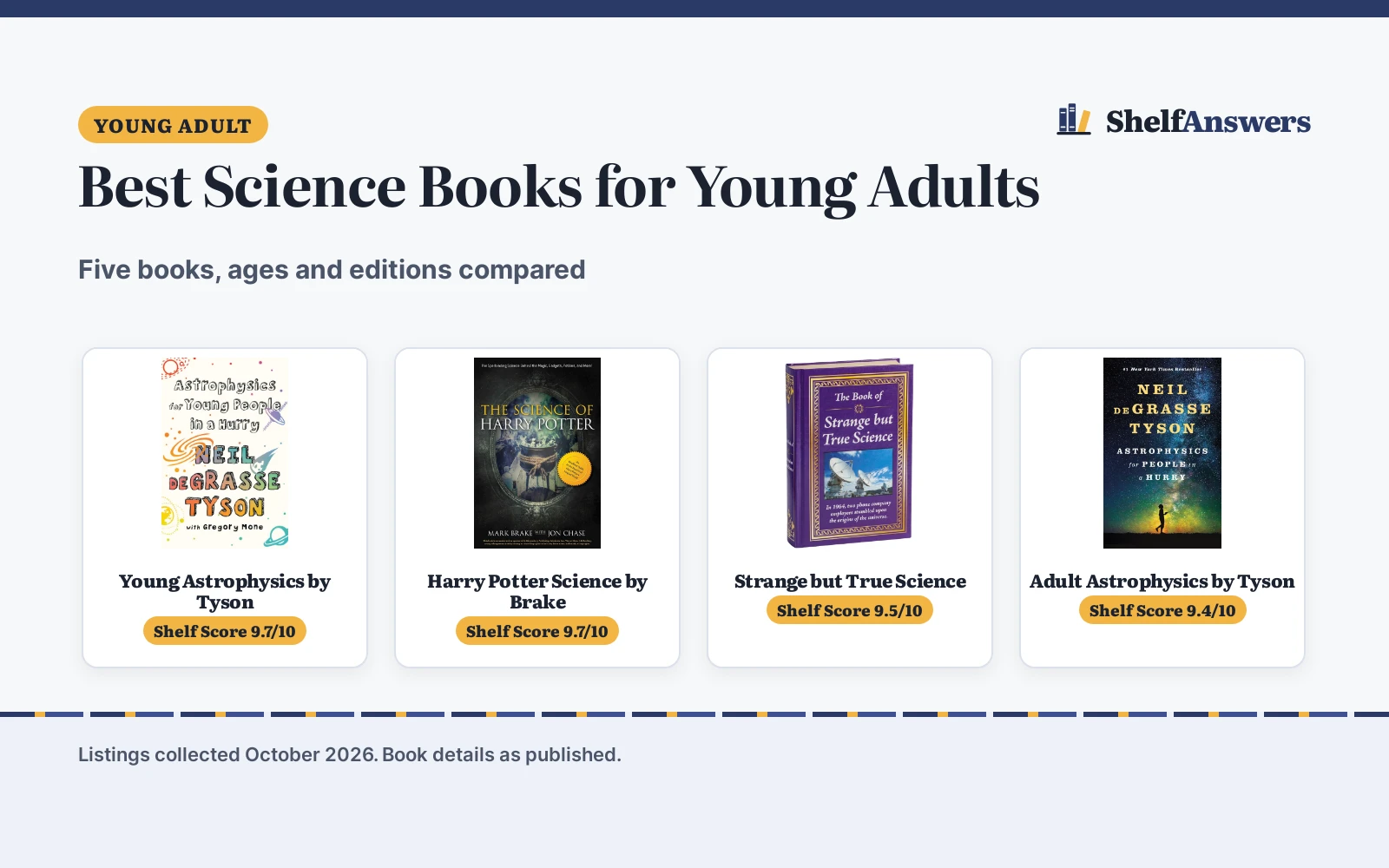
At a glance
Top picks
As an Amazon Associate I earn from qualifying purchases. How we score
A teen who just finished a fantasy series and starts asking how the magic could really work is exactly who the best science books for young adults are for. We compared five science books by stated reading age, grade level, page count, publication date and what each description says is inside. Every pick says who it fits, because a book bought for a curious twelve-year-old and a book bought for a college-bound senior are rarely the same book.
ShelfAnswers earns a commission when you buy through links on this page, at no extra cost to you. As an Amazon Associate I earn from qualifying purchases. Affiliate disclosure.
Quick picks
 Best Overall Young Astrophysics by Tyson: young-readers adaptation, 40 illustrations, 2019 Check price on Amazon
 Best for Fantasy Fans Harry Potter Science by Brake: science behind the magic, ages 12 to 16 Check price on Amazon
 Best Big Gift Book Strange but True Science: 632-page hardcover, 300+ articles Check price on Amazon
 Best for Older Teens Adult Astrophysics by Tyson: original 224-page edition, 2017 Check price on Amazon
 Most Ambitious Life on the Edge by McFadden: 368 pages on quantum biology Check price on Amazon
The picks
| # | Product | Shelf Score | Buy |
|---|---|---|---|
| 1 | Young Astrophysics by Tyson | 9.7/10 | Buy |
| 2 | Harry Potter Science by Brake | 9.7/10 | Buy |
| 3 | Strange but True Science | 9.5/10 | Buy |
| 4 | Adult Astrophysics by Tyson | 9.4/10 | Buy |
| 5 | Life on the Edge by McFadden | 9.4/10 | Buy |

Young Astrophysics by Tyson
The young-readers adaptation of Tyson's cosmos guide, with full-color photos and infographics for teen readers.
Pros
- Written as a young-readers adaptation with extra explanations
- 40 color illustrations and infographics stated
- 176 pages from Norton Young Readers, 2019
Cons
- Reading age 8 to 12 is marked as from customers, not the publisher
- Grade level 3 to 7 sits below the teen years
- Shortest of the five at 176 pages

Harry Potter Science by Brake
The real science behind Harry Potter's magic, from invisibility cloaks to potions, for readers 12 to 16.
Pros
- Reading age 12 to 16 matches the list's readers
- 224 pages on the science behind familiar magic
- Hooks fantasy fans into real physics and biology
Cons
- Only suits readers who know the Harry Potter books
- No grade level is stated
- Published 2017, some examples may feel dated

Strange but True Science
A 632-page hardcover of over 300 short science articles, from astronomy to the human body, for curious browsers.
Pros
- 632 pages with over 300 articles stated
- Hardcover format suits gifting and heavy use
- Wide subject range: astronomy, medicine, animals and more
Cons
- No reading age or grade level is stated
- Article format, not a narrative to read cover to cover
- Published December 2019

Adult Astrophysics by Tyson
Tyson's original 224-page cosmos overview for adult readers, best for older teens ready for the full text.
Pros
- Concise 224-page tour from the Big Bang to black holes
- First edition from W. W. Norton, 2017
- Suits older teens who outgrew the young-readers version
Cons
- No reading age or grade level is stated
- The adult edition, not adapted for young readers
- A newer young-readers adaptation sits in this list

Life on the Edge by McFadden
A 368-page look at quantum biology, from bird migration to how genes copy, for science-curious older teens.
Pros
- 368 pages on quantum biology, a rare topic for teens
- Listing states it won the Stephen Hawking Medal for Science Communication
- Reprint edition from Crown, 2016
Cons
- No reading age or grade level is stated
- Dense adult popular science, a stretch for younger teens
- Published 2016, the field has moved since
As an Amazon Associate I earn from qualifying purchases.
More picks to compare
 Visual Learning: Physics by Bakerillustrated physics guide, reading age 13 to 17Check on Amazon
 Disappearing Spoon YR by Keanyoung readers edition, reading age 10 and upCheck on Amazon
 Inspiring Science Stories by Fox12 scientists' stories with home experimentsCheck on Amazon
 The Universe by Woodreading age 12 to 15, with STEAM activitiesCheck on Amazon
Compare the picks
| Book | Shelf Score | Author | Pages | Reading age or grade | Published | Amazon |
|---|---|---|---|---|---|---|
| Young Astrophysics by Tyson | 9.7/10 | Neil deGrasse Tyson | 176 | 8 to 12, from customers; grade 3 to 7 | 2019 | Check price |
| Harry Potter Science by Brake | 9.7/10 | Mark Brake | 224 | 12 to 16 | 2017 | Check price |
| Strange but True Science | 9.5/10 | Publications International | 632 | Not stated | 2019 | Check price |
| Adult Astrophysics by Tyson | 9.4/10 | Neil deGrasse Tyson | 224 | Not stated | 2017 | Check price |
| Life on the Edge by McFadden | 9.4/10 | Johnjoe McFadden | 368 | Not stated | 2016 | Check price |
Book details as published on each listing, collected 17 October 2026.
How we scored them
The Shelf Score weighs fit for the reader, contents and edition, value, and the listed reading age or level where one is given. Two of the five picks list a reading age or grade level. How we pick explains the weights.
| Book | Shelf Score | Fit /35 | Contents /25 | Value /25 | Age/level /10 |
|---|---|---|---|---|---|
| Young Astrophysics by Tyson | 9.7 | 33 | 21 | 20 | 6 |
| Harry Potter Science by Brake | 9.7 | 30 | 20 | 20 | 7 |
| Strange but True Science | 9.5 | 29 | 21 | 21 | 0 |
| Adult Astrophysics by Tyson | 9.4 | 26 | 19 | 19 | 0 |
| Life on the Edge by McFadden | 9.4 | 24 | 19 | 19 | 0 |
Scores run from 9.2 to 9.8: each book’s point total is placed on that range, so more points always means a higher score. Reading age or level counts on a list where at least one listing gives one, and a book whose listing gives none then scores zero on it. Where no listing gives one, the score is taken over the other 85 points. Books carry no warranty, so warranty is not scored.
How to choose the best science books for young adults
Reading level and age
Only two listings state a reading age or grade level, so read the wording carefully. The young-readers adaptation listing gives a reading age of 8 to 12 years, marked as from customers, and grade level 3 to 7. “From customers” means other shoppers supplied the age, not the publisher, so treat it as a rough signal and match it against the reader you know. The Harry Potter science listing gives a reading age of 12 to 16 years with no such mark, which sits squarely in the teen years. The other three listings state no reading age or grade level at all, so judge them by topic and page count instead.
Adaptations, editions and format
Illustrations matter for this audience. The young-readers adaptation states 40 color illustrations, photos and infographics, which help visual learners through the harder concepts. The adult editions state no illustrations, so a reader who leans on pictures will do better with the adaptation or the illustrated physics more-pick.
This list holds both Tyson editions, and the choice matters. The young-readers adaptation is 176 pages from 2019 with full-color photos, infographics and extra explanations; the adult original is 224 pages from 2017 with no stated reading age. For most teen readers, the adaptation comes first. The Book of Strange but True Science is a different animal: a 632-page hardcover of short articles that suits browsing and gifting rather than reading straight through. Life on the Edge is a 2016 reprint edition, so check the listing if you want the newest printing. Our young adult books lists cover more teen reading, and our science books for teens picks overlap this list for slightly younger readers.
Before you buy
- Check the edition and publication date on the listing: the Tyson adult edition is dated 2017 and the young-readers adaptation 2019.
- For the two Tyson books, buy the young-readers adaptation for a teen and the adult edition for an older teen ready for the full text.
- A reading age marked “from customers” is other shoppers’ input, not a publisher recommendation; weigh it against what you know of the reader.
Frequently Asked Questions
What age is the young-readers Astrophysics adaptation for?
The listing gives a reading age of 8 to 12 years, marked as from customers, and grade level 3 to 7. It is the young-readers adaptation, with illustrations and extra explanations.
Which book suits a Harry Potter fan?
The Science of Harry Potter, which examines the science behind the spells and scenes. The listing gives a reading age of 12 to 16 years, 224 pages, published 2017.
Should I buy the adult or the young-readers Astrophysics?
For most teens, the young-readers adaptation: 176 pages, 2019, with photos and infographics. The adult edition is 224 pages from 2017 with no stated reading age, better for older teens.
Related lists
See every young adult books list and all kids and teens books lists.
More lists: science books for teens, fantasy books for young adults, mystery books for young adults and illustrated books for young adults.