Best Nature Books for Teens (2026): 5 Compared
Five nature books for teens compared: field skills, ocean anatomy, illustrated science and activity picks, with reading ages and fit.

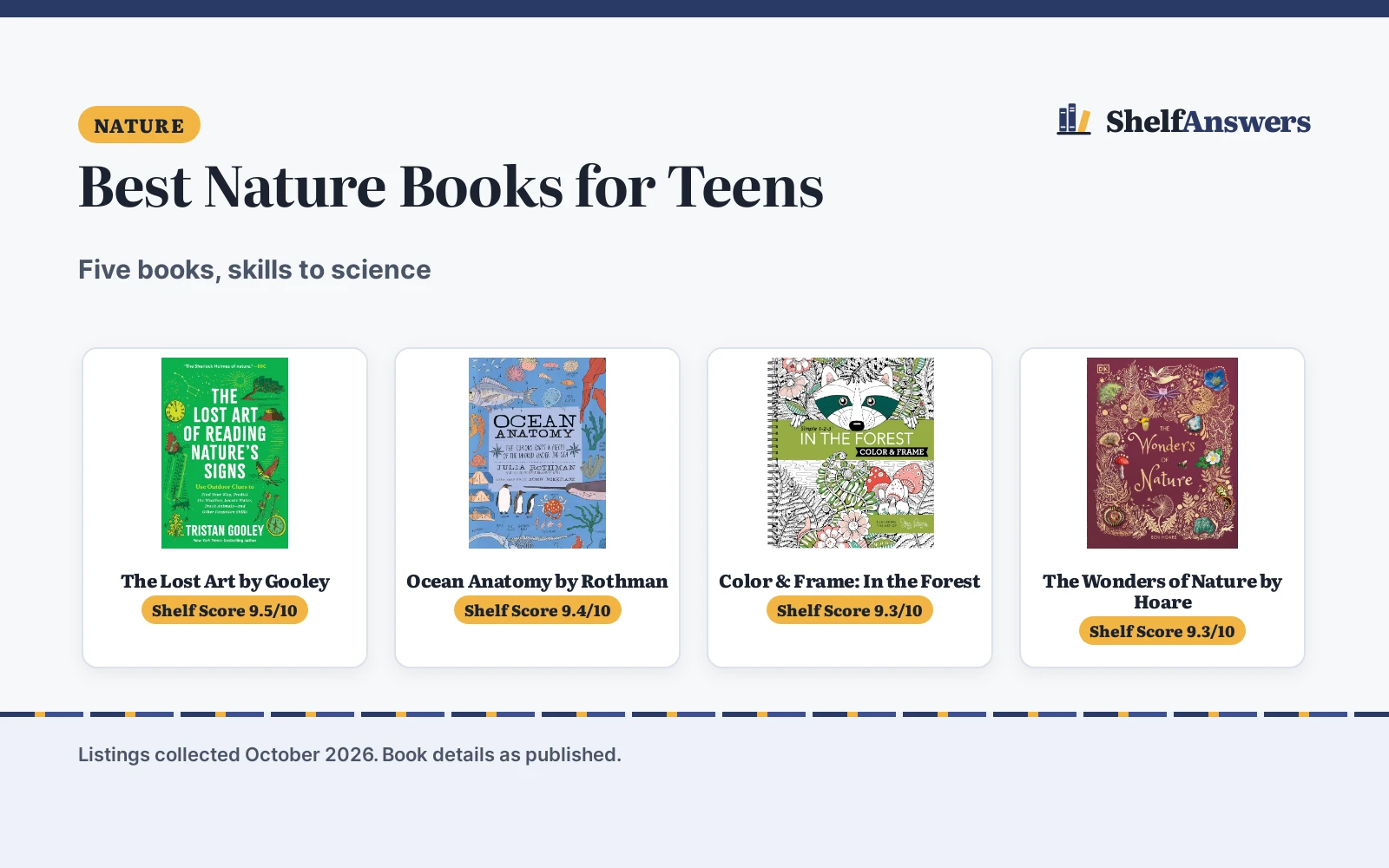
At a glance
Top picks
As an Amazon Associate I earn from qualifying purchases. How we score
The best nature books for teens span field skills, ocean life and illustrated science, and the honest fit varies: one teaches 850 outdoor skills in 416 pages, while another is built for ages 4 to 8. We compared five by fit for teenage readers, contents and edition, value, and the listed reading age, so you can match the book to the reader.
ShelfAnswers earns a commission when you buy through links on this page, at no extra cost to you. As an Amazon Associate I earn from qualifying purchases. Affiliate disclosure.
Quick picks
 Best Overall The Lost Art by Gooley: 850+ nature tips, 416 pages, 2015. Check price on Amazon
 Best Ocean Guide Ocean Anatomy by Rothman: 208 pages of illustrated sea curiosities. Check price on Amazon
 Best Coloring Color & Frame: In the Forest: 31 forest images, 64 pages. Check price on Amazon
 Best for Younger Readers The Wonders of Nature by Hoare: 100 nature items, 224 pages. Check price on Amazon
 Most Interactive Backpack Explorer by Storey: Games, stickers, magnifying glass. Check price on Amazon
The picks
| # | Product | Shelf Score | Buy |
|---|---|---|---|
| 1 | The Lost Art by Gooley | 9.5/10 | Buy |
| 2 | Ocean Anatomy by Rothman | 9.4/10 | Buy |
| 3 | Color & Frame: In the Forest | 9.3/10 | Buy |
| 4 | The Wonders of Nature by Hoare | 9.3/10 | Buy |
| 5 | Backpack Explorer by Storey | 9.2/10 | Buy |

The Lost Art by Gooley
An 850-tip guide to reading nature's signs for navigation and weather; skip it if your teen wants picture-heavy reading.
Pros
- More than 850 tips for forecasting, tracking and navigation, per the description
- 416 pages; the longest book here
- 77 illustrations included, per the listing
Cons
- No reading age or grade level stated
- Previously published under a different UK title; check the edition you receive
- Dense skills content; not a casual browse

Ocean Anatomy by Rothman
An illustrated 208-page tour of the sea for readers of all ages; skip it for teens who want text-heavy nonfiction.
Pros
- Illustrated ocean guide covering formation, sea creatures and ocean phenomena, per the description
- For readers of all ages, per the listing
- April 2020 publication; the newest non-activity pick
Cons
- No reading age or grade level stated
- Illustration-led; light on long-form text
- Sea-focused; no land nature content
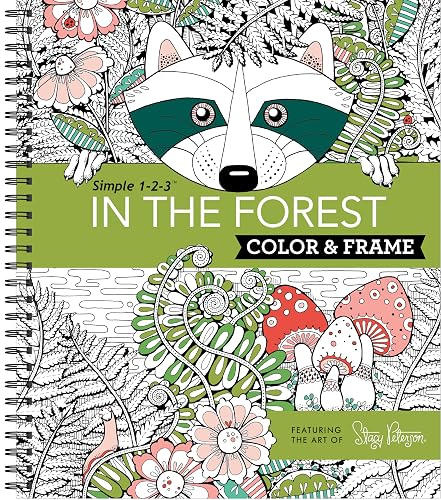
Color & Frame: In the Forest
An adult coloring book of 31 forest scenes on 64 pages; skip it for teens who want facts, not coloring.
Pros
- 31 forest images to color, per the listing
- Thicker paper and spiral binding, per the listing
- Reading age 7 years and up stated
Cons
- A coloring book, not a nature book; off-genre for this list
- 64 pages; the shortest non-activity book here
- Adult-oriented marketing may not appeal to teens

The Wonders of Nature by Hoare
A 224-page illustrated encyclopedia aimed at ages 6-8; skip it for older teens who will find it young.
Pros
- 100 remarkable items with photography and illustrations, per the listing
- 224 pages in an illustrated 2019 edition
- Gold foil and metallic edge details, per the listing
Cons
- Aimed at ages 6-8; too young for teens
- Reading age 5+ years and grade 2 - 4 stated
- Storybook style may bore older readers

Backpack Explorer by Storey
A 48-page activity book with games and a magnifying glass for ages 4-8; skip it for teens.
Pros
- Games, sticker sheets, scavenger hunts and a real magnifying glass included
- Interactive outdoor field guide format
- Won a Mom's Choice Award, per the listing
Cons
- Aimed at ages 4-8; far too young for teens
- 48 pages; the shortest book here
- Activity kit, not a reading book
As an Amazon Associate I earn from qualifying purchases.
More picks to compare
 The Wondrous Workings of Planet EarthEcosystems guide, 128 pages, ages 10-13.Check on Amazon
 Nature Anatomy by RothmanIllustrated nature guide, 224 pages.Check on Amazon
 The Secret World of Plants100+ plant stories, 192 pages.Check on Amazon
 The Nature ConnectionOutdoor workbook, 304 pages, ages 6-10.Check on Amazon
 Weird and Wonderful Nature100+ unusual species stories, 192 pages.Check on Amazon
Compare the picks
| Book | Shelf Score | Author | Pages | Reading age | Amazon |
|---|---|---|---|---|---|
| The Lost Art by Gooley | 9.5/10 | Tristan Gooley | 416 | Not stated | Check price |
| Ocean Anatomy by Rothman | 9.4/10 | Julia Rothman | 208 | Not stated | Check price |
| Color & Frame: In the Forest | 9.3/10 | New Seasons | 64 | 7 years and up | Check price |
| The Wonders of Nature by Hoare | 9.3/10 | Ben Hoare | 224 | 5+ years | Check price |
| Backpack Explorer by Storey | 9.2/10 | Editors of Storey Publishing | 48 | 3 – 6 years | Check price |
Book details as published on each listing, collected 17 October 2026.
How we scored them
The Shelf Score weighs fit for teenage readers, contents and edition, value, and the listed reading age or level. Two of the five state no reading age; the three that do skew younger than the teen years, which costs them fit points. How we pick explains the weights.
| Book | Shelf Score | Fit /35 | Contents /25 | Value /25 | Age/level /10 |
|---|---|---|---|---|---|
| The Lost Art by Gooley | 9.5 | 28 | 20 | 19 | 0 |
| Ocean Anatomy by Rothman | 9.4 | 26 | 19 | 18 | 0 |
| Color & Frame: In the Forest | 9.3 | 21 | 16 | 16 | 4 |
| The Wonders of Nature by Hoare | 9.3 | 19 | 18 | 16 | 3 |
| Backpack Explorer by Storey | 9.2 | 16 | 15 | 15 | 2 |
Scores run from 9.2 to 9.8: each book’s point total is placed on that range, so more points always means a higher score. Reading age or level counts on a list where at least one listing gives one, and a book whose listing gives none then scores zero on it. Where no listing gives one, the score is taken over the other 85 points. Books carry no warranty, so warranty is not scored.
How to choose the best nature books for teens
Check the reading age first
Three listings state one, and all three sit below the teen years: 7 years and up for the coloring book, 5+ years for The Wonders of Nature, and 3 to 6 years for Backpack Explorer. Those are fine gifts for younger siblings, but a 14-year-old will outgrow them fast. The two picks with no stated age, The Lost Art and Ocean Anatomy, are the ones aimed at older readers.
Skills versus pictures
The Lost Art of Reading Nature’s Signs is the skills book: more than 850 tips and 77 illustrations for navigation, weather prediction and tracking, per its description. Ocean Anatomy is the visual book: an illustrated tour of the sea for readers of all ages. Pick skills for the teen who hikes, pictures for the teen who browses.
Activity books are for younger kids
Backpack Explorer packs games, sticker sheets, scavenger hunts and a real magnifying glass into 48 pages for ages 4 to 8, per its listing. It is a great outdoor kit for a young child, not a teen read. If your teen wants outdoor activities, the two illustrated science picks give more lasting value. Browse our young adult books.
Before you buy
- Match the reading age to the reader; three of these skew well below teen.
- Decide between skills (The Lost Art), ocean life (Ocean Anatomy) or coloring (Color & Frame).
- Check the page count: 48 to 416 pages here is a wide spread.
Frequently Asked Questions
Which nature book here suits an older teen best?
The Lost Art of Reading Nature’s Signs: 416 pages of outdoor skills with no stated age limit, aimed at the reader who walks and explores.
Are any of these activity books?
Yes, two: Color & Frame is an adult coloring book of forest scenes, and Backpack Explorer is an activity kit for ages 4 to 8 with games and a magnifying glass.
Which book has the most pages?
The Lost Art of Reading Nature’s Signs at 416 pages, then The Wonders of Nature at 224.
Related lists
See every young adult list and all kids and teens lists.
More lists: science books for teens, travel books for teens and history books for teens.