Best Math Books for Machine Learning (2026): 5 Picks
5 books for machine learning math, from a narrative history to rigorous textbooks with Python code, compared by fit, contents and stated level.

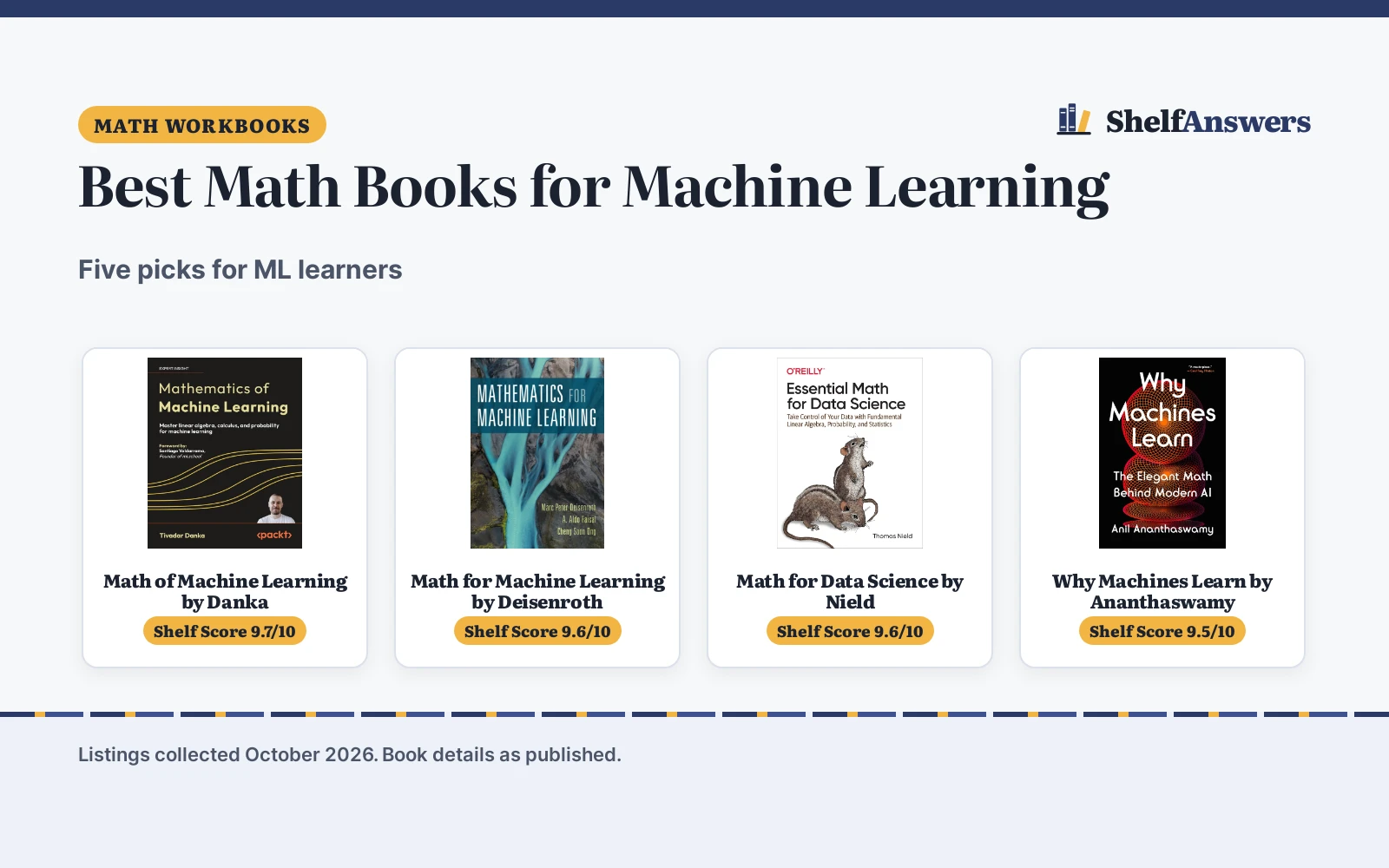
At a glance
Top picks
As an Amazon Associate I earn from qualifying purchases.
A reader who wants to understand machine learning from the mathematics up needs a book that matches their level, so the best math books for machine learning here run from narrative history to textbooks with Python code. We compared 5 books by fit, contents and value.
ShelfAnswers earns a commission when you buy through links on this page, at no extra cost to you. As an Amazon Associate I earn from qualifying purchases. Affiliate disclosure.
Quick picks
 Best Overall Math of Machine Learning by Danka: 730 pages, Python examples, Beginner to Intermediate level Check price on Amazon
 Best Textbook Math for Machine Learning by Deisenroth: Derives 4 ML methods, exercises in every chapter Check price on Amazon
 Best Plain English Math for Data Science by Nield: Plain English math with Python code, 349 pages Check price on Amazon
 Best Narrative Why Machines Learn by Ananthaswamy: Narrative math behind modern AI, 480 pages Check price on Amazon
 Best Short Intro Machine Learning by Wilmott: Self-contained intro, 242 pages, 2019 edition Check price on Amazon
The picks
| # | Product | Shelf Score | Buy |
|---|---|---|---|
| 1 | Math of Machine Learning by Danka | 9.7/10 | Buy on Amazon |
| 2 | Math for Machine Learning by Deisenroth | 9.6/10 | Buy on Amazon |
| 3 | Math for Data Science by Nield | 9.6/10 | Buy on Amazon |
| 4 | Why Machines Learn by Ananthaswamy | 9.5/10 | Buy on Amazon |
| 5 | Machine Learning by Wilmott | 9.4/10 | Buy on Amazon |

Math of Machine Learning by Danka
For engineers at a Beginner to Intermediate level who want Python implementations for machine learning.
Pros
- 730 pages on linear algebra, calculus and probability
- Practical Python examples with NumPy and scikit-learn
- Level stated as Beginner to Intermediate
Cons
- Requires algebra and Python basics
- No companion answer key is stated
- Longest book on this list at 730 pages

Math for Machine Learning by Deisenroth
For readers with a mathematical background who want the fundamentals of linear regression and support vector machines.
Pros
- Derives linear regression, principal component analysis and support vector machines
- Worked examples and exercises in every chapter
- Programming tutorials on the book's web site
Cons
- No reading age or grade level stated
- Older than the 2025 Danka book
- Tutorials sit on the web site, not in the book

Math for Data Science by Nield
For data science readers who want calculus, probability, linear algebra and statistics in plain English with Python code.
Pros
- Plain English with minimal mathematical notation
- Python code with SymPy, NumPy and scikit-learn
- Descriptive statistics and hypothesis checks with p-values
Cons
- No reading age or grade level stated
- Older than the 2025 Danka book
- Fewer pages than the 730 page Danka book

Why Machines Learn by Ananthaswamy
For readers who want a narrative explanation of the mathematics behind machine learning and modern AI.
Pros
- Narrative explanation of the mathematics behind modern AI
- Linear algebra and calculus from seventeenth- and eighteenth-century mathematics
- 480 pages from Dutton, published July 16, 2024
Cons
- No exercises or practice problems stated
- No reading age or grade level stated
- No Python code or tutorials stated

Machine Learning by Wilmott
For readers with basic matrix algebra and calculus who want a self-contained introduction to machine learning methods.
Pros
- Self-contained, requiring only basic matrix algebra and calculus
- Nearest neighbours, decision trees and neural networks
- Real-world examples from finance, economics, politics and marketing
Cons
- Oldest on this list, published May 26, 2019
- No reading age or grade level stated
- 242 pages, the shortest book on this list
As an Amazon Associate I earn from qualifying purchases.
More picks to compare
 Before Machine Learning Vol 2 by BrasilFor calculus learners who want bee-biology analogies and coding exercises.Check on Amazon
 Linear Algebra for ML by FesslerFor upper-level undergraduates and first-year graduates studying matrix methods.Check on Amazon
Compare the picks
| Book | Shelf Score | Author | Pages | Reading age or grade | Amazon |
|---|---|---|---|---|---|
| Math of Machine Learning by Danka | 9.7/10 | Danka | 730 | Beginner to Intermediate | View on Amazon |
| Math for Machine Learning by Deisenroth | 9.6/10 | Deisenroth | 398 | Not stated | View on Amazon |
| Math for Data Science by Nield | 9.6/10 | Nield | 349 | Not stated | View on Amazon |
| Why Machines Learn by Ananthaswamy | 9.5/10 | Ananthaswamy | 480 | Not stated | View on Amazon |
| Machine Learning by Wilmott | 9.4/10 | Wilmott | 242 | Not stated | View on Amazon |
Book details as published on each listing, collected 25 October 2026.
How we scored them
The Shelf Score weighs fit, contents and edition, value, and the listed reading level where one is given. Only the Danka book states a reading level. How we pick explains the weights.
| Book | Shelf Score | Fit /35 | Contents /25 | Value /25 | Age/level /10 |
|---|---|---|---|---|---|
| Math of Machine Learning by Danka | 9.7 | 30 | 22 | 21 | 7 |
| Math for Machine Learning by Deisenroth | 9.6 | 32 | 22 | 22 | 0 |
| Math for Data Science by Nield | 9.6 | 30 | 21 | 21 | 0 |
| Why Machines Learn by Ananthaswamy | 9.5 | 28 | 20 | 20 | 0 |
| Machine Learning by Wilmott | 9.4 | 28 | 19 | 19 | 0 |
Scores run from 9.2 to 9.8: each book’s point total is placed on that range, so more points always means a higher score. Reading age or level counts on a list where at least one listing gives one, and a book whose listing gives none then scores zero on it. Where no listing gives one, the score is taken over the other 85 points. Books carry no warranty, so warranty is not scored.
How to choose the best math books for machine learning
Match the level to the reader
The Danka book states a Beginner to Intermediate level, the Wilmott book requires only basic matrix algebra and calculus, and the Deisenroth book suits readers with a mathematical background. See the math for ml book lists.
Textbook or narrative
The Deisenroth, Danka, Nield and Wilmott books teach with exercises and code, while the Ananthaswamy book is a narrative without exercises. See best book to learn math.
Before you buy
- Check the edition date: the Danka book is dated 2025, and the Wilmott book 2019.
- Check whether the book states a reading level: only the Danka book states one.
- Check whether code is included: the Nield book states Python code.
Frequently Asked Questions
Which book should I start with for machine learning math?
The Danka book states a Beginner to Intermediate level.
Which book is the most recent?
The Danka book, published May 30, 2025. The Wilmott book is the oldest, published May 26, 2019.
Do any of these books include Python code?
The Nield book states Python code, and the Danka book states practical Python examples.
Related lists
See every math workbooks list and all workbooks and homeschool lists.
More lists: best math books to read for fun, best ACT math study guide, best math workbook for 8th grade.