Best Japanese Kanji Workbook (2026): 5 Picks for JLPT Study
Kanji workbooks for JLPT N5 to N3 study compared on coverage, lessons and practice material, with more options for beginners.
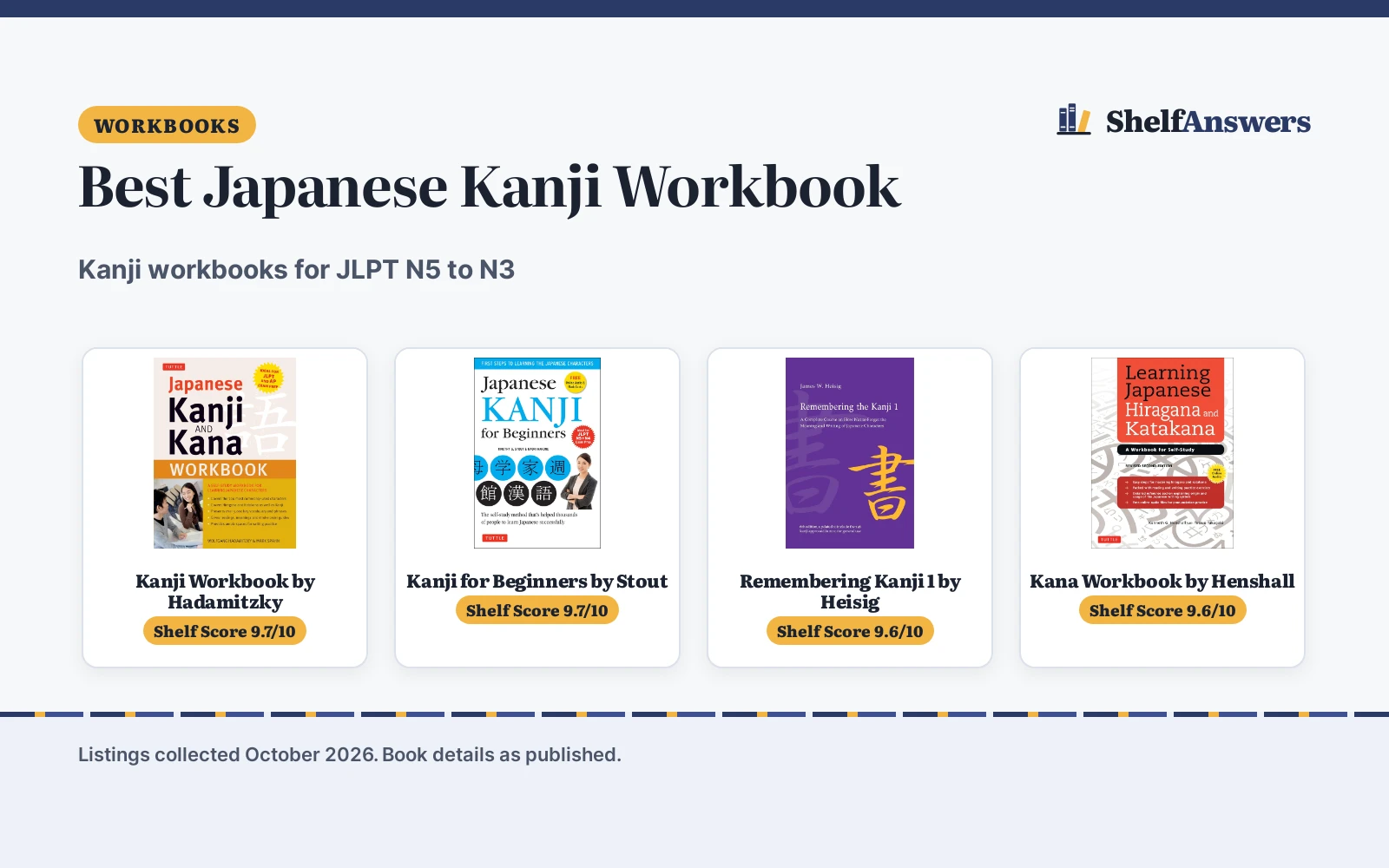
At a glance
Top picks
As an Amazon Associate I earn from qualifying purchases.
The best japanese kanji workbook matches the book to the learner: a beginner needs stroke order and practice rows, while a JLPT student needs the right kanji level and steady review. We compared ten books on kanji coverage, lessons, practice material and edition.
ShelfAnswers earns a commission when you buy through links on this page, at no extra cost to you. As an Amazon Associate I earn from qualifying purchases. Affiliate disclosure.
Quick picks
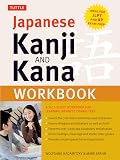 Best Overall Kanji Workbook by Hadamitzky: 92 kana, 617 kanji and 3,000+ words in one self-study volume. Check price on Amazon
 Best for Beginners Kanji for Beginners by Stout: 44 lessons, online audio and flashcards for 430 kanji. Check price on Amazon
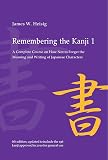 Best Memory Method Remembering Kanji 1 by Heisig: Story-based system for kanji meanings and writing, 490 pages. Check price on Amazon
 Best Companion Look and Learn Book by Banno: Workbook practice in sentences, pairs with its textbook. Check price on Amazon
 Kana First Kana Workbook by Henshall: Hiragana and katakana practice before kanji. Check price on Amazon
The picks
| # | Product | Shelf Score | Buy |
|---|---|---|---|
| 1 | Kanji Workbook by Hadamitzky | 9.7/10 | Buy on Amazon |
| 2 | Kanji for Beginners by Stout | 9.7/10 | Buy on Amazon |
| 3 | Remembering Kanji 1 by Heisig | 9.6/10 | Buy on Amazon |
| 4 | Hiragana and Katakana by Henshall | 9.6/10 | Buy on Amazon |
| 5 | Look and Learn Book by Banno | 9.4/10 | Buy on Amazon |

Kanji Workbook by Hadamitzky
A one-volume workbook covering 92 kana and 617 kanji with 3,000+ words, for self-study, homeschool and JLPT N5 to N3.
Pros
- 92 kana and 617 kanji plus 3,000+ vocabulary words in one volume
- Stroke order guides, radical breakdowns and two indexes
- Suits JLPT N5 to N3, the AP exam and self-study
Cons
- No online audio or flashcards stated, unlike the Stout book
- 617 kanji in 288 pages means dense pages for beginners
- 2017 edition; no newer edition stated

Kanji for Beginners by Stout
A lesson-based beginner book teaching 430 kanji in 44 lessons, with audio and printable flashcards.
Pros
- 44 lessons teach 430 kanji with audio and printable flashcards
- Kanji match those in the major Japanese textbooks
- Built for the AP Japanese exam as well as classes
Cons
- Fewer kanji than the Hadamitzky workbook's 617
- Beginner focus; N3 learners will outgrow it
- 2017 edition; no newer edition stated
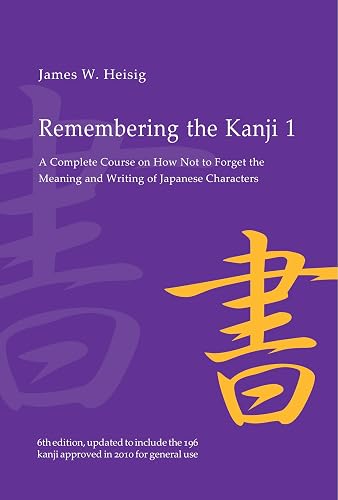
Remembering Kanji 1 by Heisig
A classic method book teaching kanji meanings and writing through stories built from component parts.
Pros
- 490 pages on one method: stories from primitive elements
- Includes the 196 general-use kanji approved in 2010
- Book 1 of 3; readings continue in a separate volume
Cons
- Meanings and writing only; no readings in this volume
- A story method, not a practice workbook
- 2011 edition is the latest stated

Hiragana and Katakana by Henshall
A kana-only starter for self-study learners, with stroke-by-stroke guides for all 92 hiragana and katakana characters.
Pros
- Stroke-by-stroke guides and writing practice sheets for all 92 kana
- Online audio for pronunciation, as the listing states
- At 128 pages, it is a short, focused start
Cons
- Published August 5, 2014 as a 2nd edition, and the listing states no newer edition year
- Covers only the kana, so kanji and grammar need a second book
- No answer key is stated in the listing

Look and Learn Book by Banno
A companion workbook to the Kanji Look and Learn textbook, practicing kanji and words in sentences.
Pros
- Pairs with the Kanji Look and Learn text
- Japanese edition from the Japan Times
- Practices kanji in sentences, not in isolation
Cons
- Needs the companion textbook to make full sense
- 2009 edition is the oldest stated here
- Less stated content than the Tuttle workbooks
As an Amazon Associate I earn from qualifying purchases.
More picks to compare
 Kanji Made Easy N4 by Lingo MasteryA JLPT N4 workbook covering 200 kanji with stroke order practice and audio exercises.Check on Amazon
 N5 Kanji Workbook by TanakaAn all-in-one N5 workbook with stroke order diagrams, practice rows and cut-out flashcards.Check on Amazon
 Your First 100 Kanji by TamakiA beginner N5 workbook with 100 kanji, writing exercises and a companion learning app.Check on Amazon
 Kanji for Beginners by TachibanaA gentle N5 workbook teaching 119 kanji with stroke order guides and review sections.Check on Amazon
Compare the picks
| Book | Shelf Score | Author | Pages | Published | Amazon |
|---|---|---|---|---|---|
| Kanji Workbook by Hadamitzky | 9.7/10 | Wolfgang Hadamitzky | 288 | December 12, 2017 | View on Amazon |
| Kanji for Beginners by Stout | 9.7/10 | Timothy G. Stout | 320 | January 17, 2017 | View on Amazon |
| Remembering Kanji 1 by Heisig | 9.6/10 | James W. Heisig | 490 | March 31, 2011 | View on Amazon |
| Look and Learn Book by Banno | 9.4/10 | Eri Banno | 206 | June 1, 2009 | View on Amazon |
| Kana Workbook by Henshall | 9.6/10 | Kenneth G. Henshall | Not stated | Not stated |
Details as published on each listing, collected 22 October 2026.
How we scored them
The Shelf Score weighs fit for the kanji learner, contents and edition, value, and the listed reading age or level. None states a reading age or grade level, so the ranking comes from the other three. How we pick explains the weights.
| Book | Shelf Score | Fit /35 | Contents /25 | Value /25 | Age/level /10 |
|---|---|---|---|---|---|
| Kanji Workbook by Hadamitzky | 9.7 | 30 | 22 | 21 | n/a |
| Kanji for Beginners by Stout | 9.7 | 30 | 21 | 20 | n/a |
| Remembering Kanji 1 by Heisig | 9.6 | 27 | 20 | 19 | n/a |
| Look and Learn Book by Banno | 9.4 | 26 | 16 | 16 | n/a |
Scores run from 9.2 to 9.8: each book’s point total is placed on that range, so more points always means a higher score. Reading age or level counts on a list where at least one listing gives one, and a book whose listing gives none then scores zero on it. Where no listing gives one, the score is taken over the other 85 points. Books carry no warranty, so warranty is not scored.
How to choose the best japanese kanji workbook
Match the kanji count to your level
A beginner working toward JLPT N5 wants a few hundred well-drilled kanji, while an N3 student needs a bigger set. The Hadamitzky workbook covers 617 kanji across N5 to N3; the Stout book teaches 430 kanji for N5 and N4 in 44 lessons.
Decide how you want to practice
The Stout book includes online audio and printable flashcards, while the Banno workbook practices kanji inside sentences rather than alone. For home study, browse the homeschool curriculum lists for companions.
Before you buy
- Check the edition or publication date; the picks run from 2009 to 2017.
- The Heisig book is Book 1 of 3; readings come in a separate volume.
- Confirm the kanji count and whether audio or flashcards are included.
Frequently Asked Questions
Which kanji workbook should a beginner start with?
The Stout book teaches 430 kanji in 44 lessons with audio and flashcards; the Hadamitzky workbook adds kana and 3,000+ words.
Do these workbooks teach kanji readings?
The Hadamitzky and Stout books include readings and meanings; the Heisig book teaches meanings and writing only, with readings in a separate volume.
Which workbook has the most writing practice?
One workbook lists over 150 pages of writing practice, with practice rows on every character page plus 39 full pages of extra practice. The Hadamitzky book also includes a dedicated writing area in each chapter.
Related lists
See every Homeschool Curriculum list and all Workbooks and Homeschool lists.
More lists: math workbooks, reading and phonics workbooks, self-improvement books.