Best High School Physics Workbook (2026): 9 Picks Compared
We compared nine high school physics study books by listed pages, level and content, and ranked the five strongest picks for teens and homeschoolers.

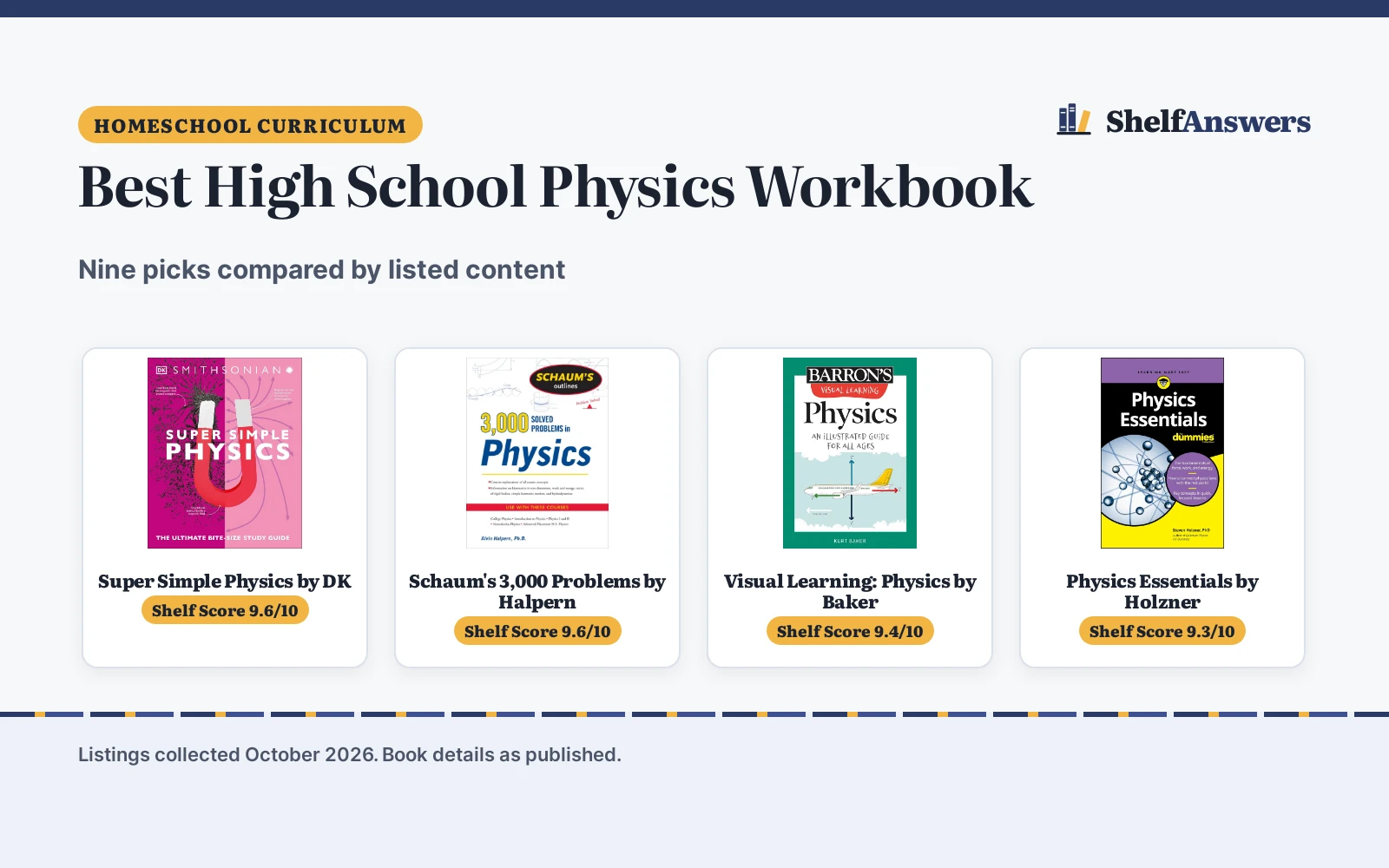
At a glance
Top picks
As an Amazon Associate I earn from qualifying purchases.
Finding the best high school physics workbook gets easier once you know the student: some need a shelf of practice problems before an exam, others absorb physics best from illustrations and short summaries. We compared the picks by listed print length, reading age, grade level, publication date and what each description says.
ShelfAnswers earns a commission when you buy through links on this page, at no extra cost to you. As an Amazon Associate I earn from qualifying purchases. Affiliate disclosure.
Quick picks
 Best Overall Super Simple Physics by DK: Illustrated revision guide, grade 7 to 9, 288 pages Check price on Amazon
 Best for Practice Problems Schaum’s 3,000 Problems by Halpern: 3,000 solved problems across every area of physics Check price on Amazon
 Best for Visual Learners Visual Learning: Physics by Baker: Reading age 13 to 17 years, 192 illustrated pages Check price on Amazon
 Best Concise Review Physics Essentials by Holzner: Key concepts only in 192 pages, published 2019 Check price on Amazon
 Best Quick Reference Physics Terminology by Jackson: Laminated terminology guide in 6 pages Check price on Amazon
The picks
| # | Product | Shelf Score | Buy |
|---|---|---|---|
| 1 | Super Simple Physics by DK | 9.6/10 | Buy on Amazon |
| 2 | Schaum's 3,000 Problems by Halpern | 9.6/10 | Buy on Amazon |
| 3 | Visual Learning: Physics by Baker | 9.4/10 | Buy on Amazon |
| 4 | Physics Essentials by Holzner | 9.3/10 | Buy on Amazon |
| 5 | Physics Terminology by Jackson | 9.2/10 | Buy on Amazon |

Super Simple Physics by DK
Illustrated revision guide breaking core physics into one-page chunks for readers around grade 7 to 9; skip it past that level.
Pros
- Grade 7 to 9 and reading age 10+ years both stated, so the audience is clear.
- 288 illustrated pages with one-page topics and Key Facts boxes.
- The listing says it supports homework, coursework and exam preparation.
Cons
- Reading age is marked as from customers, not from the publisher.
- The listing states no practice problem count.
- Published in 2021, older than the 2022 and 2024 books in this list.

Schaum's 3,000 Problems by Halpern
Practice volume with 3,000 solved problems for students who learn by working questions; also suits undergraduates, so younger high schoolers should skip it.
Pros
- 3,000 solved problems with step-by-step solutions, the most in this list.
- 780 pages cover every area of physics, with diagrams and an index.
- The listing says it suits high school and undergraduate courses.
Cons
- No reading age or grade level is stated.
- Published June 20, 2011, the oldest edition in this list.
- The listing names no newer edition.

Visual Learning: Physics by Baker
Illustrated guide for visual learners around reading age 13 to 17, from forces to astrophysics; skip it for practice problems.
Pros
- Reading age 13 to 17 years matches the high school reader.
- 192 pages of large graphics, diagrams and labeled illustrations.
- Published March 23, 2021, a recent edition from Barrons Educational Services.
Cons
- The listing states no practice problems.
- No grade level is stated with the reading age.
- One of the two shortest guides in this list at 192 pages.

Physics Essentials by Holzner
Concise refresher on key introductory physics topics for a student needing a quick review; skip it for a full course.
Pros
- Key topics only, with plain explanations from force to momentum.
- 192 pages; the listing says parents use it to help high schoolers with homework.
- Published May 7, 2019.
Cons
- No reading age or grade level is stated.
- The listing says it is not a new or updated product, only a new cover.
- Concise by design, so no practice problem count is stated.

Physics Terminology by Jackson
Laminated 6-page terminology reference for high school and college courses; skip it for an actual workbook.
Pros
- Succinct definitions from a listed Harvard Ph.D. author.
- Laminated 6-page format keeps every term in one place.
- Published December 31, 2013.
Cons
- 6 pages, far shorter than any workbook in this list.
- No reading age or grade level is stated.
- The listing states no practice problems or explanations.
As an Amazon Associate I earn from qualifying purchases.
More picks to compare
 Physics I Workbook For DummiesWorkbook with online chapter quizzes for high school physics practice.Check on Amazon
 McGraw Hill Physics Review WorkbookReview workbook with 500 questions, grade level 10 to 12.Check on Amazon
 High School Physics Content by SterlingComprehensive content book, reading age 14 to 18 years.Check on Amazon
 High School Physics Q&A by SterlingOver one thousand practice questions with step-by-step explanations.Check on Amazon
Compare the picks
| Book | Shelf Score | Author | Pages | Reading age or grade | Published | Amazon |
|---|---|---|---|---|---|---|
| Super Simple Physics by DK | 9.6/10 | DK | 288 | 10+ / grade 7 to 9 | February 9, 2021 | View on Amazon |
| Schaum’s 3,000 Problems by Halpern | 9.6/10 | Halpern | 780 | Not stated | June 20, 2011 | |
| Visual Learning: Physics by Baker | 9.4/10 | Kurt Baker | 192 | 13 to 17 years | March 23, 2021 | View on Amazon |
| Physics Essentials by Holzner | 9.3/10 | Steven Holzner | 192 | Not stated | May 7, 2019 | View on Amazon |
| Physics Terminology by Jackson | 9.2/10 | Mark Jackson | 6 | Not stated | December 31, 2013 | View on Amazon |
Book details as published on each listing, collected 22 October 2026.
How we scored them
The Shelf Score weighs fit for the reader, contents and edition, value, and the listed reading age or level where one is given. Two of the five picks state one: Super Simple Physics lists grade 7 to 9 with a customer-marked reading age of 10+ years, and Visual Learning: Physics lists a reading age of 13 to 17 years. How we pick explains the weights.
| Book | Shelf Score | Fit /35 | Contents /25 | Value /25 | Age/level /10 |
|---|---|---|---|---|---|
| Super Simple Physics by DK | 9.6 | 29 | 20 | 20 | 6 |
| Schaum’s 3,000 Problems by Halpern | 9.6 | 28 | 22 | 22 | 0 |
| Visual Learning: Physics by Baker | 9.4 | 23 | 18 | 16 | 7 |
| Physics Essentials by Holzner | 9.3 | 23 | 18 | 16 | 0 |
| Physics Terminology by Jackson | 9.2 | 12 | 8 | 10 | 0 |
Scores run from 9.2 to 9.8: each book’s point total is placed on that range, so more points always means a higher score. Reading age or level counts on a list where at least one listing gives one, and a book whose listing gives none then scores zero on it. Where no listing gives one, the score is taken over the other 85 points. Books carry no warranty, so warranty is not scored.
How to choose the best high school physics workbook
Match the level to the student
Super Simple Physics lists grade level 7 to 9, so a later high school class may find it light, while Visual Learning: Physics lists a reading age of 13 to 17 years. When the level is missing, as on the Schaum’s 3,000 Problems listing, use the publication date and the description instead. Our best workbooks for high school students roundup sets similar bands for other subjects.
Check the edition and the format
Physics Essentials For Dummies states its content matches an earlier release rather than a new or updated product, and Schaum’s lists a 2011 publication date. The laminated QuickStudy guide covers terms in 6 pages, so it suits quick lookups rather than a full course. See the best study guide for high school list for more review-first books.
Before you buy
- Check the edition and publication date; the books here range from 2011 to 2021, and the Physics Essentials For Dummies listing says it is not a new or updated product.
- Match the stated reading age or grade level to the student; only two of the five listings state one.
- See whether practice problems are stated: Schaum’s 3,000 lists 3,000 solved problems; the terminology guide lists none.
Frequently Asked Questions
Which of these physics books has the most practice problems?
Schaum’s 3,000 Solved Problems in Physics lists 3,000 solved problems, the largest count in this list. The McGraw Hill Physics Review and Workbook in the extra options lists 500 review questions.
Which book fits a high school freshman?
Super Simple Physics lists grade level 7 to 9, and Visual Learning: Physics lists a reading age of 13 to 17 years. Use the stated level as a starting point, not as advice for one child.
Is there a newer edition of Schaum’s 3,000 Solved Problems in Physics?
The listing gives a publication date of June 20, 2011 and states no newer edition. The other listings give dates from December 31, 2013 to March 23, 2021.
Related lists
See every Homeschool Curriculum list and all Workbooks and Homeschool lists.
More lists: science textbooks for high school students, geometry workbook for high school, grammar workbook for high school, books for high school.