Best Workbook for Handwriting (2026): 5 Workbooks Compared
Five handwriting workbooks compared by page count, grade level, practice format and listed age, from preschool letter tracing to early elementary cursive.


On this page
When a child begins forming their first pencil strokes or struggles to keep their handwriting legible on lined paper, finding the best workbook for handwriting depends on matching the exercises to their exact learning stage. Whether you are guiding a preschooler through uppercase letter tracing, helping an early elementary student connect words, or introducing cursive in third grade, the right practice pages turn writing into a calm daily habit. We compared five workbooks by page count, target grade level, practice format, and listed age ranges to help you choose the best workbook for handwriting practice at home or in class.
ShelfAnswers earns a commission when you buy through links on this page, at no extra cost to you. As an Amazon Associate I earn from qualifying purchases. Affiliate disclosure.
Quick picks
- Best Overall K-2 Printing Workbook by Brighter Child: Full-color K-2 printing practice with step-by-step guides and an included answer key. Check price
- Best for Preschoolers Trace Letters by Lalgudi: Dot-to-dot letter tracing, sight words, and coloring pictures across 108 pages. Check price
- Best for Reluctant Writers All-in-One Print Workbook by Mubasher: 152 pages of print practice featuring 101 science facts, jokes, and creative prompts. Check price
- Best for Cursive Beginning Cursive by Carson Dellosa: Focused letter connections and stroke practice for grades 1 to 3 with a reference chart. Check price
- Best for Joke Drills Handwriting Practice Book by Lalgudi: Combines letter and number tracing with 101 knock-knock jokes across 109 pages. Check price
Compare the picks
| Book | Shelf Score | Author | Pages | Reading age or grade | Published |
|---|---|---|---|---|---|
| K-2 Printing Workbook by Brighter Child | 8.8/10 | Brighter Child, Carson Dellosa Education | 80 | Grade level Kindergarten – 2, reading age 4 – 6 (customers) | March 12, 2015 |
| Trace Letters by Lalgudi | 8.4/10 | Sujatha Lalgudi, Hippidoo | 108 | Reading age 3 – 5 (customers) | August 15, 2019 |
| All-in-One Print Workbook by Mubasher | 8.1/10 | Khaula Mubasher | 152 | Ages 8 – 12, reading age 5 – 9 (customers) | April 21, 2025 |
| Beginning Cursive by Carson Dellosa | 7.5/10 | Carson Dellosa Education | 32 | Grade level 1 – 3, reading age 6 – 9 (customers) | January 2, 2013 |
| Handwriting Practice Book by Lalgudi | 7.5/10 | Sujatha Lalgudi, Hippidoo | 109 | Ages 6 – 10, reading age 5 – 9 (customers) | October 29, 2020 |
Book details as published on each listing, collected 15 October 2026.
The picks
| # | Product | Shelf Score | Buy |
|---|---|---|---|
| 1 |  K-2 Printing Workbook by Brighter Child K-2 Printing Workbook by Brighter Child | 8.8/10 | Buy |
| 2 |  Trace Letters by Lalgudi Trace Letters by Lalgudi | 8.4/10 | Buy |
| 3 |  All-in-One Print Workbook by Mubasher All-in-One Print Workbook by Mubasher | 8.1/10 | Buy |
| 4 |  Beginning Cursive by Carson Dellosa Beginning Cursive by Carson Dellosa | 7.5/10 | Buy |
| 5 |  Handwriting Practice Book by Lalgudi Handwriting Practice Book by Lalgudi | 7.5/10 | Buy |
K-2 Printing Workbook by Brighter Child
A printing workbook covering letter formation, sight words and sentences for kindergarten through second grade, with an included answer key.
Pros
- Covers uppercase and lowercase letter tracing, word formation and simple sentences
- Full-color practice pages across 80 pages of activities
- Answer key is included according to the listing description
- Lists both grade level Kindergarten to 2 and reading age 4 to 6 years
Cons
- Published March 12, 2015, an older edition
- Reading age of 4 to 6 years is marked as from customers
- The spec table lists phonics skills and stickers that differ from the handwriting description
- Reading age 4 to 6 stops before second grade, though the grade level spans Kindergarten to 2
Detailed Review
The description frames this workbook as guided printing practice that teaches letter recognition, stroke formation and sentence building through interactive tracing. The listing gives 80 pages, an 8 by 11 inch format, a publication date of March 12, 2015, grade level Kindergarten to 2, and a customer-listed reading age of 4 to 6 years. There is an inconsistency in the listing: the spec table mentions 60 beginning phonics pages and gold star stickers, while the title and description focus on an 80-page handwriting workbook with an answer key.
Who it's for: a kindergartener, first grader or second grader who needs structured, full-color printing practice with an answer key. Who should skip it: a family seeking a recent publication date or practice that includes cursive.
Its Shelf Score of 8.8/10 comes from fit 32/35, contents and edition 22/25, value 21/25 and reading age or level 9/10.
Book Details
| Publisher | Brighter Child |
|---|---|
| Author | Brighter Child, Carson Dellosa Education |
| Print length | 80 pages |
| Grade level | Kindergarten - 2 |
| Published | March 12, 2015 |
Details as published on the retailer listing, collected 15 October 2026. Editions and formats change; check the listing before you buy.
Reading Age and Edition
What this listing states. Grade level Kindergarten to 2 and a reading age of 4 to 6 years, marked as from customers, so reading age or level scores 9 of 10. Books carry no warranty, so warranty is not part of the score. See How We Pick.
Check the grade and the answer key. Workbook levels differ between publishers. Confirm the grade level and whether answers are included in the book or sold separately.
Listed reading ages and grade levels are a guide, not advice about a particular reader. Editions and formats change, so check the listing before you buy. See our Reading Age Disclaimer.
Trace Letters by Lalgudi
A preschool and kindergarten tracing workbook focused on uppercase and lowercase letters, sight words and simple sentences.
Pros
- Progressive structure moving from dot-to-dot letter tracing to sight words and sentences
- 108 pages of practice in a large 8.5 by 11 inch format
- Includes cheerful illustrations to color alongside writing exercises
- Customer-listed reading age of 3 to 5 years aligns with preschool and kindergarten learners
Cons
- No grade level is stated in the spec table
- Published August 15, 2019, without note of a newer edition
- Reading age of 3 to 5 years is marked as from customers
- Description mentions over 100 pages while the spec table lists 108 pages
Detailed Review
The description presents this workbook as an early penmanship guide that uses dot-to-dot tracing, vocabulary sight words and coloring pictures to build writing confidence. The listing gives a print length of 108 pages, dimensions of 8.5 by 11 inches, a publication date of August 15, 2019, and a customer-listed reading age of 3 to 5 years. While the title notes Pre-K and Kindergarten, no official grade level is listed in the spec table.
Who it's for: a preschooler or kindergartener starting with pencil control, alphabet shapes and early sight words. Who should skip it: an older elementary student who already knows basic letter strokes and needs cursive or paragraph practice.
Its Shelf Score of 8.4/10 comes from fit 30/35, contents and edition 21/25, value 21/25 and reading age or level 7/10.
Book Details
| Author | Sujatha Lalgudi, Hippidoo |
|---|---|
| Print length | 108 pages |
| Reading age | 3 - 5 years, from customers |
| Published | August 15, 2019 |
Details as published on the retailer listing, collected 15 October 2026. Editions and formats change; check the listing before you buy.
Reading Age and Edition
What this listing states. A reading age of 3 to 5 years, marked as from customers, so reading age or level scores 7 of 10. Books carry no warranty, so warranty is not part of the score. See How We Pick.
Check the grade and the answer key. Workbook levels differ between publishers. Confirm the grade level and whether answers are included in the book or sold separately.
Listed reading ages and grade levels are a guide, not advice about a particular reader. Editions and formats change, so check the listing before you buy. See our Reading Age Disclaimer.
All-in-One Print Workbook by Mubasher
An elementary handwriting workbook with 152 pages featuring 101 science facts, jokes and creative writing prompts.
Pros
- 152 pages of practice, the longest workbook in this comparison
- Features 101 science facts, 101 jokes and creative writing prompts
- Published April 21, 2025, the newest release among these picks
- Layout accommodates both left-handed and right-handed learners
Cons
- Conflicting age guidance: description targets ages 8 to 12 while spec table lists reading age 5 to 9 from customers
- Page count discrepancy between the title stating 145 pages and the spec table listing 152 pages
- No answer key is listed
- Published by an independent publisher rather than an established textbook press
Detailed Review
The maker describes this book as an engaging writing guide designed to replace dull drills with 101 science facts, 101 jokes, scientist spotlights and short prompt exercises. The listing gives a print length of 152 pages, an independently published imprint, and a publication date of April 21, 2025. There are multiple listing contradictions: the title mentions 145 pages while the spec table lists 152, and the description targets ages 8 to 12 and grades 3 to 6 while the spec table gives a customer-listed reading age of 5 to 9 years.
Who it's for: an elementary student in grades 3 to 6 or a reluctant writer who enjoys science trivia, jokes and short prompts. Who should skip it: a parent seeking a formal cursive curriculum or a book with an answer key.
Its Shelf Score of 8.1/10 comes from fit 29/35, contents and edition 21/25, value 22/25 and reading age or level 4/10.
Book Details
| Author | Khaula Mubasher |
|---|---|
| Publisher | Independently published |
| Print length | 152 pages |
| Reading age | 5 - 9 years, from customers |
| Published | April 21, 2025 |
Details as published on the retailer listing, collected 15 October 2026. Editions and formats change; check the listing before you buy.
Reading Age and Edition
What this listing states. A reading age of 5 to 9 years, marked as from customers, contradicting the listed age range of 8 to 12, so reading age or level scores 4 of 10. Books carry no warranty, so warranty is not part of the score. See How We Pick.
Check the grade and the answer key. Workbook levels differ between publishers. Confirm the grade level and whether answers are included in the book or sold separately.
Listed reading ages and grade levels are a guide, not advice about a particular reader. Editions and formats change, so check the listing before you buy. See our Reading Age Disclaimer.
Beginning Cursive by Carson Dellosa
A 32-page workbook teaching cursive letter formation, stroke connections and number words for grades 1 through 3.
Pros
- Dedicated focus on beginning traditional cursive letter strokes and connections
- Includes a lined practice page and an alphabet reference chart
- Both grade level 1 to 3 and customer-listed reading age 6 to 9 are stated and align
- Large 11 by 8.5 inch format provides ample writing room
Cons
- Only 32 pages, making it the shortest book in this comparison
- Published January 2, 2013, the oldest edition among these picks
- Listing spec table contains an error describing math skills and gold stars instead of cursive
- Does not cover manuscript or print letter formation
Detailed Review
The description outlines a structured approach to learning cursive penmanship, guiding students through uppercase and lowercase letter strokes, connecting letters and writing number words. The listing gives 32 pages, dimensions of 11 by 8.5 inches, a publication date of January 2, 2013, grade level 1 to 3, and a customer-listed reading age of 6 to 9 years. The listing contains a glaring contradiction: the spec table lists skills as 60 beginning math practice pages with 140 gold star stickers, directly contradicting the cursive writing title and 32-page length.
Who it's for: a student in first, second or third grade ready to transition from print to traditional cursive strokes. Who should skip it: a child who needs basic print handwriting practice or a comprehensive, year-long workbook.
Its Shelf Score of 7.5/10 comes from fit 28/35, contents and edition 18/25, value 16/25 and reading age or level 9/10.
Book Details
| Publisher | Carson Dellosa Education |
|---|---|
| Author | Carson Dellosa Education |
| Print length | 32 pages |
| Grade level | 1 - 3 |
| Published | January 2, 2013 |
Details as published on the retailer listing, collected 15 October 2026. Editions and formats change; check the listing before you buy.
Reading Age and Edition
What this listing states. Grade level 1 to 3 and a reading age of 6 to 9 years, marked as from customers, so reading age or level scores 9 of 10. Books carry no warranty, so warranty is not part of the score. See How We Pick.
Check the grade and the answer key. Workbook levels differ between publishers. Confirm the grade level and whether answers are included in the book or sold separately.
Listed reading ages and grade levels are a guide, not advice about a particular reader. Editions and formats change, so check the listing before you buy. See our Reading Age Disclaimer.
Handwriting Practice Book by Lalgudi
A printing workbook with 109 pages of alphabet tracing, numbers 1 to 100, sight words and 101 jokes for early grades.
Pros
- 109 pages organized into progressive sections from letters to knock-knock jokes
- Includes tracing practice for numbers and number words from 1 to 100
- Humorous jokes and tongue twisters keep practice engaging
- Provides smaller letter size practice in later joke sections
Cons
- Muddled age targeting across the title, description and spec table
- Description mentions a preschool head-start while the title targets grades 1, 2 and 3
- Reading age of 5 to 9 years is marked as from customers
- No grade level is stated in the spec table
Detailed Review
The description structures penmanship practice across five parts, beginning with alphabet letters and numbers 1 to 100 before moving into sight words, knock-knock jokes and tongue twisters. The listing gives a print length of 109 pages, a publication date of October 29, 2020, and a customer-listed reading age of 5 to 9 years. The listing has noticeable internal contradictions: the title specifies ages 6 to 10 and grades 1 to 3, the description mentions ages 6 to 8 and giving a preschool head-start, while the spec table lists a reading age of 5 to 9 years.
Who it's for: an early elementary child in grades 1 through 3 who enjoys jokes and needs to practice both letters and numbers. Who should skip it: a buyer looking for clear, consistent grade level labeling or a curriculum with an answer key.
Its Shelf Score of 7.5/10 comes from fit 27/35, contents and edition 20/25, value 20/25 and reading age or level 4/10.
Book Details
| Author | Sujatha Lalgudi, Hippidoo |
|---|---|
| Print length | 109 pages |
| Reading age | 5 - 9 years, from customers |
| Published | October 29, 2020 |
Details as published on the retailer listing, collected 15 October 2026. Editions and formats change; check the listing before you buy.
Reading Age and Edition
What this listing states. A reading age of 5 to 9 years, marked as from customers, with conflicting age ranges in the listing, so reading age or level scores 4 of 10. Books carry no warranty, so warranty is not part of the score. See How We Pick.
Check the grade and the answer key. Workbook levels differ between publishers. Confirm the grade level and whether answers are included in the book or sold separately.
Listed reading ages and grade levels are a guide, not advice about a particular reader. Editions and formats change, so check the listing before you buy. See our Reading Age Disclaimer.
As an Amazon Associate I earn from qualifying purchases.
How we scored them
The Shelf Score weighs fit for handwriting development, contents and edition, value, and the listed reading age or grade level where one is provided. All five of the picks list a reading age marked as from customers, and two state a grade level in their listing specifications. Page counts range from 32 to 152 pages, and listings with verified grade bands and structured progression score higher on fit and contents. How we pick explains the weights.
| Book | Shelf Score | Fit /35 | Contents /25 | Value /25 | Age/level /10 |
|---|---|---|---|---|---|
| K-2 Printing Workbook by Brighter Child | 8.8 | 32 | 22 | 21 | 9 |
| Trace Letters by Lalgudi | 8.4 | 30 | 21 | 21 | 7 |
| All-in-One Print Workbook by Mubasher | 8.1 | 29 | 21 | 22 | 4 |
| Beginning Cursive by Carson Dellosa | 7.5 | 28 | 18 | 16 | 9 |
| Handwriting Practice Book by Lalgudi | 7.5 | 27 | 20 | 20 | 4 |
Scores run from 0 to 10. Reading age or level counts on a list where at least one listing gives one, and a book whose listing gives none then scores zero on it. Where no listing gives one, the score is taken over the other 85 points. Books carry no warranty, so warranty is not scored.
How to choose the best workbook for handwriting
Match practice to the reader’s grade band
Handwriting needs change dramatically between preschool and early elementary school. For children ages 3 to 5 who are developing fine motor grip, Trace Letters by Lalgudi provides wide dot-to-dot guides and coloring pictures. In kindergarten through second grade, Carson Dellosa K-2 Printing reinforces letter sounds, sight words and full sentences. Pairing letter formation with early reading reinforces letter-sound recognition; see our guide to reading and phonics workbooks for more literacy practice.
Choose between manuscript printing and cursive
Most elementary writing begins with manuscript printing before moving to connected script. If your learner already prints comfortably and needs to learn cursive connections in grades 1 through 3, Carson Dellosa Beginning Traditional Cursive offers targeted letter strokes. For older elementary children in grades 3 through 6 who resist repetitive drills, The All-in-One Print Handwriting Workbook by Mubasher introduces science facts and jokes to keep print practice engaging. You can also explore structured homeschool curriculum options for full subject planning.
Evaluate page count and daily format
| Book | Pages | Listed Grade or Age | Practice Format |
|---|---|---|---|
| Carson Dellosa K-2 Printing | 80 | Grade level Kindergarten – 2 | Printing, sight words, sentences |
| Trace Letters by Lalgudi | 108 | Reading age 3 – 5 years | Dot-to-dot alphabet tracing |
| All-in-One Print Workbook | 152 | Ages 8 – 12 (Grades 3 – 6) | Print practice with jokes and prompts |
| Beginning Traditional Cursive | 32 | Grade level 1 – 3 | Cursive strokes and connections |
| Handwriting Practice Book | 109 | Ages 6 – 10 (Grades 1 – 3) | Letters, numbers 1-100, jokes |
A concise 32-page workbook fits a focused summer transition, while 100-plus page workbooks provide enough material for an entire school term. To balance handwriting routines with other subjects, consider supplementing with math workbooks.
Before you buy
- Check whether an answer key is included: the Carson Dellosa K-2 printing workbook includes one, while other practice titles omit answer solutions.
- Verify the listed grade level against the reader: the Carson Dellosa workbooks state specific grade bands like Kindergarten to 2 or 1 to 3, whereas others list only customer reading ages.
- Note the publication date on the listing: dates among these titles range from January 2, 2013 for Beginning Traditional Cursive to April 21, 2025 for The All-in-One Print Workbook.
- Look for listing discrepancies between the description and the spec table, such as conflicting page counts or misplaced subject descriptions.
Frequently Asked Questions
Which workbook is best for a preschooler starting to write?
Trace Letters by Sujatha Lalgudi provides 108 pages designed for ages 3 to 5, featuring dot-to-dot alphabet tracing, sight words and coloring activities. It builds fine motor control in an 8.5 by 11 inch format before children enter kindergarten.
Do handwriting workbooks include an answer key?
Most handwriting practice books do not require one, but Carson Dellosa K-2 Printing Handwriting Workbook explicitly includes an answer key across its 80 pages. Other listings in this group do not state that an answer key is included.
What grade level is appropriate for beginning cursive?
Beginning Traditional Cursive by Carson Dellosa lists grade level 1 to 3 and a customer-reported reading age of 6 to 9 years. Its 32 pages focus on forming individual cursive letters, connecting strokes and writing number words.
How many pages of practice are typical in a handwriting workbook?
Page lengths vary widely among listings, ranging from 32 pages in Carson Dellosa Beginning Traditional Cursive to 152 pages in The All-in-One Print Handwriting Workbook by Khaula Mubasher. Titles from Sujatha Lalgudi offer 108 and 109 pages of guided drills.
Related lists
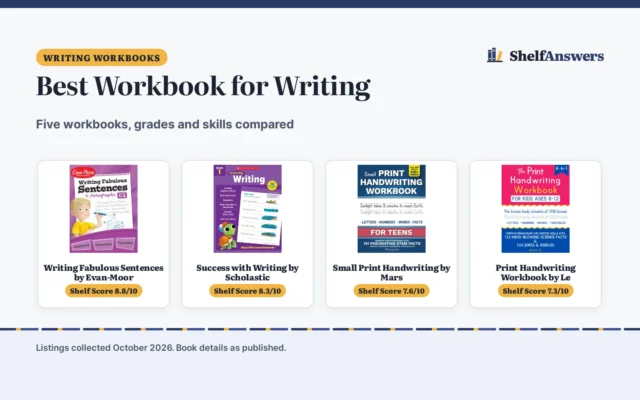
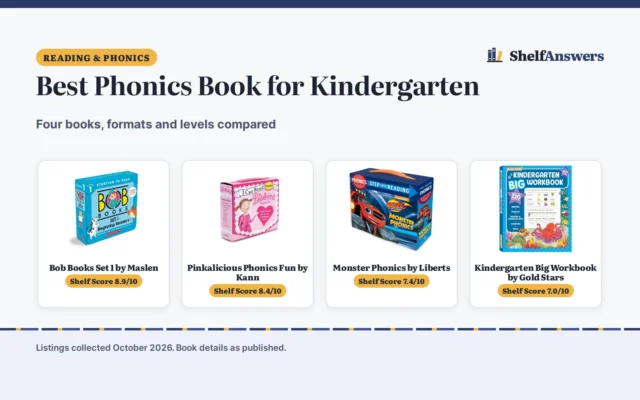
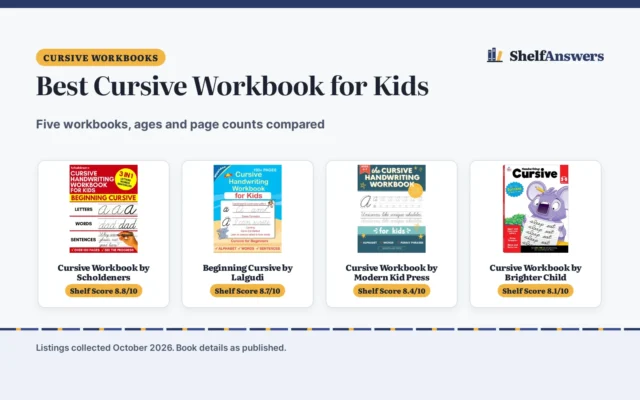
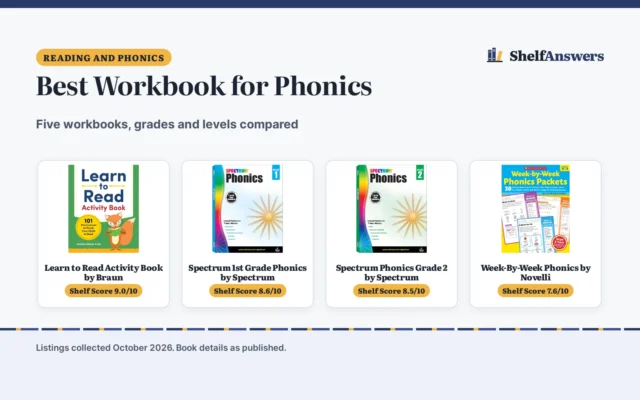
See every Reading and Phonics list and all Workbooks and Homeschool lists. Also see our best workbook for spelling. Also see our best workbook for phonics. Also see our best cursive workbook for kids. Also see our best phonics book for kindergarten. Also see our best workbook for writing.
More lists: explore homeschool curriculum, math workbooks and picture books.