Best Self Help Books for Autistic Adults (2026): 5 Picks Compared
Five self-help books for autistic adults compared by format, page count and focus, from practical burnout workbooks to guides for newly diagnosed adults.
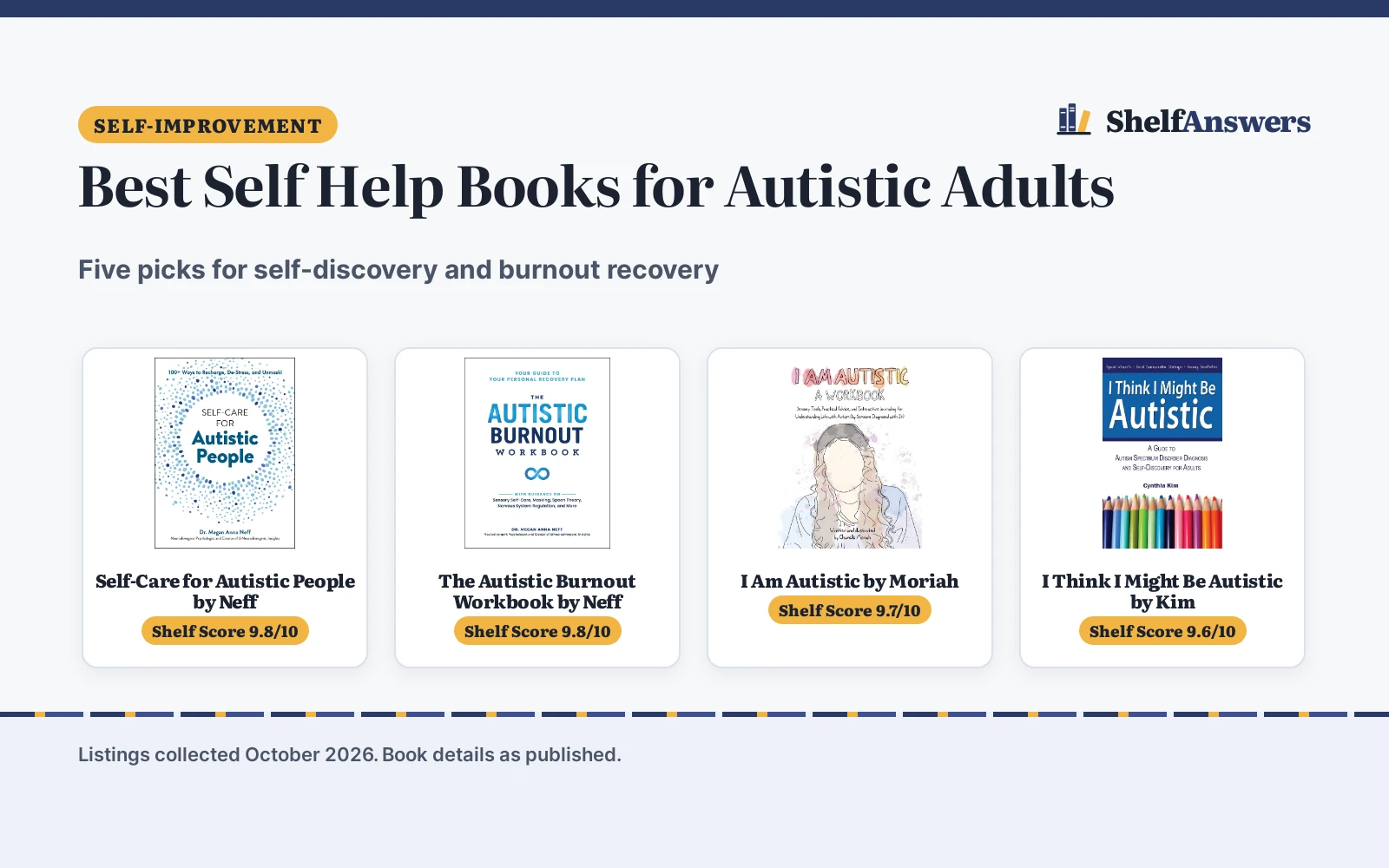
At a glance
Top picks
As an Amazon Associate I earn from qualifying purchases.
Finding the best self help books for autistic adults starts with recognizing where you are on your journey, whether navigating a new diagnosis or seeking relief from chronic sensory exhaustion. We compared titles across listed print length, publication date, interactive exercises and everyday coping strategies to help neurodivergent readers choose the right guide.
ShelfAnswers earns a commission when you buy through links on this page, at no extra cost to you. As an Amazon Associate I earn from qualifying purchases. Affiliate disclosure.
Quick picks
 Best Overall Self-Care for Autistic People by Neff: Features 100+ neurodivergent self-care exercises focused on unmasking. Check price on Amazon
 Best for Burnout The Autistic Burnout Workbook by Neff: A 240-page interactive recovery plan targeting sensory overload. Check price on Amazon
 Best Visual Workbook I Am Autistic by Moriah: Full-color illustrations and guided journaling for self-reflection. Check price on Amazon
 Best for Late Diagnosis I Think I Might Be Autistic by Kim: Guides adults through the ASD assessment process and self-discovery. Check price on Amazon
 Best Daily Guide Self Care for Autistic Adults by Nurture: Practical routines for managing sensory overload at home and work. Check price on Amazon
The books

Self-Care for Autistic People by Neff
This guide provides practical daily self-care activities tailored for autistic adults seeking to destress and embrace their neurodivergent identity.
Pros
- The listing details more than 100 practical activities designed for neurodivergent wellness
- Published in March 2024 by Adams Media, offering a current guide
- Written by therapist Dr. Megan Anna Neff with a focus on unmasking
Cons
- No reading age or grade level is stated on the listing
- At 192 pages, readers seeking in-depth psychological theory may find it concise
- Focuses on personal wellness rather than workplace accommodations

The Autistic Burnout Workbook by Neff
This structured workbook helps autistic adults identify overload triggers and build an individualized burnout recovery plan.
Pros
- Provides 240 pages of interactive prompts, visuals, and recovery exercises
- Published in March 2025 by Adams Media as a dedicated recovery workbook
- Directly addresses sensory overload, triggers, and building personal resilience
Cons
- No reading age or grade level is stated on the listing
- Interactive format requires active writing, which may feel demanding during severe burnout
- Concentrates on autistic burnout rather than general adult diagnosis assessment

I Am Autistic by Moriah
This visual, full-color workbook offers sensory tools and journaling prompts for both diagnosed and self-diagnosed adults navigating autism.
Pros
- Includes full-color illustrations and sensory-friendly interactive journaling pages
- Written by an autistic author for both formally and self-diagnosed readers
- Published by Ulysses Press with a print length of 144 pages
Cons
- No reading age or grade level is stated on the listing
- The visual journaling layout may not suit readers wanting standard text
- The listing spec table notes ADHD under description alongside autism

I Think I Might Be Autistic by Kim
This concise guide walks adults through the formal assessment process, self-discovery, and the emotional realities of a late autism diagnosis.
Pros
- Addresses adult assessment questions, preparation steps, and post-diagnosis decisions
- The listing notes an illustrated edition from publisher Narrow Gauge Press
- Focuses on late-diagnosed adults and navigating personal disclosure
Cons
- Published in August 2013, making it the oldest release among our picks
- Print length of 112 pages provides a concise introduction rather than exercises
- No reading age or grade level is stated on the listing

Self Care for Autistic Adults by Nurture
This practical manual provides everyday coping techniques for sensory overload, workplace dynamics, and emotional regulation.
Pros
- Covers concrete scenarios including crowded environments, workplace dynamics, and home setups
- Published in November 2024 with strategies for emotional regulation and unmasking
- Includes interactive exercises for self-acceptance without prescriptive language
Cons
- The publisher is not clearly identified in the listing extracted facts
- At 118 pages, it offers a brief overview rather than detailed chapters
- No reading age or grade level is stated on the listing
As an Amazon Associate I earn from qualifying purchases.
More picks to compare
 The Unmasking Workbook by PenotFor autistic adults seeking to unmask, avoid burnout, and practice self-advocacy.Check on Amazon
 Avoiding Anxiety by BeardonFor autistic adults wanting practical strategies to minimize anxiety in daily life.Check on Amazon
 Adult Autism Support Guide by KelleyFor adults seeking guidance on sensory overload, communication, and executive functioning.Check on Amazon
 Autistic Burnout Recovery by ReeseFor late-diagnosed and high-masking autistic adults recovering from chronic exhaustion.Check on Amazon
 4 Books in 1 Blueprint by SorrFor autistic adults wanting a comprehensive guide covering mental health and work.Check on Amazon
Compare the list
| Book | Shelf Score | Author | Pages | Published | Amazon |
|---|---|---|---|---|---|
| Self-Care for Autistic People by Neff | 9.8/10 | Dr. Megan Anna Neff | 192 | 2024 | View on Amazon |
| The Autistic Burnout Workbook by Neff | 9.8/10 | Dr. Megan Anna Neff | 240 | 2025 | View on Amazon |
| I Am Autistic by Moriah | 9.7/10 | Chanelle Moriah | 144 | 2022 | View on Amazon |
| I Think I Might Be Autistic by Kim | 9.6/10 | Cynthia Kim | 112 | 2013 | View on Amazon |
| Self Care for Autistic Adults by Nurture | 9.6/10 | Neuro Nurture | 118 | 2024 | View on Amazon |
Book details as published on each listing, collected 16 October 2026.
How the Shelf Score was applied
The Shelf Score weighs fit for the reader, contents and edition, value, and the listed reading age or level where one is given. None of the five picks list a reading age or grade level on their Amazon listings, which is typical for adult self-help books. Scores reflect practical coping tools, publication recency, and structured workbook exercises. How we pick explains the weights.
| Book | Shelf Score | Fit /35 | Contents /25 | Value /25 | Age/level /10 |
|---|---|---|---|---|---|
| Self-Care for Autistic People by Neff | 9.8 | 33 | 22 | 22 | n/a |
| The Autistic Burnout Workbook by Neff | 9.8 | 32 | 22 | 22 | n/a |
| I Am Autistic by Moriah | 9.7 | 30 | 21 | 20 | n/a |
| I Think I Might Be Autistic by Kim | 9.6 | 30 | 19 | 19 | n/a |
| Self Care for Autistic Adults by Nurture | 9.6 | 29 | 19 | 18 | n/a |
Scores run from 9.2 to 9.8: each book’s point total is placed on that range, so more points always means a higher score. Reading age or level counts on a list where at least one listing gives one, and a book whose listing gives none then scores zero on it. Where no listing gives one, the score is taken over the other 85 points. Books carry no warranty, so warranty is not scored.
How to choose the best self help books for autistic adults
Decide between guided workbooks and narrative guides
Consider how much energy you have for written exercises versus direct reading. Interactive titles like The Autistic Burnout Workbook by Neff and I Am Autistic by Moriah offer structured prompts and visual pages for active reflection. If you prefer broader reading, explore our guide to the best workbooks for self improvement to compare different formats.
Match the book to your diagnostic stage
Readers in different stages of self-discovery benefit from different starting points. For those exploring an initial evaluation, I Think I Might Be Autistic by Kim details the assessment process and post-diagnosis questions. Readers who already understand their diagnosis can explore general self-improvement books focused on everyday routines and unmasking.
Before you buy
- Check the publication date: titles like The Autistic Burnout Workbook were published in 2025, while I Think I Might Be Autistic dates to 2013.
- Review the page count and format to verify whether the listing is an interactive workbook with journaling space or a standard reading volume.
- Look for specific focus areas in the description, such as sensory overload management, workplace navigation, or formal diagnosis preparation.
FAQ for readers
Which book is best for someone newly diagnosed with autism?
I Think I Might Be Autistic by Cynthia Kim addresses the assessment process and emotional adjustments for late-diagnosed adults across 112 pages.
What is the difference between a self-care guide and an autistic burnout workbook?
Self-Care for Autistic People by Dr. Megan Anna Neff provides over 100 practical activities across 192 pages, whereas The Autistic Burnout Workbook offers 240 pages focused on trigger identification and burnout recovery.
Do any of these books include visual tools or illustrations?
Yes. The listing for I Am Autistic by Chanelle Moriah highlights full-color illustrations, sensory-friendly features, and interactive journaling pages across 144 pages.
More lists like this
See every self-improvement list and all nonfiction lists.
More lists: explore books for self improvement, books for avoidant attachment, self-help books for men, and books for after a breakup.