Best Japanese Minimalism Book (2026): 5 Picks Compared

At a glance
Top picks
As an Amazon Associate I earn from qualifying purchases.
A reader hunting for calm at home may turn to the best japanese minimalism book for a gentler way to live with less. We compared listings by title, description, publication date, and print length.
ShelfAnswers earns a commission when you buy through links on this page, at no extra cost to you. As an Amazon Associate I earn from qualifying purchases. Affiliate disclosure.
Quick picks
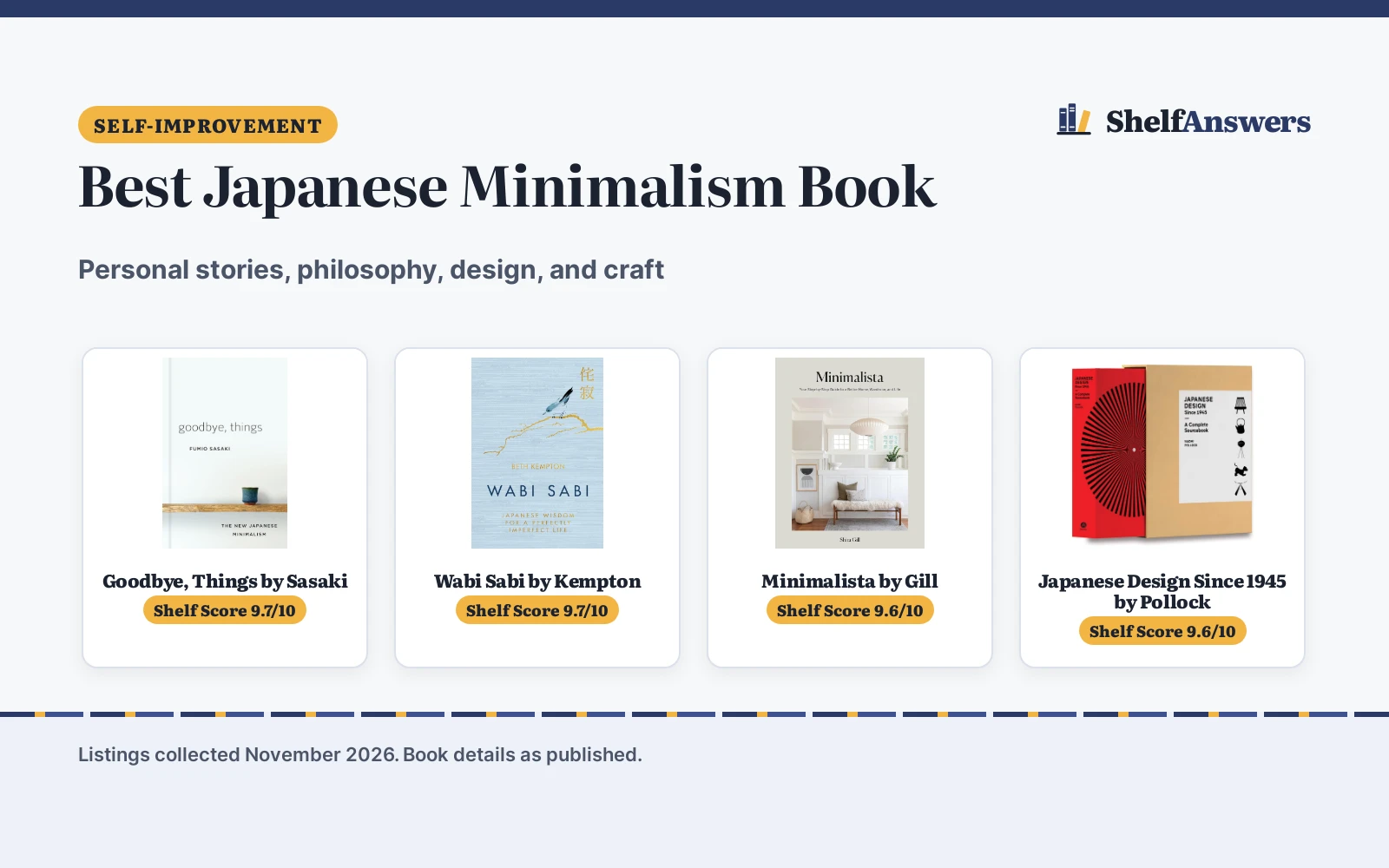
 Best Overall Goodbye, Things by Sasaki: Personal Japanese minimalism story with practical tips for clearing space Check price on Amazon
 Best Japanese Philosophy Wabi Sabi by Kempton: Japanese wabi sabi wisdom for finding beauty in imperfection Check price on Amazon
 Best Step-by-Step Guide Minimalista by Gill: Room-by-room process built around Clarify, Edit, Organize, Elevate, Maintain Check price on Amazon
 Best Design History Japanese Design Since 1945 by Pollock: Visual history of Japanese design from postwar minimalism onward Check price on Amazon
 Best Craft Pick Zakka Embroidery by Higuchi: Spare Japanese-style embroidery motifs paired with small craft projects Check price on Amazon
The books
| # | Product | Shelf Score | Buy |
|---|---|---|---|
| 1 | Goodbye, Things by Sasaki | 9.7/10 | Buy on Amazon |
| 2 | Wabi Sabi by Kempton | 9.7/10 | Buy on Amazon |
| 3 | Minimalista by Gill | 9.6/10 | Buy on Amazon |
| 4 | Japanese Design Since 1945 by Pollock | 9.6/10 | Buy on Amazon |
| 5 | Zakka Embroidery by Higuchi | 9.3/10 | Buy on Amazon |

Goodbye, Things by Sasaki
For a reader who wants a personal Japanese minimalism story; skip it for design history or craft.
Pros
- Shares a personal minimalist experience with minimizing tips
- Includes color illustrations alongside the personal story
- Frames minimalism around freedom, focus, and gratitude
Cons
- No reading age or grade level is stated
- Personal story format, not a structured room-by-room method
- Covers letting go, not design history or craft projects

Wabi Sabi by Kempton
For a reader who wants Japanese wabi sabi philosophy; skip it for a method with steps.
Pros
- Explains wabi sabi as beauty in imperfection and simplicity
- Covers home, seasons, failure, and aging
- Rooted in Zen and the Way of Tea
Cons
- No reading age or grade level is stated
- Philosophy-led, not a decluttering method with steps
- Design history and craft readers should look elsewhere

Minimalista by Gill
For a reader who wants a room-by-room method for home and wardrobe; skip it for Japanese minimalism.
Pros
- Shares a toolkit built around Clarify, Edit, Organize, Elevate, Maintain
- Applies the process room by room, down to a drawer
- Frames minimalism as the perfect amount for each reader
Cons
- No reading age or grade level is stated
- General minimalism guide, not about Japanese minimalism
- Home and wardrobe focus, not design history or craft

Japanese Design Since 1945 by Pollock
For a reader who wants a visual history of Japanese design; skip it for practical living advice.
Pros
- Comprehensive overview of Japanese design across the postwar period
- Covers furniture, cameras, fashion, buildings, and vehicles
- Connects design with Japanese culture and tradition
Cons
- No reading age or grade level is stated
- Design history, not a guide to living with less
- History scope leaves less room for decluttering advice

Zakka Embroidery by Higuchi
For a stitcher who wants spare Japanese-style motifs with small projects; skip it for minimalist living.
Pros
- Presents spare embroidery motifs in one or two colors
- Pairs each design with a craft project such as pouches, pillows, aprons
- Includes photographs, step-by-step instructions, and diagrams
Cons
- No reading age or grade level is stated
- Embroidery craft book, not a guide to minimalist living
- Suits stitchers, so non-stitchers should skip it
As an Amazon Associate I earn from qualifying purchases.
More picks to compare
 Stillness by NormFor readers drawn to humane simplicity in architecture and designCheck on Amazon
 The Japandi Home by St HillFor readers interested in Nordic minimalism meeting Japanese ZenCheck on Amazon
 Danshari by YamashitaFor readers who want Japanese decluttering ideas for their spaceCheck on Amazon
 Freedom Is Surprisingly Cheap by TanakaFor readers who want a Japanese minimalist guide to working less and living moreCheck on Amazon
- Simplicity at HomeFor readers interested in Japanese rituals, recipes, and arrangementsCheck on Amazon
Compare the list
| Book | Shelf Score | Author | Pages | Published | Amazon |
|---|---|---|---|---|---|
| Goodbye, Things by Sasaki | 9.7/10 | Fumio Sasaki | 272 | 2017 | View on Amazon |
| Wabi Sabi by Kempton | 9.7/10 | Beth Kempton | 256 | 2018 | View on Amazon |
| Minimalista by Gill | 9.6/10 | Shira Gill | 320 | 2021 | View on Amazon |
| Japanese Design Since 1945 by Pollock | 9.6/10 | Naomi Pollock | 448 | 2020 | View on Amazon |
| Zakka Embroidery by Higuchi | 9.3/10 | Yumiko Higuchi | 192 | 2016 | View on Amazon |
Book details as published on each listing, collected 3 November 2026.
How the Shelf Score was applied
The Shelf Score weighs fit for the reader, contents and edition, value, and the listed reading age or level where a listing gives it. None of the picks list a reading age or grade level. How we pick explains the weights.
| Book | Shelf Score | Fit /35 | Contents /25 | Value /25 | Age/level /10 |
|---|---|---|---|---|---|
| Goodbye, Things by Sasaki | 9.7 | 32 | 21 | 21 | n/a |
| Wabi Sabi by Kempton | 9.7 | 30 | 20 | 20 | n/a |
| Minimalista by Gill | 9.6 | 26 | 21 | 20 | n/a |
| Japanese Design Since 1945 by Pollock | 9.6 | 24 | 21 | 19 | n/a |
| Zakka Embroidery by Higuchi | 9.3 | 16 | 18 | 16 | n/a |
Scores run from 9.2 to 9.8: each book’s point total is placed on that range, so more points always means a higher score. Reading age or level counts on a list where at least one listing gives one, and a book whose listing gives none then scores zero on it. Where no listing gives one, the score is taken over the other 85 points. Books carry no warranty, so warranty is not scored.
How to choose the best japanese minimalism book
Start with the kind of book
A reader who wants a personal story about letting go can start with Goodbye, Things by Sasaki. A reader who wants Japanese philosophy can turn to Wabi Sabi by Kempton, with more choices among self-improvement books.
Weigh length and focus
Japanese Design Since 1945 by Pollock lists a print length of 448 pages. A reader who wants a craft project can look at Zakka Embroidery by Higuchi, with more options among nonfiction books.
Before you buy
- Check the edition and publication date stated on the listing.
- Check whether the listing states a reading age or grade level.
- Check the print length for the reader.
FAQ for readers
Which book is a good starting point?
Goodbye, Things by Sasaki suits a reader who wants a personal Japanese minimalism story.
Do these books state a reading age or grade level?
None state a reading age or grade level, so check the description and print length.
Which pick suits a reader who wants design?
Japanese Design Since 1945 by Pollock suits that reader, and its listing gives a print length of 448 pages.
More lists like this
See every self-improvement list and all nonfiction lists.
More lists: business books, history and biography books, and reading guides.