Best Study Guide for Organic Chemistry (2026): 5 Picks Compared
Five organic chemistry study guides compared by edition date, page count and format, from comprehensive solutions manuals to quick reference charts and workbooks.

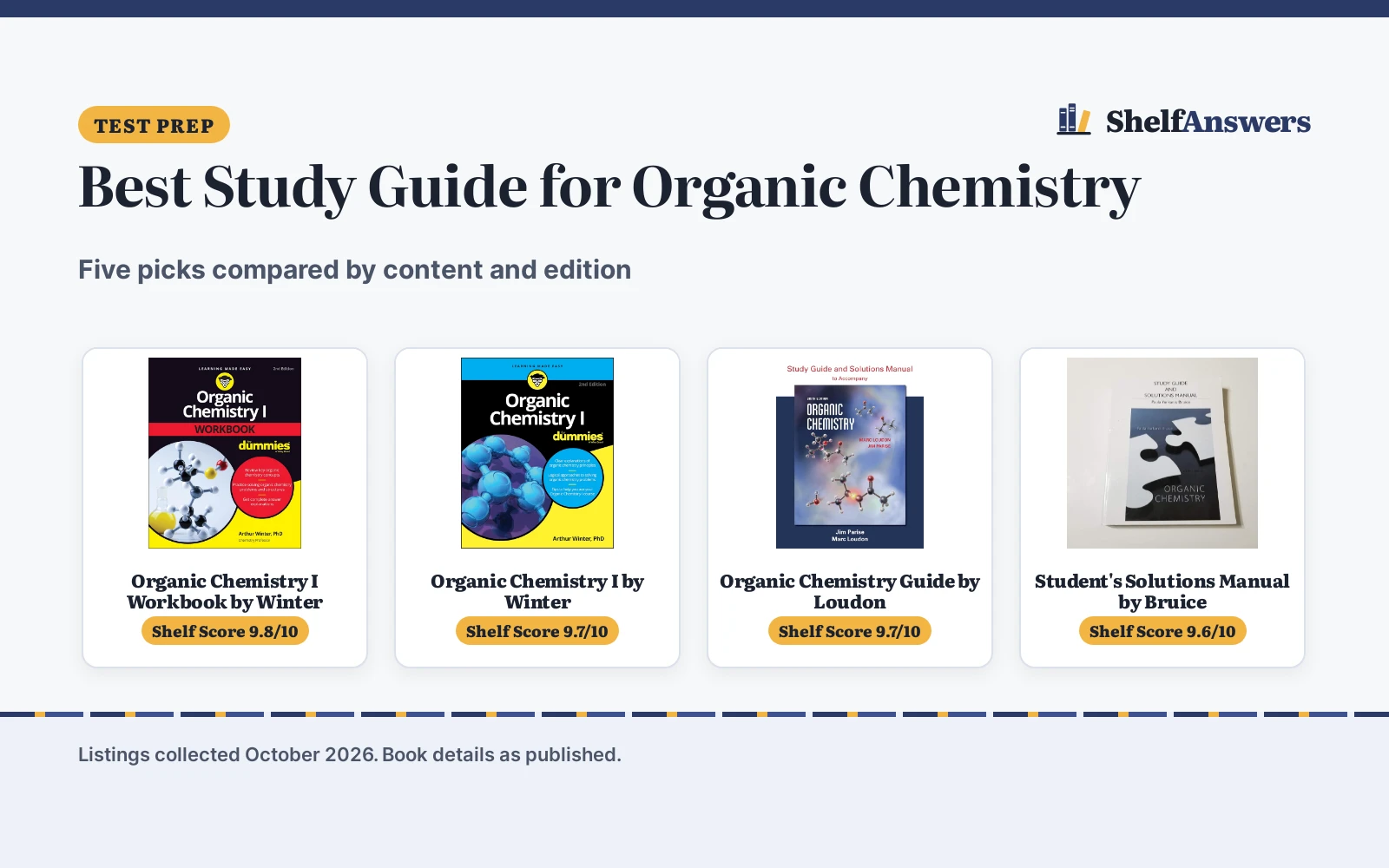
At a glance
Top picks
As an Amazon Associate I earn from qualifying purchases. How we score
For an undergraduate facing a demanding semester of reaction mechanisms, choosing the best study guide for organic chemistry comes down to matching the format to your study routine. We compared five published titles by print length, edition year, problem sets and whether they serve as primary review guides or companion solutions manuals. This guide helps you identify the right volume for your coursework and upcoming exams.
ShelfAnswers earns a commission when you buy through links on this page, at no extra cost to you. As an Amazon Associate I earn from qualifying purchases. Affiliate disclosure.
Quick picks
 Best Overall Organic Chemistry I Workbook by Winter: 400 pages of practice questions and worked solutions published in 2022. Check price on Amazon
 Best for Beginners Organic Chemistry I by Winter: Clear plain-English explanations and fully worked problems across 384 pages. Check price on Amazon
 Best for Problem Sets Organic Chemistry Guide by Loudon: Extensive 1080-page solutions manual with reaction mechanism summaries. Check price on Amazon
 Best Solutions Manual Student’s Solutions Manual by Bruice: Detailed 864-page study guide and solutions manual with practice problems. Check price on Amazon
 Best Quick Reference QuickStudy Fundamentals by Jackson: Six laminated pages with categorized tables and memory aids for fast review. Check price on Amazon
The picks
| # | Product | Shelf Score | Buy |
|---|---|---|---|
| 1 | Organic Chemistry I Workbook by Winter | 9.8/10 | Buy |
| 2 | Organic Chemistry I by Winter | 9.7/10 | Buy |
| 3 | Organic Chemistry Guide by Loudon | 9.7/10 | Buy |
| 4 | Student's Solutions Manual by Bruice | 9.6/10 | Buy |
| 5 | QuickStudy Fundamentals by Jackson | 9.5/10 | Buy |

Organic Chemistry I Workbook by Winter
This workbook suits college students who want targeted practice solving organic chemistry problems alongside their first semester lectures.
Pros
- The listing states it includes hundreds of exam questions with walk-through answers to show where you went right or wrong.
- The 400 pages cover core topics including functional groups, resonance, alkanes and stereochemistry.
- Published on January 26, 2022, making it the most recently published print workbook in our comparison.
Cons
- Covers only the first semester curriculum rather than a full two-semester organic chemistry sequence.
- The listing does not state a reading age or grade level.
- Focuses on practice problems and review rather than providing a comprehensive primary textbook.

Organic Chemistry I by Winter
This guide suits beginners seeking plain-English explanations of foundational organic chemistry concepts and worked example equations.
Pros
- The description states it provides plain-English explanations of basic principles, major compound classes and trouble spots.
- Includes 384 pages of fully worked-out organic chemistry problems and refreshed example equations according to the listing.
- Available in both print and Kindle formats as indicated in the listing details.
Cons
- The description notes that the 2016 2nd edition features a new cover design but shares the same content as the prior release.
- The listing does not state a reading age or grade level.
- Focuses strictly on first semester material rather than advanced second semester reactions.

Organic Chemistry Guide by Loudon
This reference suits students working through textbook problem sets who need comprehensive mechanism breakdowns and reaction summaries.
Pros
- The listing provides 1080 pages containing solutions to all textbook problems with detailed approaches.
- The description highlights reaction summaries that examine key mechanisms and stereochemistry in depth.
- Includes study links with problem-solving hints and further explorations for challenging topics as stated by the publisher.
Cons
- Published on July 1, 2015, so it reflects the Sixth edition rather than a more recent release.
- Designed primarily as a companion solutions manual to the authors' main textbook rather than a standalone primer.
- The listing does not state a reading age or grade level.

Student's Solutions Manual by Bruice
This volume suits chemistry students paired with the Bruice curriculum who want extensive practice problems and step-by-step solutions.
Pros
- The listing provides a substantial print length of 864 pages published by Pearson.
- The description states the volume was extensively revised and contains many more practice problems.
- Combines both a study guide and a complete student solutions manual in a single volume.
Cons
- Published on April 1, 2013 for the 7th edition, representing the oldest publication date among our picks.
- The listing offers only a brief one-sentence description without detailing specific chapter coverage.
- The listing does not state a reading age or grade level.

QuickStudy Fundamentals by Jackson
This laminated chart suits undergraduates who need a quick desktop reference for core functional groups and terminology during lectures.
Pros
- Features 6 laminated pages designed for quick reference, memory reinforcement and pre-exam review.
- Content is organized into categorized tables and lists prepared by an experienced chemistry professor.
- The 8.5 by 11 inch laminated format resists spills and fits easily into a notebook or binder.
Cons
- At only 6 pages, it functions as a reference companion rather than a comprehensive instructional text.
- Does not include full chapter explanations or step-by-step worked practice problem sets.
- The listing does not state a reading age or grade level.
As an Amazon Associate I earn from qualifying purchases.
More picks to compare
 QuickStudy Reactions by JacksonFor students needing a six-page laminated summary of key organic chemistry reactions.Check on Amazon
 ACS Study Guide by NewstoneFor test takers preparing for the ACS exam with review and full practice tests.Check on Amazon
 Beginners Guide by Louis-CharlesFor curious beginners who want an illustrated introduction to molecules and carbon.Check on Amazon
 ACS Study Cards by Test Prep BooksFor ACS exam candidates who prefer portable color-coded study cards for review.Check on Amazon
Compare the picks
| Book | Shelf Score | Author | Pages | Published | Amazon |
|---|---|---|---|---|---|
| Organic Chemistry I Workbook by Winter | 9.8/10 | Arthur Winter | 400 | 2022 | Check price |
| Organic Chemistry I by Winter | 9.7/10 | Arthur Winter | 384 | 2016 | Check price |
| Organic Chemistry Guide by Loudon | 9.7/10 | Marc Loudon, Jim Parise | 1080 | 2015 | Check price |
| Student’s Solutions Manual by Bruice | 9.6/10 | Paula Bruice | 864 | 2013 | |
| QuickStudy Fundamentals by Jackson | 9.5/10 | Mark Jackson PhD | 6 | 2015 | Check price |
Book details as published on each listing, collected 17 October 2026.
How we scored them
The Shelf Score weighs fit for the reader, contents and edition, value, and the listed reading age or level where one is given. None of the five picks in our main comparison states a reading age or grade level in its listing, reflecting that these are college-level and adult academic titles. How we pick explains the weights.
| Book | Shelf Score | Fit /35 | Contents /25 | Value /25 | Age/level /10 |
|---|---|---|---|---|---|
| Organic Chemistry I Workbook by Winter | 9.8 | 32 | 22 | 22 | n/a |
| Organic Chemistry I by Winter | 9.7 | 30 | 20 | 21 | n/a |
| Organic Chemistry Guide by Loudon | 9.7 | 29 | 21 | 20 | n/a |
| Student’s Solutions Manual by Bruice | 9.6 | 28 | 18 | 19 | n/a |
| QuickStudy Fundamentals by Jackson | 9.5 | 27 | 16 | 18 | n/a |
Scores run from 9.2 to 9.8: each book’s point total is placed on that range, so more points always means a higher score. Reading age or level counts on a list where at least one listing gives one, and a book whose listing gives none then scores zero on it. Where no listing gives one, the score is taken over the other 85 points. Books carry no warranty, so warranty is not scored.
How to choose the best study guide for organic chemistry
Decide between a worked problem workbook and a solutions manual
If you need independent practice, Organic Chemistry I Workbook by Winter offers 400 pages of questions with walk-through explanations for coursework and exams. In contrast, Organic Chemistry Guide by Loudon spans 1080 pages dedicated to solving textbook problems and unpacking reaction mechanisms. Students preparing for professional licensing tests can explore related certification exam prep resources.
Check the edition date and textbook alignment
Course syllabi frequently align problem sets with specific textbook editions. Student’s Solutions Manual by Bruice dates from 2013 for the 7th edition, while Organic Chemistry I by Winter was published in 2016 with identical content to its prior release. Always verify whether your professor requires a specific edition before purchasing study aids.
Consider a quick reference card alongside deeper texts
A concise reference like QuickStudy Fundamentals by Jackson provides six laminated pages of categorized tables and memory companions that fit directly into a notebook. While it cannot replace a full guide, keeping key functional groups visible speeds up homework sessions. Pre-health students balancing multiple science subjects may also consult our guide to the best study guide for anatomy and physiology.
Before you buy
- Check whether the listing is a standalone study guide, a practice workbook, or a companion solutions manual tailored to a specific textbook.
- Verify the publication date and edition number, noting that Organic Chemistry I by Winter shares content with its earlier release.
- Confirm the format: QuickStudy Fundamentals provides a six-page laminated chart rather than a bound book.
Frequently Asked Questions
Does the Organic Chemistry I Workbook include an answer key?
Yes. The description states it includes walk-through answers for hundreds of exam questions so you can identify where you went right or wrong.
What is the difference between the two Arthur Winter books?
Organic Chemistry I For Dummies offers 384 pages of conceptual explanations and worked examples, while the 400-page Organic Chemistry I Workbook focuses primarily on practice questions and problem-solving exercises.
Is the QuickStudy Fundamentals guide a full textbook?
No. The listing states it consists of 6 laminated pages organized into categorized tables and lists designed as a quick memory companion rather than a comprehensive text.
Related lists
See every licensing and certification list and all test prep lists.
More lists: explore our guides to the AP biology prep book, FE exam study guide, and HESI A2 study guide.