Best Self Help Books for Kids (2026): 5 Picks Compared
Five books for kids and teens compared by listed reading age, grade level and page count, from everyday life skills to impulse control for ages 6 to 9.

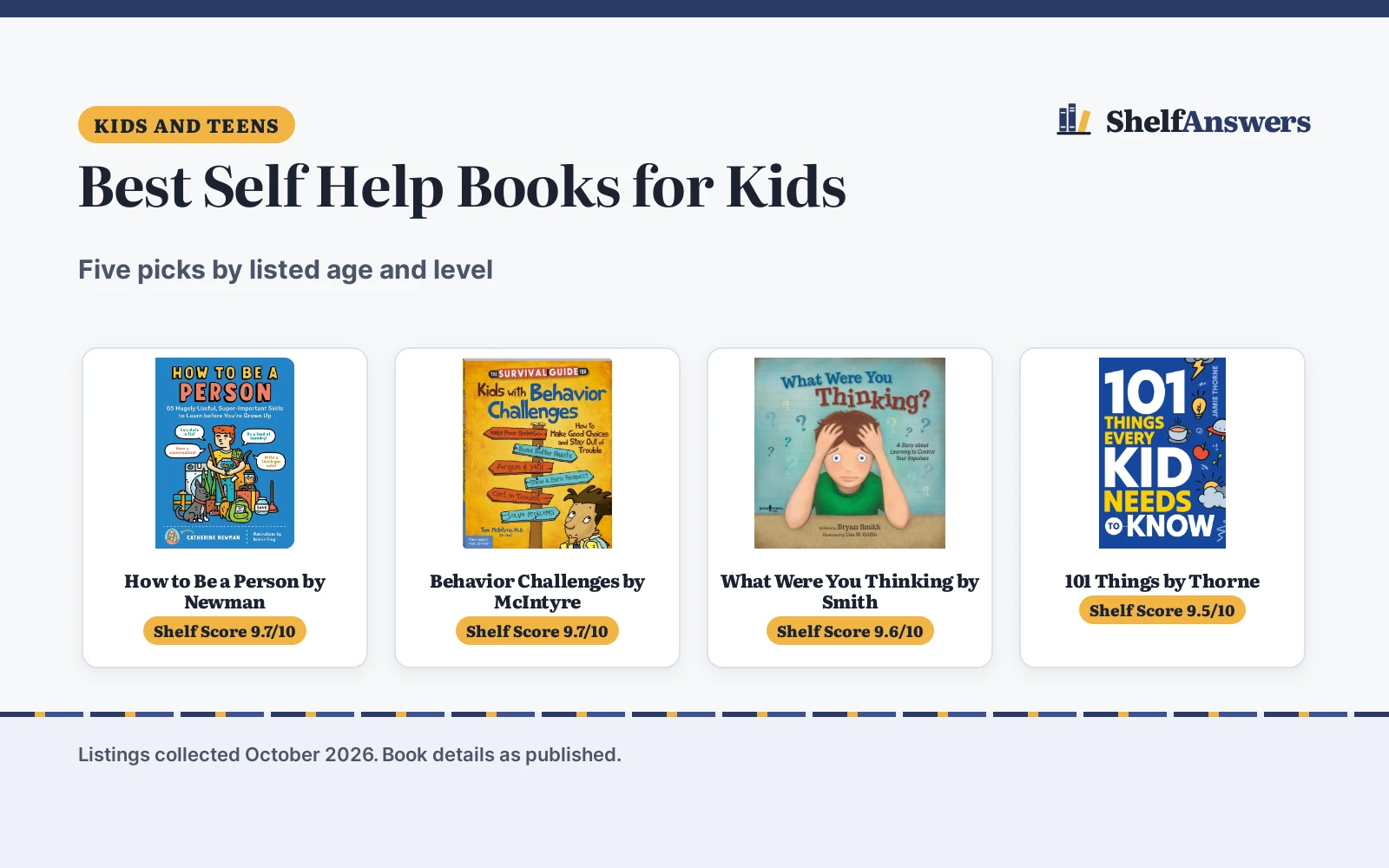
At a glance
Top picks
As an Amazon Associate I earn from qualifying purchases. How we score
A parent looking for the best self help books for kids usually has one moment in mind: a child who acts before thinking, a pre-teen who needs everyday responsibility, or a parent who wants better words at home. We compared five picks by listed reading age, grade level, page count and who each description says it suits.
ShelfAnswers earns a commission when you buy through links on this page, at no extra cost to you. As an Amazon Associate I earn from qualifying purchases. Affiliate disclosure.
Quick picks
 Best Overall How to Be a Person by Newman: Everyday responsibility skills, illustrated, with a stated grade level Check price on Amazon
 Best for Behavior Challenges Behavior Challenges by McIntyre: Quiz, glossary and strategies for choices, friends and school behavior Check price on Amazon
 Best for Impulse Control What Were You Thinking by Smith: A 31 page storybook with four steps to pause before acting Check price on Amazon
 Best Life Skills Overview 101 Things by Thorne: Short topics from making friends to protecting your skin, in one volume Check price on Amazon
 Best for Parents How to Talk by Faber: A parenting guide for talking with a child, not written for the child Check price on Amazon
The picks
| # | Product | Shelf Score | Buy |
|---|---|---|---|
| 1 | How to Be a Person by Newman | 9.7/10 | Buy |
| 2 | Behavior Challenges by McIntyre | 9.7/10 | Buy |
| 3 | What Were You Thinking by Smith | 9.6/10 | Buy |
| 4 | 101 Things by Thorne | 9.5/10 | Buy |
| 5 | How to Talk by Faber | 9.3/10 | Buy |

How to Be a Person by Newman
The description says it teaches everyday responsibility, from cleaning a room to caring for pets, in illustrated pages.
Pros
- Illustrated in a graphic novel style, which the description says runs through the book
- Covers cleaning, pet care, simple cooking and helping outside the house
- Grade level 5 to 9 and a reading age of 9+ years, marked as from customers, so the level is easy to check
Cons
- Reading age is marked as from customers, not stated by the publisher
- Covers 65 skills in one 160 page book, so each gets a short treatment
- Grade level 5 to 9 is a wide band, so it may not suit a much younger reader

Behavior Challenges by McIntyre
For a child who needs help making better choices, keeping friends and getting along at school.
Pros
- Covers making good choices, keeping friends and taking responsibility, the topics the description names
- The revised edition adds an 'Are you ready to change?' quiz, an updated glossary and resources
- Straightforward tone with realistic examples and bright illustrations, according to the description
Cons
- Reading age is marked as from customers, and grade 4 to 9 runs wider than the 6 to 10 reading age
- Published August 8, 2013 as a second edition, so check the listing for a newer edition
- A special section at the back addresses diagnosed behavior disorders, which a parent may want to read first

What Were You Thinking by Smith
For a 6 to 9 year old who acts before thinking, with a story and four steps to pause and choose.
Pros
- A story with an impulsive third grader, so a child can see the problem in a character
- Four steps for stopping, thinking and choosing, plus tips for parents and educators at the end
- The listing states it won a Counselor's Choice Award, and the author is a school counselor
Cons
- Only 31 pages, so the story is a short read
- Book 1 of 10 in a series, so buy Book 1 first and check the listing for the rest
- Grade level Kindergarten to 5 is a wide band, so it does not pin down difficulty for one child

101 Things by Thorne
For a child who wants a broad, bite-sized overview of everyday skills, from making friends to managing time.
Pros
- Covers a wide range of topics, from making friends to managing time and coping with failure
- Short, bite-sized chunks with fun illustrations, according to the description
- One 136 page volume, so a single purchase covers every topic
Cons
- Reading age is marked as from customers, and no grade level is stated
- Each topic gets a short treatment, so it works as an overview rather than a lesson on one skill
- Includes safety topics such as identifying poisonous plants, which a parent may want to go over together

How to Talk by Faber
A parenting guide for adults who want to talk with a child about feelings, limits and self-discipline.
Pros
- Covers coping with a child's negative feelings and setting firm limits, per the description
- Includes alternatives to punishment and ways to tell helpful praise from unhelpful praise
- Updated edition published February 7, 2012 by Scribner, with 384 pages
Cons
- Written for parents, so a child will not use it alone
- Reading age and grade level are Not stated, so fit depends on the reader's needs
- At 384 pages it is a long read for a parent who wants a quick answer
As an Amazon Associate I earn from qualifying purchases.
More picks to compare
 Hands Are Not for Hitting by AgassiFor toddlers ages 1 to 4, a board book on safe alternatives to hitting.Check on Amazon
 What Can I Say? by NewmanFor kids 10 and up who want scripts for talking through hard situations.Check on Amazon
 Worry Too Much by HuebnerFor kids ages 6 to 12 who worry often, with exercises inside.Check on Amazon
 What Can I Say? Teens by SquadFor teens 13 to 17 who want practice speaking up in a 30-day plan.Check on Amazon
 Temper Flares by HuebnerFor kids ages 6 to 12 who have frequent outbursts, with exercises inside.Check on Amazon
Compare the picks
| Book | Shelf Score | Author | Pages | Reading age or grade | Amazon |
|---|---|---|---|---|---|
| How to Be a Person by Newman | 9.7/10 | Catherine Newman | 160 | 9+ (marked as from customers), grade 5 to 9 | Check price |
| Behavior Challenges by McIntyre | 9.7/10 | Thomas McIntyre | 192 | 6 to 10 (marked as from customers), grade 4 to 9 | Check price |
| What Were You Thinking by Smith | 9.6/10 | Bryan Smith | 31 | 6 to 9 (marked as from customers), grade Kindergarten to 5 | Check price |
| 101 Things by Thorne | 9.5/10 | Jamie Thorne | 136 | 7 to 10 (marked as from customers), grade Not stated | Check price |
| How to Talk by Faber | 9.3/10 | Adele Faber, Elaine Mazlish | 384 | Not stated | Check price |
Book details as published on each listing, collected 17 October 2026.
How we scored them
The Shelf Score weighs fit for the reader, contents and edition, value, and the listed reading age or grade level. Four of the five picks list a reading age or grade level, and How to Talk lists neither, as a parenting book. How we pick explains the weights.
| Book | Shelf Score | Fit /35 | Contents /25 | Value /25 | Age/level /10 |
|---|---|---|---|---|---|
| How to Be a Person by Newman | 9.7 | 30 | 21 | 20 | 9 |
| Behavior Challenges by McIntyre | 9.7 | 29 | 21 | 20 | 9 |
| What Were You Thinking by Smith | 9.6 | 32 | 18 | 19 | 9 |
| 101 Things by Thorne | 9.5 | 26 | 19 | 18 | 7 |
| How to Talk by Faber | 9.3 | 21 | 19 | 18 | 0 |
Scores run from 9.2 to 9.8: each book’s point total is placed on that range, so more points always means a higher score. Reading age or level counts on a list where at least one listing gives one, and a book whose listing gives none then scores zero on it. Where no listing gives one, the score is taken over the other 85 points. Books carry no warranty, so warranty is not scored.
How to choose the best self help books for kids
Start with the listed age
What Were You Thinking lists ages 6 to 9, while How to Be a Person lists a reading age of 9+, marked as from customers. Match the listed age to the child first, then check the description for the topic.
Read the level and the age together
When the reading age and grade level agree, as with How to Be a Person, the level is easier to trust. For more choices by grade band, see middle grade books, and browse self development books for kids for more titles.
Before you buy
- Check the book number: What Were You Thinking is Book 1 of 10, so buy Book 1 first.
- Check the reading age against your child, since several listings mark it as from customers.
- Check the page count: 101 Things lists 136 pages and How to Talk lists 384 pages.
Frequently Asked Questions
Where should a child start?
Start with the title whose listed age matches the child, such as What Were You Thinking for ages 6 to 9.
Is How to Be a Person right for a 10 year old?
The listing gives grade level 5 to 9 and a reading age of 9+, marked as from customers, so it fits a 10 year old on paper.
Does any listing include an answer key?
None of these listings states an answer key, so it is Not stated for each pick.
Related lists
See every Self-Improvement list and all Nonfiction lists.
More lists: self help books for teens, self improvement books for kids and self help books for girls.