Best Self Help Books for Chronic Illness (2026)
Four books for chronic illness compared by page count, evidence-based coping tools, and caregiver advice, from mindfulness exercises to pain psychology.

At a glance
Top picks
As an Amazon Associate I earn from qualifying purchases. How we score
When daily fatigue, pain, or unpredictable symptoms disrupt your routine, finding the best self help books for chronic illness helps you regain control and build lasting resilience. This guide is for individuals living with ongoing conditions as well as the partners and caregivers supporting them. We compared each listing by page count, publication date, evidence-based coping models, and whether practical caregiver guidance is included.
ShelfAnswers earns a commission when you buy through links on this page, at no extra cost to you. As an Amazon Associate I earn from qualifying purchases. Affiliate disclosure.
Quick picks
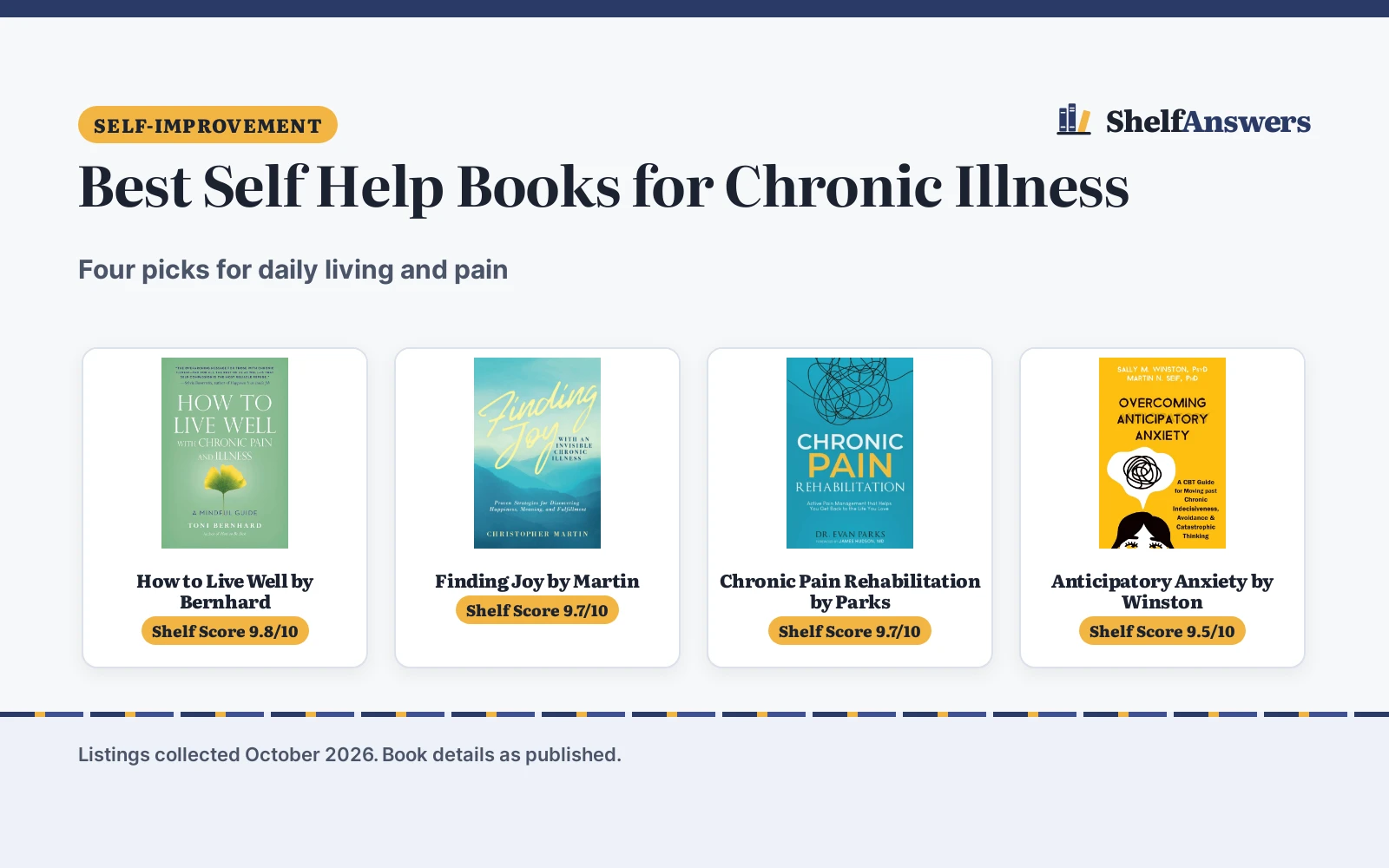
 Best Overall How to Live Well by Bernhard: Mindful guidance, daily coping tools, and caregiver advice in 352 pages Check price on Amazon
 Best for Invisible Illness Finding Joy by Martin: Psychologist-led advice on resilience and navigating healthcare in 198 pages Check price on Amazon
 Best for Chronic Pain Chronic Pain Rehabilitation by Parks: Neuroscience-based pain management and flare-up strategies in 232 pages Check price on Amazon
 Best for Health Anxiety Anticipatory Anxiety by Winston: CBT-based DANCE framework for catastrophic thinking and avoidance in 184 pages Check price on Amazon
The picks
| # | Product | Shelf Score | Buy |
|---|---|---|---|
| 1 | How to Live Well by Bernhard | 9.8/10 | Buy |
| 2 | Finding Joy by Martin | 9.7/10 | Buy |
| 3 | Chronic Pain Rehabilitation by Parks | 9.7/10 | Buy |
| 4 | Anticipatory Anxiety by Winston | 9.5/10 | Buy |

How to Live Well by Bernhard
Toni Bernhard draws on mindfulness and personal experience to help readers navigate physical limitations, medical appointments, and relationship changes.
Pros
- The description highlights practical mindfulness exercises to help mitigate physical and emotional pain.
- Provides guidance for daily hurdles like household chores, medical visits, and changing personal identity.
- Includes dedicated chapters for family and friends to help them understand their loved one's condition.
Cons
- The listing states a 2015 publication date, making it the oldest release among the picks.
- No reading age or grade level is stated on the listing.
- At 352 pages, it is the longest volume on the list and requires sustained reading energy.

Finding Joy by Martin
Written by a school psychologist living with chronic illness, this guide blends self-compassion, healthcare navigation, and resilience strategies.
Pros
- The listing states it won a 2022 Readers' Favorite Medal.
- Covers healthcare navigation alongside emotional coping and includes a dedicated chapter for caregivers.
- Print length of 198 pages makes it an accessible read for readers experiencing fatigue.
Cons
- No reading age or grade level is stated on the listing.
- The publisher is not stated in the listing details.
- Includes reflections on faith, which may not appeal to readers seeking a purely secular text.
Chronic Pain Rehabilitation by Parks
Dr. Evan Parks outlines an active pain management approach based on neuroscience and pain psychology to help readers manage flare-ups and stress.
Pros
- The description notes the author brings 32 years of experience in pain rehabilitation.
- Focuses on neuroscience and pain psychology tools to manage stress, sleep, and pain flare-ups.
- Features illustrated teachings and detailed case studies throughout its 232 pages.
Cons
- No reading age or grade level is stated on the listing.
- The publisher is not stated on the listing.
- Concentrates primarily on chronic pain rather than non-pain systemic chronic conditions.

Anticipatory Anxiety by Winston
Two psychologists present the DANCE cognitive behavioral framework to manage catastrophic thinking, chronic indecisiveness, and avoidance.
Pros
- The description outlines a clear five-step DANCE model grounded in cognitive behavioral therapy.
- Targeted print length of 184 pages offers concise strategies for decision paralysis and fear.
- Published by New Harbinger Publications with a 2022 first edition date.
Cons
- Focuses on anxiety, indecisiveness, and avoidance rather than physical chronic illness symptoms.
- No reading age or grade level is stated on the listing.
- Does not include caregiver advice or healthcare navigation tools.
As an Amazon Associate I earn from qualifying purchases.
More picks to compare
 Finding a New Normal by JacksonFor readers seeking practical advice on adapting to daily life with chronic illness.Check on Amazon
 Healing Your Grief by WolfeltFor anyone seeking practical ideas to acknowledge and process grief from chronic illness.Check on Amazon
 Being Well by Hill & PeateFor individuals looking to build resilience and navigate challenges after a chronic diagnosis.Check on Amazon
 Nervous System Reset by LutzFor readers managing chronic stress and pain through structured nervous system protocols.Check on Amazon
 Thriving in a Relationship by GrayFor couples navigating the emotional and relationship challenges brought by chronic illness.Check on Amazon
Compare the picks
| Book | Shelf Score | Author | Pages | Published | Amazon |
|---|---|---|---|---|---|
| How to Live Well by Bernhard | 9.8/10 | Toni Bernhard | 352 | 2015 | Check price |
| Finding Joy by Martin | 9.7/10 | Christopher Martin | 198 | 2021 | Check price |
| Chronic Pain Rehabilitation by Parks | 9.7/10 | Evan Parks | 232 | 2020 | Check price |
| Anticipatory Anxiety by Winston | 9.5/10 | Sally M. Winston PsyD, Martin N. Seif PhD | 184 | 2022 | Check price |
Book details as published on each listing, collected 16 October 2026.
How we scored them
The Shelf Score weighs fit for a reader living with a persistent condition, contents and edition, value, and the listed reading age or level where one is given. None of the four listings states a reading age or grade level, which is typical for adult health and psychology titles. We evaluated the clarity of each book’s coping framework, practical daily living strategies, and whether the author addresses caregivers alongside the reader. How we pick explains the weights.
| Book | Shelf Score | Fit /35 | Contents /25 | Value /25 | Age/level /10 |
|---|---|---|---|---|---|
| How to Live Well by Bernhard | 9.8 | 33 | 21 | 22 | n/a |
| Finding Joy by Martin | 9.7 | 32 | 21 | 21 | n/a |
| Chronic Pain Rehabilitation by Parks | 9.7 | 30 | 21 | 20 | n/a |
| Anticipatory Anxiety by Winston | 9.5 | 24 | 20 | 19 | n/a |
Scores run from 9.2 to 9.8: each book’s point total is placed on that range, so more points always means a higher score. Reading age or level counts on a list where at least one listing gives one, and a book whose listing gives none then scores zero on it. Where no listing gives one, the score is taken over the other 85 points. Books carry no warranty, so warranty is not scored.
How to choose the best self help books for chronic illness
Match the framework to your primary symptom
Chronic illness often involves physical discomfort, emotional fatigue, and fear of future flare-ups. If pain dominates your days, Chronic Pain Rehabilitation by Parks focuses specifically on neuroscience-based retraining for central nervous system responses. Readers whose primary hurdle is fear and decision paralysis may benefit more from the CBT techniques in Anticipatory Anxiety by Winston.
Consider reading length and energy demands
Living with chronic illness means energy fluctuates from day to day, making page count an important practical factor. A comprehensive volume like How to Live Well by Bernhard spans 352 pages and provides thorough mindfulness exercises, but it demands more sustained reading time. Finding Joy by Martin covers healthcare navigation and emotional coping across 198 pages, offering a more compact format for readers managing severe fatigue. For broader personal growth resources, browse our recommended self-improvement books.
Look for caregiver and relationship support
Long-term health challenges place significant demands on families, partners, and daily communication. Both How to Live Well by Bernhard and Finding Joy by Martin include dedicated chapters specifically designed for friends, family members, and caregivers. If emotional exhaustion at work or home is compounding your physical symptoms, you might also explore self help books for burnout to address systemic fatigue.
Before you buy
- Check the publication date on the listing: Toni Bernhard’s guide was published in 2015, while Christopher Martin’s book was released in 2021 and Sally M. Winston’s volume in 2022.
- Review the page count against your current reading stamina, ranging from 184 pages for Sally M. Winston’s work to 352 pages for Toni Bernhard’s mindfulness manual.
- Confirm whether the book focuses on physical pain management like Evan Parks’s title or on anxiety and catastrophic thinking like Sally M. Winston’s guide.
Frequently Asked Questions
Which book is best for chronic illness caregivers and family members?
Both How to Live Well with Chronic Pain and Illness by Toni Bernhard and Finding Joy with an Invisible Chronic Illness by Christopher Martin include dedicated chapters written specifically for family, friends, and caregivers.
How long are these self help books for chronic illness?
The books range in print length from 184 pages for Overcoming Anticipatory Anxiety to 352 pages for How to Live Well with Chronic Pain and Illness, with the other titles at 198 and 232 pages.
Do any of these books address chronic pain specifically?
Chronic Pain Rehabilitation by Evan Parks focuses directly on neuroscience and pain psychology across 232 pages, while Toni Bernhard’s 352-page guide offers mindfulness exercises to help manage physical discomfort.
Related lists
See every self-improvement list and all nonfiction lists.
More lists: browse books for beginners, building confidence, and workbooks for self-improvement.