Best Science Books for Kids Who Love Experiments (2026): 5 Picks
5 picks for young experimenters, compared by experiments, guidance, page counts and listed reading ages and grade levels, from family experiments to edible science.

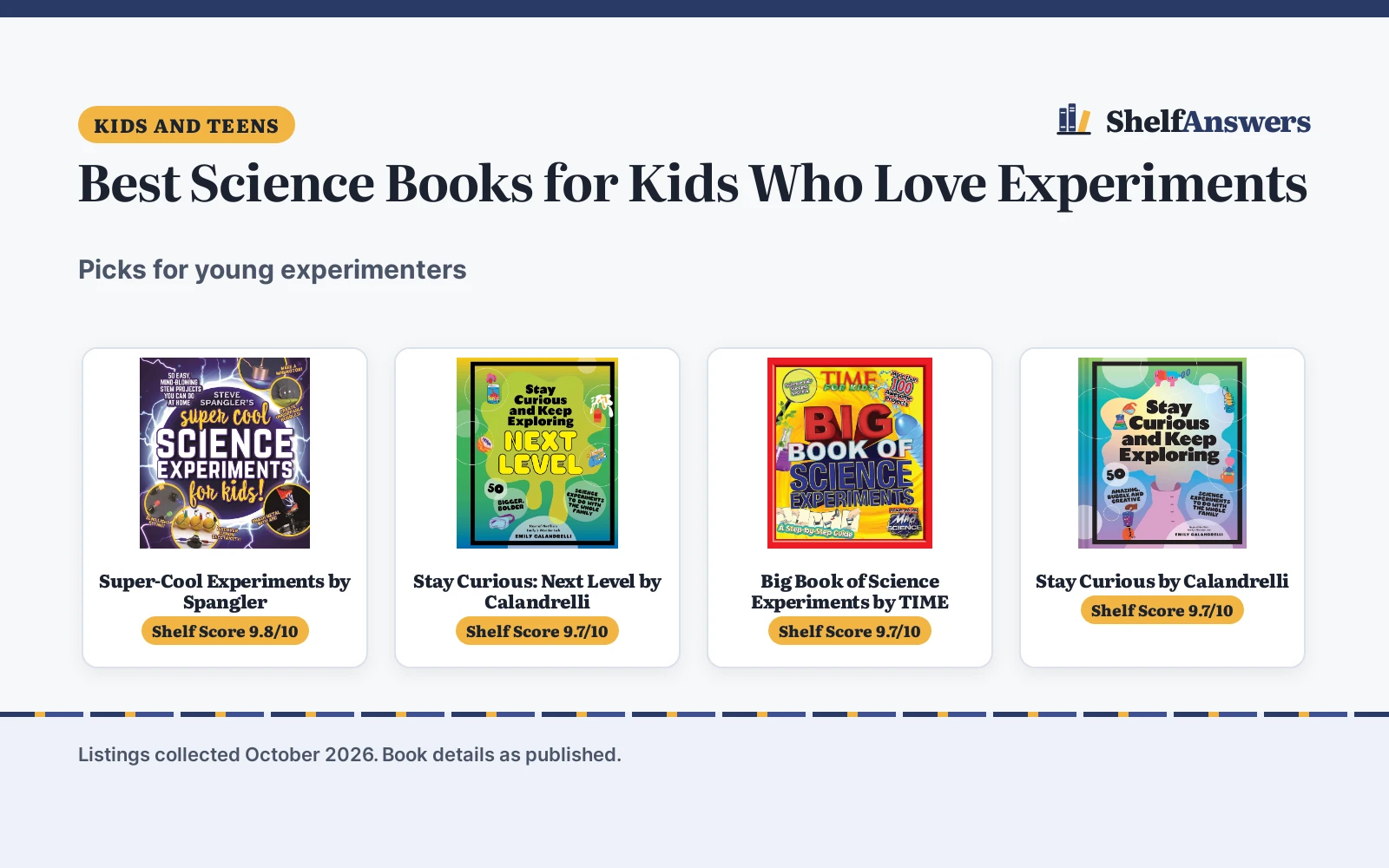
At a glance
Top picks
As an Amazon Associate I earn from qualifying purchases.
Choosing the best science books for kids who love experiments starts with a child who wants to mix and build. This list compares books for young experimenters by experiments, guidance, page count and listed reading age and grade level.
ShelfAnswers earns a commission when you buy through links on this page, at no extra cost to you. As an Amazon Associate I earn from qualifying purchases. Affiliate disclosure.
Quick picks
 Best Overall Super-Cool Experiments by Spangler: 50 experiments with step-by-step instructions and photos Check price on Amazon
 Best Follow-Up Stay Curious: Next Level by Calandrelli: 50 experiments with facts and science biographies Check price on Amazon
 Best Big Collection Big Book of Science Experiments by TIME: 100 experiments covering physical, life and earth science Check price on Amazon
 Best for Families Stay Curious by Calandrelli: 50 experiments for the whole family, with prompts Check price on Amazon
 Best Edible Experiments Science Cookbook by Highlights: Over 75 edible experiments Check price on Amazon
The picks

Super-Cool Experiments by Spangler
For a child who loves experiments at home, less suited to a reader wanting edible experiments alone.
Pros
- 50 experiments with step-by-step instructions
- Full color photos for projects
- Projects from simple to advanced
Cons
- Suits older children, not younger readers
- Some projects need household materials
- Grade level 3 - 4 only

Stay Curious: Next Level by Calandrelli
For a child ready for bigger experiments after Stay Curious, less suited to a reader new to the series.
Pros
- 50 bigger experiments for readers
- Science and technology biographies
- 176 pages covering STEAM concepts
Cons
- Reading age marked as from customers
- Suits readers who know the series
- Grade level broad, Kindergarten and up

Big Book of Science Experiments by TIME
For a child who loves varied experiments, less suited to a reader wanting edible experiments alone.
Pros
- 100 experiments for kids 8 to 12
- Covers physical, life and earth science
- Step-by-step directions with background facts
Cons
- Description says 8 to 12, listing 7 - 11 years
- Published December 6, 2011, an older edition
- Grade level broad, 3 and up

Stay Curious by Calandrelli
For a whole family starting science experiments together, less suited to a child wanting edible experiments alone.
Pros
- 50 experiments for the whole family
- Prompts for thinking like a scientist
- 168 pages with illustrations throughout
Cons
- Reading age marked as from customers
- Grade level is not stated
- Experiments need grocery items

Science Cookbook by Highlights
For a young chef who loves food and science, less suited to a reader wanting non-food experiments alone.
Pros
- Over 75 edible experiments
- Science connections to each recipe
- 160 pages with food photographs
Cons
- Reading age marked as from customers
- Suits food experiments only
- Grade level 2 - 3 only
As an Amazon Associate I earn from qualifying purchases.
More picks to compare
 Science Experiments by Gold StarsFor young learners, with fun projects using kitchen and household itemsCheck on Amazon
 Science Experiments by FuntimeFor children learning science with visual steps and everyday itemsCheck on Amazon
 Try This!For the mad scientist in you, with fun experimentsCheck on Amazon
Compare the picks
| Book | Shelf Score | Author | Pages | Amazon |
|---|---|---|---|---|
| Super-Cool Experiments by Spangler | 9.8/10 | Steve Spangler | 176 | View on Amazon |
| Stay Curious: Next Level by Calandrelli | 9.7/10 | Emily Calandrelli | 176 | View on Amazon |
| Big Book of Science Experiments by TIME | 9.7/10 | The Editors of TIME for Kids | 192 | View on Amazon |
| Stay Curious by Calandrelli | 9.7/10 | Emily Calandrelli | 168 | View on Amazon |
| Science Cookbook by Highlights | 9.7/10 | Highlights | 160 | View on Amazon |
Book details as published on each listing, collected 24 October 2026.
How we scored them
The Shelf Score weighs fit for the reader, contents and edition, value, and the listed reading age or level where given. 5 of the picks list a reading age, and 4 list a grade level. How we pick explains the weights.
| Book | Shelf Score | Fit /35 | Contents /25 | Value /25 | Age/level /10 |
|---|---|---|---|---|---|
| Super-Cool Experiments by Spangler | 9.8 | 32 | 21 | 21 | 9 |
| Stay Curious: Next Level by Calandrelli | 9.7 | 30 | 22 | 20 | 9 |
| Big Book of Science Experiments by TIME | 9.7 | 29 | 22 | 20 | 9 |
| Stay Curious by Calandrelli | 9.7 | 32 | 21 | 20 | 7 |
| Science Cookbook by Highlights | 9.7 | 28 | 21 | 20 | 9 |
Scores run from 9.2 to 9.8: each book’s point total is placed on that range, so more points always means a higher score. Reading age or level counts on a list where at least one listing gives one, and a book whose listing gives none then scores zero on it. Where no listing gives one, the score is taken over the other 85 points. Books carry no warranty, so warranty is not scored.
How to choose the best science books for kids who love experiments
Match reading age and grade to the reader
Steve Spangler’s book lists grade level 3 – 4 and a reading age of 8 – 12 years, while the cookbook lists grade level 2 – 3 and a reading age of 6 – 10 years, marked as from customers. Check both figures against the reader. For more science reading, see Best Science Encyclopedia for Kids.
Choose experiments that fit the reader
The cookbook lists over 75 edible experiments, while Steve Spangler’s book lists 50 experiments using materials found at home. Calandrelli’s first book lists grocery items, so check what each book needs. For structured practice, see Best Science Workbook.
Check page count and edition before buying
Big Book lists 192 pages, Next Level lists 176 pages, and the cookbook lists 160 pages. Big Book was published December 6, 2011, while the cookbook was published February 25, 2025, so confirm the edition.
Before you buy
- Check the publication date and edition on the listing.
- For a series, read Stay Curious before Next Level.
- Compare the listed reading age and grade level with the reader.
Frequently Asked Questions
Where should a child start with Stay Curious?
Start with Stay Curious and Keep Exploring, the book Next Level follows.
What reading age do these books list?
Spangler lists 8 – 12 years, the cookbook lists 6 – 10 years, marked as from customers, and Big Book lists 7 – 11 years, marked as from customers.
Which book is about edible experiments?
The cookbook lists over 75 edible experiments, with science connections to each recipe.
Related lists
See every Kids and Teens list.
More lists: Best Science Encyclopedia for Kids, Best Science Workbook, Best Lego Books for Kids Who Love Building.