Best Math Book for Kids Who Hate Math (2026): 5 Picks
Five books for kids who hate math, compared by reading age and grade level: bedtime riddles, a math-anxiety picture book and a middle-school survival guide.

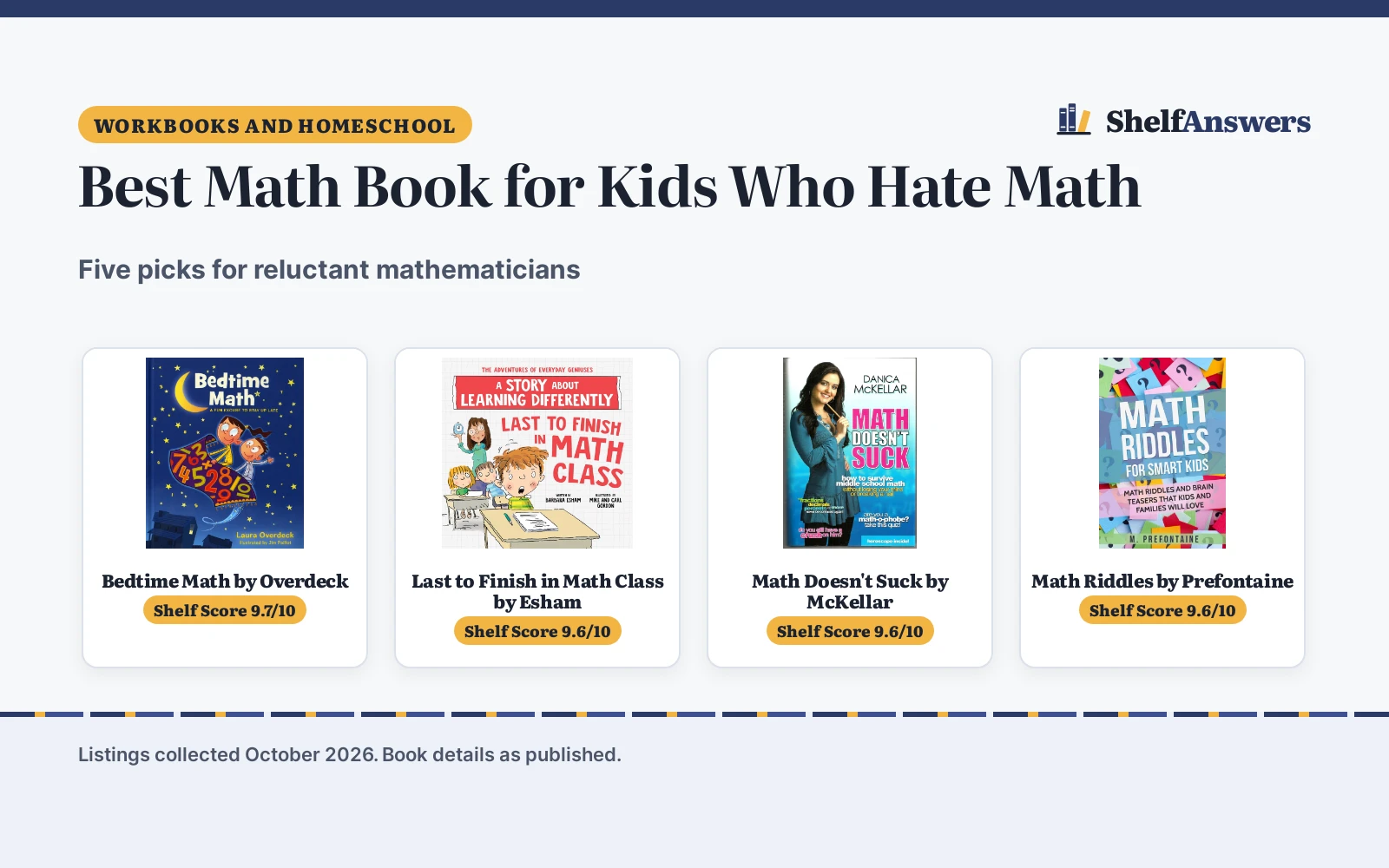
At a glance
Top picks
As an Amazon Associate I earn from qualifying purchases.
When a child has decided math is the enemy, another worksheet will not change their mind, and the best math book for kids who hate math meets them where they are, with riddles, stories and jokes instead of drills. We compared books by listed reading age, grade level, print length, series position and what each description says, so you can match the book to the child in front of you.
ShelfAnswers earns a commission when you buy through links on this page, at no extra cost to you. As an Amazon Associate I earn from qualifying purchases. Affiliate disclosure.
Quick picks
 Best Overall Bedtime Math by Overdeck: Over 100 riddles at 3 challenge levels for the whole family Check price on Amazon
 Best for Math Anxiety Last to Finish in Math Class by Esham: Picture book about timed-test stress for ages 4 to 8 Check price on Amazon
 Best for Middle School Math Doesn’t Suck by McKellar: Step-by-step guide to fractions and pre-algebra, grades 4 to 6 Check price on Amazon
 Riddle Night Pick Math Riddles by Prefontaine: Family brain teasers for a kid who likes puzzles Check price on Amazon
 Mystery Story Pick The Math Inspectors by Kenney: A math mystery adventure for kids who love stories Check price on Amazon
The picks
| # | Product | Shelf Score | Buy |
|---|---|---|---|
| 1 | Bedtime Math by Overdeck | 9.7/10 | Buy on Amazon |
| 2 | Last to Finish in Math Class by Esham | 9.6/10 | Buy on Amazon |
| 3 | Math Doesn't Suck by McKellar | 9.6/10 | Buy on Amazon |
| 4 | Math Riddles by Prefontaine | 9.6/10 | Buy on Amazon |
| 5 | The Math Inspectors by Kenney | 9.6/10 | Buy on Amazon |

Bedtime Math by Overdeck
Over 100 bedtime riddles at three challenge levels, built to make math feel nothing like school.
Pros
- Over 100 math riddles, from roller coasters to flamingos, per the description
- Three challenge levels (wee ones, little kids and big kids) span a wide age range
- Book 1 of 3, so a hooked reader has two more books to try
Cons
- Reading age is marked as from customers rather than stated by the publisher
- The 2013 edition is the oldest full-data listing here
- Riddle-a-night format suits families doing math together more than solo study

Last to Finish in Math Class by Esham
A picture book about a boy who freezes on timed math tests but secretly loves solving hard problems.
Pros
- Built around math anxiety and timed-test stress, the exact theme of this list
- Reading age of 4 - 8 years and grade level Preschool - 3 agree with each other
- May 27, 2024 publication date, the most recent listing here
Cons
- At 32 pages it is one short sitting, not a book to grow with
- Picture-book format will not hold an older kid who resists math
- No series stated, so there is no follow-up book to move to

Math Doesn't Suck by McKellar
A friendly guide that walks middle schoolers through fractions, percentages and pre-algebra with real-world examples.
Pros
- Step-by-step instruction on fractions, percentages and pre-algebra, per the description
- 320 pages with quizzes, examples and stories, the longest book here
- Grade level 4 - 6 and reading age 10 - 13 years are both stated and in line
Cons
- 2007 First Edition is the oldest listing on this page
- Reading age is marked as from customers
- Aimed at middle schoolers, so it misses younger kids who hate math

Math Riddles by Prefontaine
A 70-page collection of 150 math riddles and logic puzzles arranged in three progressive difficulty levels with answers at the back.
Pros
- Contains 150 brain-teasing math riddles designed to test lateral thinking and pattern recognition
- Organized into three chapters that increase in difficulty as the reader progresses
- Includes an answer key section at the back of the book
- Second volume in an 8-book Thinking Books for Kids series
Cons
- Short print length of 70 pages compared to comprehensive workbooks
- Published August 22, 2017, making it the oldest release in this comparison
- No grade level is stated on the listing
- Contradiction between the description recommending age 10 onwards and the customer-listed reading age of 8 to 11 years

The Math Inspectors by Kenney
Book 1 of 6 in a mystery series for readers who like puzzles with a bit of math, for ages 9 and up.
Pros
- Book 1 of 6 gives a clear starting point in the series
- Mystery and math sit in the same plot, which suits a child who likes numbers
- At 140 pages, it is a short read for a reader who tires of long books
Cons
- Independently published, so the listing names no established publisher
- The description says age 9 and up, while the reading age is 8 to 10 from customers
- The description also lists journals and a comic book kit, so check you are buying the novel
As an Amazon Associate I earn from qualifying purchases.
More picks to compare
 Dear Math by StrongFor parents and teachers who want to understand why kids resist math.Check on Amazon
Compare the picks
| Book | Shelf Score | Author | Pages | Reading age or grade | Series | Amazon |
|---|---|---|---|---|---|---|
| Bedtime Math by Overdeck | 9.7/10 | Laura Overdeck | 96 | 4 – 7 (from customers) / Preschool and up | Book 1 of 3 | View on Amazon |
| Last to Finish in Math Class by Esham | 9.6/10 | Barbara Esham | 32 | 4 – 8 / Preschool – 3 | Standalone | View on Amazon |
| Math Doesn’t Suck by McKellar | 9.6/10 | Danica McKellar | 320 | 10 – 13 (from customers) / 4 – 6 | Standalone | |
| Math Riddles by Prefontaine | 9.6/10 | M Prefontaine | Not stated | Not stated | Not stated | View on Amazon |
| The Math Inspectors by Kenney | 9.6/10 | Daniel Kenney | Not stated | Not stated | Not stated | View on Amazon |
Book details as published on each listing, collected 23 October 2026.
How we scored them
The Shelf Score weighs fit for a kid who hates math, contents and edition, value, and the listed reading age or grade level. Three of the five listings give both a reading age and a grade level, and the two title-only listings state neither. How we pick explains the weights.
| Book | Shelf Score | Fit /35 | Contents /25 | Value /25 | Age/level /10 |
|---|---|---|---|---|---|
| Bedtime Math by Overdeck | 9.7 | 32 | 21 | 20 | 9 |
| Last to Finish in Math Class by Esham | 9.6 | 30 | 19 | 18 | 9 |
| Math Doesn’t Suck by McKellar | 9.6 | 28 | 20 | 19 | 9 |
Scores run from 9.2 to 9.8: each book’s point total is placed on that range, so more points always means a higher score. Reading age or level counts on a list where at least one listing gives one, and a book whose listing gives none then scores zero on it. Where no listing gives one, the score is taken over the other 85 points. Books carry no warranty, so warranty is not scored.
How to choose the best math book for kids who hate math
Match the age on the listing to the child
A riddle book listed for ages 4 to 7 will bore a middle schooler, and a 320 page guide will sink a young elementary reader. Bedtime Math gives a reading age of 4 to 7 years with grade level Preschool and up, while Math Doesn’t Suck lists grade level 4 to 6 with a reading age of 10 to 13 years. For more ideas by age, see our picture books about math.
Pick a format that does not look like school
Kids who hate math often hate worksheets, not numbers. Bedtime Math wraps over 100 math riddles in bedtime stories, and The Math Inspectors turns math into a diamond-heist mystery. For a broader starting point, browse the best math book for kids list.
Before you buy
- Check the edition and ISBN on the listing: Math Doesn’t Suck is a 2007 First Edition, so confirm the printing you want.
- For a series, start with Book 1: Bedtime Math is Book 1 of 3.
- Compare the listed reading age and grade level with your child’s level, and read the description for themes.
Frequently Asked Questions
What age is Bedtime Math for?
The listing gives a reading age of 4 to 7 years, marked as from customers, and grade level Preschool and up.
Which pick suits a middle schooler who hates math?
Math Doesn’t Suck lists grade level 4 to 6 and a reading age of 10 to 13 years, and its description covers fractions, percentages and pre-algebra with step-by-step instruction.
Is there a book here about math anxiety?
Last to Finish in Math Class is a picture book about timed-test stress and confidence, with a reading age of 4 to 8 years and grade level Preschool – 3.
Related lists
See every math workbooks list and all workbooks and homeschool lists.
More lists: best math book for kids, picture books about math, preschool math workbook and book to learn math.