Best Marketing Design Books (2026): 5 Picks Compared
Five best marketing design books compared on contents, edition and fit, covering brand strategy, product discovery and identity design.

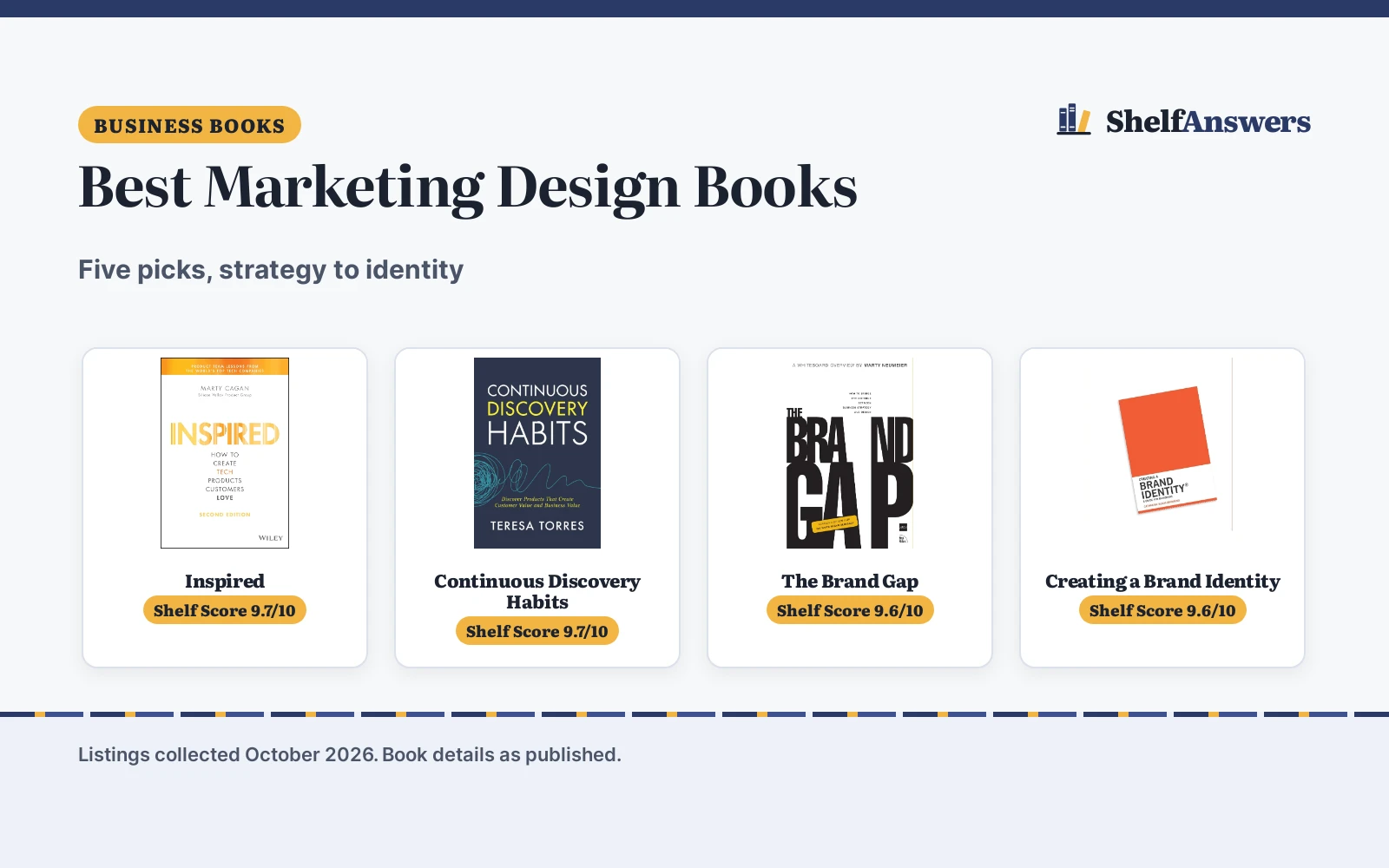
At a glance
Top picks
As an Amazon Associate I earn from qualifying purchases.
A marketer asked to make it look good without a design background, or a designer who needs to think in strategy, both reach for the same shelf. These best marketing design books bridge the distance between business thinking and design practice, from brand theory to product discovery and identity work.
ShelfAnswers earns a commission when you buy through links on this site, at no extra cost to you. As an Amazon Associate I earn from qualifying purchases. Affiliate disclosure.
Quick picks
 Best Overall Inspired: The classic product design reference, 2nd edition. Check price on Amazon
 Newest Pick Continuous Discovery Habits: 2021 system for weekly product discovery. Check price on Amazon
 Best Quick Read The Brand Gap: Brand theory in a two-hour read. Check price on Amazon
 Best for Designers Creating a Brand Identity: Practical brand identity exercises and cases. Check price on Amazon
 Best for Founders Monetizing Innovation: Design the product around the price. Check price on Amazon
The picks
| # | Product | Shelf Score | Buy |
|---|---|---|---|
| 1 | Inspired | 9.7/10 | Buy on Amazon |
| 2 | Continuous Discovery Habits | 9.7/10 | Buy on Amazon |
| 3 | The Brand Gap | 9.6/10 | Buy on Amazon |
| 4 | Creating a Brand Identity | 9.6/10 | Buy on Amazon |
| 5 | Monetizing Innovation | 9.6/10 | Buy on Amazon |

Inspired
A master class in product management and discovery, for teams that build tech products; skip it if visual design is the goal.
Pros
- 2nd edition, updated with current practices of top tech companies.
- 368 pages of product organization and discovery method.
- Profiles of successful product managers and companies.
Cons
- 2017 edition; the field has moved since.
- Focuses on process, not visual design.
- Longer read than the other picks.

Continuous Discovery Habits
A practical system for continuous product discovery, for product teams; skip it for brand or graphic design.
Pros
- 2021 publication, the newest of the picks.
- Teaches a structured weekly discovery cadence.
- Endorsed by Marty Cagan and other product leaders.
Cons
- Narrow focus on discovery habits.
- No edition beyond the first is stated.
- Less useful for pure brand or graphic design.

The Brand Gap
A short unified theory of branding, for beginners; skip it if a deep design manual is needed.
Pros
- Short two-hour read, per the listing.
- Unified theory of brand-building in five disciplines.
- Includes a 220-word brand glossary.
Cons
- 2005 publication, the oldest pick here.
- Aimed at beginners; thin for experts.
- Little on practical design technique.

Creating a Brand Identity
A practical guide to designing brand identities, for design students and professionals; skip it for marketing strategy alone.
Pros
- Exercises and case studies throughout.
- Covers logo design, rebranding and client presentations.
- Derived from university teaching materials.
Cons
- 160 pages, the shortest pick.
- 2016 publication date.
- Focused on graphic design, not marketing strategy.

Monetizing Innovation
A pricing-first approach to innovation, for founders and product leaders; skip it for design craft.
Pros
- Nine-step approach drawn from 10,000 client projects.
- Case studies from LinkedIn, Uber and Porsche.
- Design-around-price framing for founders.
Cons
- Pricing focus, not design craft.
- 2016 1st edition.
- Less relevant for pure designers.
As an Amazon Associate I earn from qualifying purchases.
More picks to compare
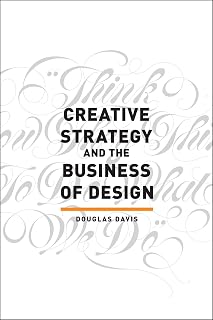 Creative Strategy and DesignBusiness skills for creative thinkers.Check on Amazon
 Hacking the Human MindBehavioral science behind 17 leading brands.Check on Amazon
Compare the picks
| Book | Shelf Score | Pages | Edition | Published | Amazon |
|---|---|---|---|---|---|
| Inspired | 9.7/10 | 368 | 2nd (2017) | December 12, 2017 | View on Amazon |
| Continuous Discovery Habits | 9.7/10 | 244 | Not stated | April 14, 2021 | View on Amazon |
| The Brand Gap | 9.6/10 | 208 | 2nd (2005) | August 4, 2005 | View on Amazon |
| Creating a Brand Identity | 9.6/10 | 160 | Not stated | January 26, 2016 | View on Amazon |
| Monetizing Innovation | 9.6/10 | 256 | 1st (2016) | May 2, 2016 | View on Amazon |
Book details as published on each listing, collected 17 October 2026.
How we scored them
| Book | Shelf Score | Fit /35 | Contents /25 | Value /25 | Age/level /10 |
|---|---|---|---|---|---|
| Inspired | 9.7 | 32 | 20 | 20 | n/a |
| Continuous Discovery Habits | 9.7 | 30 | 20 | 20 | n/a |
| The Brand Gap | 9.6 | 30 | 19 | 20 | n/a |
| Creating a Brand Identity | 9.6 | 29 | 19 | 19 | n/a |
| Monetizing Innovation | 9.6 | 28 | 19 | 19 | n/a |
Scores run from 9.2 to 9.8: each book’s point total is placed on that range, so more points always means a higher score. Reading age or level counts on a list where at least one listing gives one, and a book whose listing gives none then scores zero on it. Where no listing gives one, the score is taken over the other 85 points. Books carry no warranty, so warranty is not scored.
The Shelf Score weighs fit for the reader, contents and edition, and value. None of the five picks lists a reading age or grade level, so scoring rests on what each book covers and how current the edition is. How we pick explains the weights.
How to choose the best marketing design books
Start with your job
A product manager learns the discovery loop from Inspired and Continuous Discovery Habits, both built around customer value. A brand designer starts with The Brand Gap or Creating a Brand Identity, which teach strategy and visual identity. For the marketing side, see the marketing books Harvard list.
Check the edition and page count
Inspired is the 2nd edition from 2017 and The Brand Gap is the 2nd edition from 2005; editions matter when a field moves fast. At 368 pages, Inspired is the longest pick; Creating a Brand Identity runs 160 pages for a quicker read. Readers of marketing psychology may also like Hacking the Human Mind in the more picks.
Match the book to the reader’s level
Beginners do well with The Brand Gap, a two-hour read, or Creating a Brand Identity, which grew from university teaching materials. Experienced product people get more from Inspired and Continuous Discovery Habits, which assume a working team. For pure business thinking, the books written on marketing list goes wider.
Before you buy
- Confirm the edition on the listing: Inspired and The Brand Gap are 2nd editions.
- Check the print length against the reader: 160 to 368 pages across the picks.
- None of the five picks lists a reading age or grade level; read the description for themes.
Frequently Asked Questions
Where should a beginner start with marketing design books?
The Brand Gap is a two-hour read, per the listing, and explains brand strategy simply; Creating a Brand Identity adds practical exercises.
Which book covers product design best?
Inspired (368 pages, 2nd edition) covers discovering and delivering tech products customers love; Continuous Discovery Habits (244 pages, 2021) teaches the discovery cadence.
Are these books for designers or marketers?
Both: Creating a Brand Identity suits designers, while Monetizing Innovation and The Brand Gap suit marketers; each listing names its audience.
Related lists
See every business books list and all nonfiction lists.