Best Homeschool Curriculum for History (2026): 5 Picks Compared
Five history and social studies workbooks compared by listed grade level, reading age, page count and answer key for homeschool families.

At a glance
Top picks
As an Amazon Associate I earn from qualifying purchases. How we score
Choosing the best homeschool curriculum for history often comes down to one question: which grade is the workbook written for? The picks below run from kindergarten through high school, and each one is compared by the grade level, reading age, page count, series position and answer key that its listing publishes.
ShelfAnswers earns a commission when you buy through links on this page, at no extra cost to you. As an Amazon Associate I earn from qualifying purchases. Affiliate disclosure.
Quick picks
 Best Overall Mark Twain US History Workbook by Lee: Ranked first: US history from 1865 to the present for grades 6 to 12. Check price on Amazon
 Best for Daily Practice 180 Days Social Studies 5th by Cotton: One page per school day for grade 5 and up, with an answer key. Check price on Amazon
 Best for Younger Students 180 Days Social Studies K by Flynn: Kindergarten and up, with a listed reading age of 4 to 8 years. Check price on Amazon
 Best for Government US Constitution Workbook by Stange: The Constitution, amendments and branches of government, grades 5 to 12. Check price on Amazon
The picks
| # | Product | Shelf Score | Buy |
|---|---|---|---|
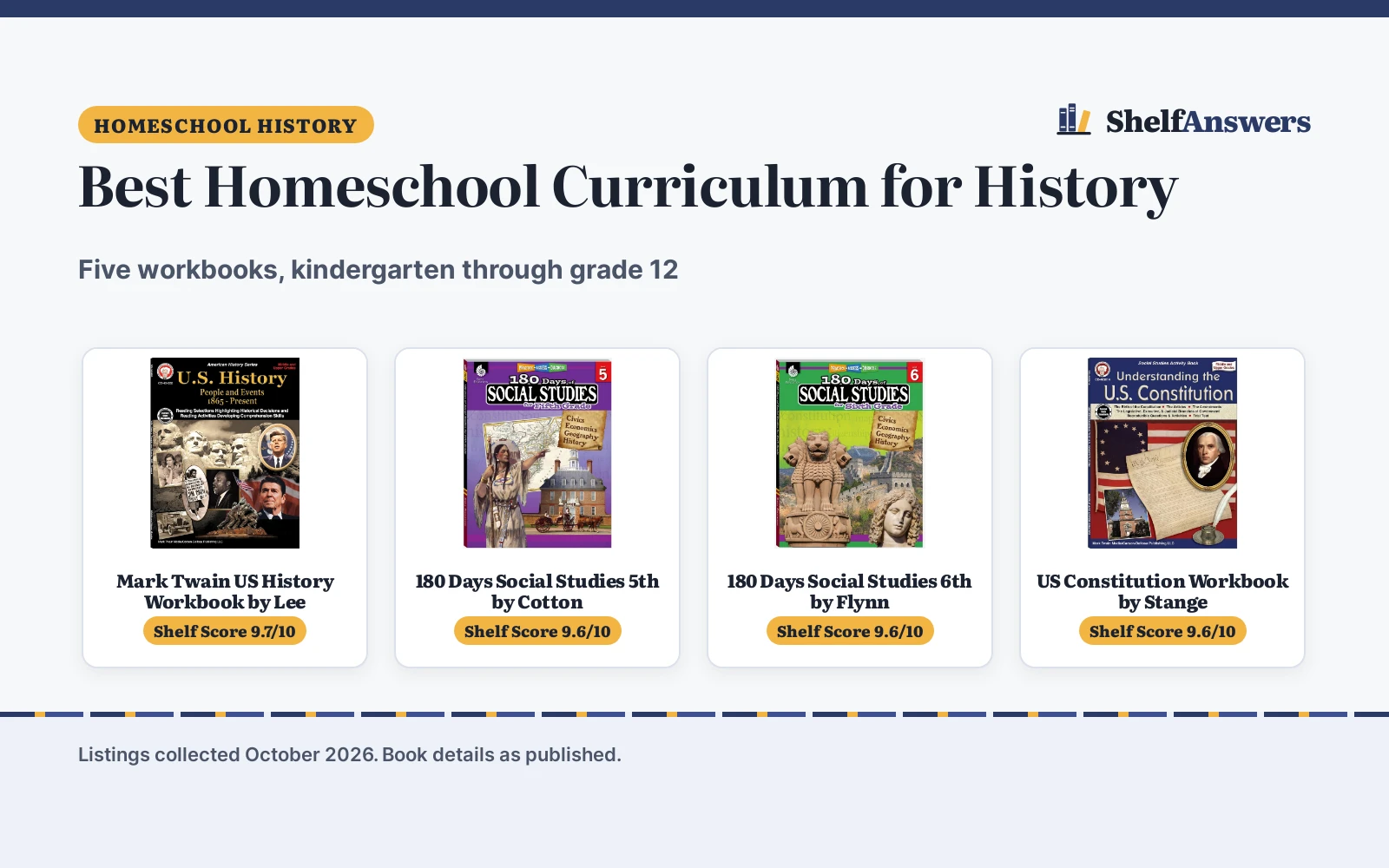
| 1 | Mark Twain US History Workbook by Lee | 9.7/10 | Buy |
| 2 | 180 Days Social Studies 5th by Cotton | 9.6/10 | Buy |
| 3 |  180 Days Social Studies 6th by Flynn 180 Days Social Studies 6th by Flynn | 9.6/10 | Buy |
| 4 | US Constitution Workbook by Stange | 9.6/10 | Buy |
| 5 | 180 Days Social Studies K by Flynn | 9.6/10 | Buy |

Mark Twain US History Workbook by Lee
A US history workbook for a grade 6 to 12 student who needs practice on the period from 1865 to the present day.
Pros
- Covers US history from 1865 to the present with lessons, activities and essays
- Includes a timeline of events and online resources, as the listing states
- An answer key in the back lets a parent track progress before the next lesson
Cons
- Covers World War I, World War II, the Vietnam War and September 11, so you may want to preview those parts for a younger reader
- At 96 pages it covers a long span in a short book, so each topic gets limited space
- Reading age of 11 to 17 years and grade 6 to 12 are both broad bands, so check the fit against your student

180 Days Social Studies 5th by Cotton
One social studies page per school day for a fifth grader, with weekly topics across history, economics, civics and geography.
Pros
- A daily page of practice across the school year, with 10 to 15 minute activities
- Answer key included, so a parent can record and assess progress
- Reading age of 9 to 13 years and grade 5 and up agree with each other
Cons
- Part of an eight-book series, and the listing shows Book 7 of 8
- The spec table gives the subject focus as reading comprehension, while the description is social studies, so check which the book is for
- History is one of four weekly strands, so a student who wants only history gets less of it per page

180 Days Social Studies 6th by Flynn
A daily social studies workbook for a sixth grader building comprehension and analysis skills.
Pros
- One page per school day, with 10 to 15 minute activities and spiral review, per the spec table
- Asks students to answer text-dependent questions and examine primary sources, per the description
- Answer key included, which the listing states
Cons
- Book 8 of 8, so the listing shows the final volume of the series
- The spec table gives the subject focus as reading comprehension and text analysis, while the description is social studies
- History is one of four weekly strands alongside economics, civics and geography

US Constitution Workbook by Stange
A workbook on the US Constitution, its amendments and the branches of government, for a student studying how the country is governed.
Pros
- Covers articles, amendments and the three branches of government, as the title states
- Includes a Constitution test and an answer key, per the listing
- Graphic organizers and activity pages add practice, the listing states
Cons
- Narrow subject: it covers the Constitution and government, not a full history timeline
- Reading age of 10 to 17 years and grade 5 to 12 is a wide range, so a younger reader may need help
- Series position is not stated, so it is unclear whether the workbook connects to other volumes

180 Days Social Studies K by Flynn
A daily social studies workbook for a kindergarten student who is starting to learn about history, economics, civics and geography.
Pros
- One page per school day, with 10 to 15 minute activities, per the spec table
- Answer key included, so a parent can record and assess progress
- Overview pages explain what children are learning and offer tips for parents
Cons
- The spec table gives the subject focus as early reading skills, while the description is social studies, so check which the book is for
- Reading age of 4 to 8 years and grade Kindergarten and up are broad, so an older reader may find it too easy
- Published April 2, 2018, and the listing does not point to a newer edition
As an Amazon Associate I earn from qualifying purchases.
More picks to compare
 Mark Twain World CivilizationsAncient world history for grades 5 to 8, with maps and a glossary.Check on Amazon
 History Pockets: Native AmericansFor early elementary learners: Native American tribes in nine pockets, with crafts and writing.Check on Amazon
 Mark Twain American History 1607-1865For grades 6 to 12: US history from 1607 to 1865, with timelines.Check on Amazon
Compare the picks
| Book | Shelf Score | Pages | Reading age or grade | Series | Amazon |
|---|---|---|---|---|---|
| Mark Twain US History Workbook by Lee | 9.7/10 | 96 | 11 to 17 years; grade 6 to 12 | Not stated | Check price |
| 180 Days Social Studies 5th by Cotton | 9.6/10 | 216 | 9 to 13 years; grade 5 and up | Book 7 of 8 | Check price |
| 180 Days Social Studies 6th by Flynn | 9.6/10 | 216 | 10 to 14 years; grade 6 and up | Book 8 of 8 | Check price |
| US Constitution Workbook by Stange | 9.6/10 | 96 | 10 to 17 years; grade 5 to 12 | Not stated | Check price |
| 180 Days Social Studies K by Flynn | 9.6/10 | 208 | 4 to 8 years; Kindergarten and up | Book 2 of 8 | Check price |
Book details as published on each listing, collected 16 October 2026.
How we scored them
The Shelf Score weighs fit for a homeschool history reader, contents and edition, value, and the listed reading age or grade level. All five picks list both a reading age and a grade level, so all five earn points in that part of the score. How we pick explains the weights.
| Book | Shelf Score | Fit /35 | Contents /25 | Value /25 | Age/level /10 |
|---|---|---|---|---|---|
| Mark Twain US History Workbook by Lee | 9.7 | 30 | 20 | 19 | 9 |
| 180 Days Social Studies 5th by Cotton | 9.6 | 27 | 21 | 20 | 9 |
| 180 Days Social Studies 6th by Flynn | 9.6 | 26 | 21 | 20 | 9 |
| US Constitution Workbook by Stange | 9.6 | 26 | 20 | 19 | 9 |
| 180 Days Social Studies K by Flynn | 9.6 | 23 | 21 | 20 | 9 |
Scores run from 9.2 to 9.8: each book’s point total is placed on that range, so more points always means a higher score. Reading age or level counts on a list where at least one listing gives one, and a book whose listing gives none then scores zero on it. Where no listing gives one, the score is taken over the other 85 points. Books carry no warranty, so warranty is not scored.
How to choose the best homeschool curriculum for history
Match grade level and reading age
Grade level shows the year a workbook targets, and reading age shows how much text a child can handle. The Mark Twain US History Workbook lists grade 6 to 12 and a reading age of 11 to 17 years, while the 180 Days Social Studies Kindergarten book lists a reading age of 4 to 8 years.
Choose daily practice or a single topic
The 180 Days books give one page for each school day, which suits a family that wants short, steady sessions. A single-topic workbook such as the US Constitution Workbook suits a student who needs practice on government rather than a full timeline.
Check the series and the answer key
Three of the picks are numbered volumes in a series, such as Book 7 of 8, so check the number before you buy. All five listings state an answer key is included. For more options by level, browse the full best homeschool curriculum for history category, or see our history books for homeschool list for more options.
Before you buy
- Check the grade level and reading age against your student, since the listings give ranges, not single years.
- Read the series line, such as Book 2 of 8, and decide whether you want the volume on its own.
- Confirm the publication date on the listing, since the 180 Days books were published April 2, 2018.
Frequently Asked Questions
Do the 180 Days books need to be used in order?
Each listing shows its place in the series, such as Book 2 of 8 or Book 8 of 8. The listings do not say the volumes must be used in order, so check the description before you buy.
Does each workbook include an answer key?
Yes. All five listings state an answer key is included, so a parent can check work against it.
Which pick suits a middle or high school student?
The Mark Twain US History Workbook lists grade 6 to 12 and a reading age of 11 to 17 years, and its description covers US history from 1865 to the present day.
Related lists
See every Homeschool Curriculum list and all Workbooks and Homeschool lists.