Best Critical Thinking Books (2026): 5 Picks by Reader
Five critical thinking books compared by fit, contents and edition, value and reading level, from logic basics to daily practice.
At a glance
Top picks
As an Amazon Associate I earn from qualifying purchases.
A reader who wants to argue better and spot weak reasoning needs a starting shelf, and the best critical thinking books cover it from logic basics to daily practice. We compared five books by fit, contents, edition and value.
ShelfAnswers earns a commission when you buy through links on this page, at no extra cost to you. As an Amazon Associate I earn from qualifying purchases. Affiliate disclosure.
Quick picks
 Best Overall Logic Mastery by Thinknetic: 3 books in 1 on decisions, fallacies and sharper thinking Check price on Amazon
 Best History Critical Thinking by Haber: Practice, teaching and history from Aristotle to Dewey Check price on Amazon
 Best on Errors The Art of Thinking Clearly by Dobelli: Faulty reasoning and repeated mistakes, 384 pages Check price on Amazon
 Best Daily Critical Thinking Daily by Snook: 365 short lessons for a daily thinking practice Check price on Amazon
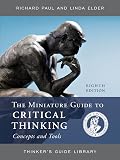 Best Short Guide Miniature Guide by Paul: Core concepts and tools in 48 pages Check price on Amazon
The picks
| # | Product | Shelf Score | Buy |
|---|---|---|---|
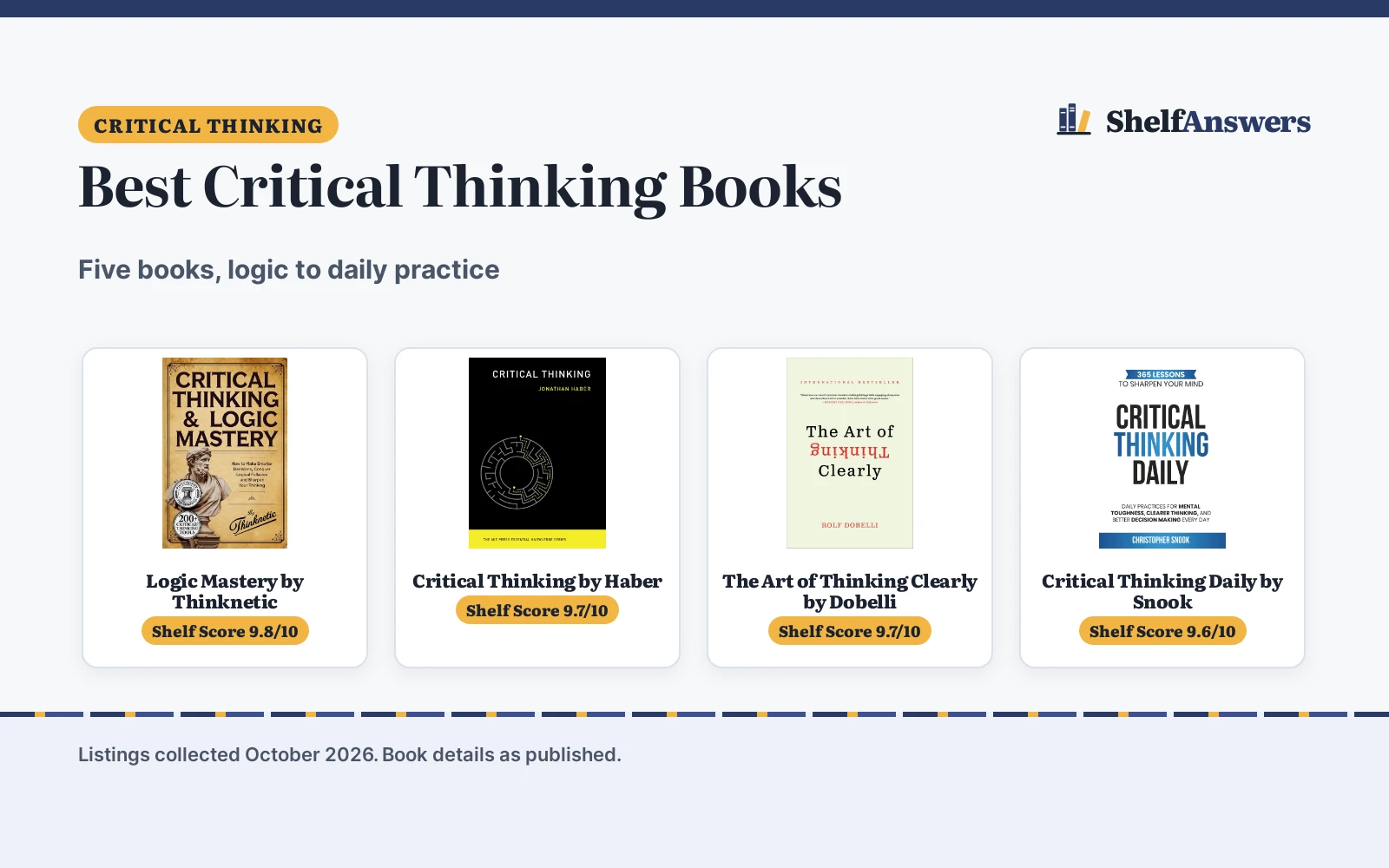
| 1 | Logic Mastery by Thinknetic | 9.8/10 | Buy on Amazon |
| 2 | Critical Thinking by Haber | 9.7/10 | Buy on Amazon |
| 3 | The Art of Thinking Clearly by Dobelli | 9.7/10 | Buy on Amazon |
| 4 | Critical Thinking Daily by Snook | 9.6/10 | Buy on Amazon |
| 5 | Miniature Guide by Paul | 9.6/10 | Buy on Amazon |

Logic Mastery by Thinknetic
A 3-in-1 volume on decisions, fallacies and sharper thinking, for readers wanting logic basics in one volume.
Pros
- Three books in one volume: decisions, fallacies, thinking
- 302 pages, published January 6, 2022
- Addresses misinformation, biases and flawed arguments
Cons
- No reading age or grade level is stated
- Independently published, no publisher series behind it
- No exercise count is stated

Critical Thinking by Haber
A compact guide to the practice, teaching and history of critical thinking, for teachers and students.
Pros
- Practice, teaching and history, Aristotle to Dewey
- 232 pages, published April 7, 2020
- Illustrated edition in the Essential Knowledge series
Cons
- No reading age or grade level is stated
- Shorter than the longer guides at 232 pages
- No exercise count is stated

The Art of Thinking Clearly by Dobelli
A look at faulty reasoning and repeated mistakes, for readers spotting cognitive errors.
Pros
- 384 pages on faulty reasoning and repeated mistakes
- May 6, 2014 reprint from Harper Paperbacks
- Frames decisions through cognitive errors in daily life
Cons
- No reading age or grade level is stated
- 2014 reprint, older than the other main picks
- No exercise count is stated

Critical Thinking Daily by Snook
A year-long companion of 365 daily lessons, for readers who want a daily practice.
Pros
- 365 lessons across 399 pages for daily practice
- Draws on Stoicism, Buddhism and modern psychology
- November 4, 2025, the newest main pick here
Cons
- No reading age or grade level is stated
- Daily format suits steady readers, not single-sitting readers
- No exercise count is stated

Miniature Guide by Paul
A 48-page guide to core concepts and tools, for readers wanting the foundations in short form.
Pros
- 48-page guide to core concepts and tools
- 8th edition, published September 20, 2019
- Thinking framed through elements of reasoning
Cons
- No reading age or grade level is stated
- Short length limits depth against longer guides
- No exercise count is stated
As an Amazon Associate I earn from qualifying purchases.
More picks to compare
 Beginner's Guide by BrownFor beginners wanting rational analysis and creative problem solving.Check on Amazon
 Art of Critical Thinking by ThorogoodFor readers wanting smarter thinking and faster problem solving.Check on Amazon
 Skill Sharpeners Grade 5 by Evan-MoorFor fifth graders, with an answer key and 144 pages.Check on Amazon
 Becoming a Critical Thinker by BogartFor students thinking well amid information overload.Check on Amazon
 Tools for Taking Charge by PaulFor students wanting basic tools for learning and life.Check on Amazon
Compare the picks
| Book | Shelf Score | Author | Pages | Published | Amazon |
|---|---|---|---|---|---|
| Logic Mastery by Thinknetic | 9.8/10 | Thinknetic | 302 pages | 2022 | View on Amazon |
| Critical Thinking by Haber | 9.7/10 | Jonathan Haber | 232 pages | 2020 | View on Amazon |
| The Art of Thinking Clearly by Dobelli | 9.7/10 | Rolf Dobelli | 384 pages | 2014 | View on Amazon |
| Critical Thinking Daily by Snook | 9.6/10 | Christopher Snook | 399 pages | 2025 | View on Amazon |
| Miniature Guide by Paul | 9.6/10 | Paul and Elder | 48 pages | 2019 | View on Amazon |
Book details as published on each listing, collected 25 October 2026.
How we scored them
The Shelf Score weighs fit, contents, edition, value and listed reading level. None of the five picks lists a reading age or grade level. How we pick explains the weights.
| Book | Shelf Score | Fit /35 | Contents /25 | Value /25 | Age/level /10 |
|---|---|---|---|---|---|
| Logic Mastery by Thinknetic | 9.8 | 32 | 21 | 22 | n/a |
| Critical Thinking by Haber | 9.7 | 30 | 21 | 20 | n/a |
| The Art of Thinking Clearly by Dobelli | 9.7 | 30 | 21 | 19 | n/a |
| Critical Thinking Daily by Snook | 9.6 | 29 | 21 | 19 | n/a |
| Miniature Guide by Paul | 9.6 | 28 | 18 | 19 | n/a |
Scores run from 9.2 to 9.8: each book’s point total is placed on that range, so more points always means a higher score. Reading age or level counts on a list where at least one listing gives one, and a book whose listing gives none then scores zero on it. Where no listing gives one, the score is taken over the other 85 points. Books carry no warranty, so warranty is not scored.
How to choose the best critical thinking books
Start with the reader
Teachers and students who want the history of the subject fit the Haber guide, while logic basics in one volume fit the Thinknetic set. Page counts run from 48 pages to 399 pages, so match length to the reader’s time. See every workbooks and homeschool list.
Single book or daily practice
The Dobelli or Haber books suit a single read-through, while the Snook book gives 365 lessons for a daily habit. The 48-page Paul book suits a reader who wants foundations, not a long study. For workbook practice, see critical thinking workbooks for high school.
Check the edition
Editions run from a 2014 reprint to a 2025 release, so check the date on the listing. The Paul guide is a 2019 8th edition; the Snook book is a 2025 release. For study use, match the edition year to the goal.
Before you buy
- Check the edition and date; editions run from 2014 to 2025.
- Check whether an answer key is included; none of the five main picks states one.
- Check page count, from 48 pages to 399 pages.
Frequently Asked Questions
Where should a new reader start?
The Thinknetic set covers decisions, fallacies and thinking in one volume; the 48-page Paul guide gives the foundations.
Which book suits a daily habit?
The Snook book offers 365 lessons across 399 pages for a year-long practice.
Do any of these books list a reading age or grade level?
None of the five main picks lists one.
Related lists
See every workbooks and homeschool list.
More lists: browse self-improvement books, homeschool curriculum and math workbooks.