Best Business Books for Kids (2026): 5 Top Picks Compared
Five business books for young readers compared by publication date, page count, grade levels and practical lessons, from startup ventures to personal finance.

On this page
When an elementary or middle school student starts asking how shops set prices or dreams of running a lemonade stand, the best business books for kids channel that curiosity into real-world understanding. Whether a young reader wants to start a small neighborhood enterprise or simply learn where money goes, selecting the right volume depends on finding clear explanations matched to their reading level. We compared five titles by publication date, page count, stated age ranges and the practical financial concepts covered on each listing.
ShelfAnswers earns a commission when you buy through links on this page, at no extra cost to you. As an Amazon Associate I earn from qualifying purchases. Affiliate disclosure.
Quick picks
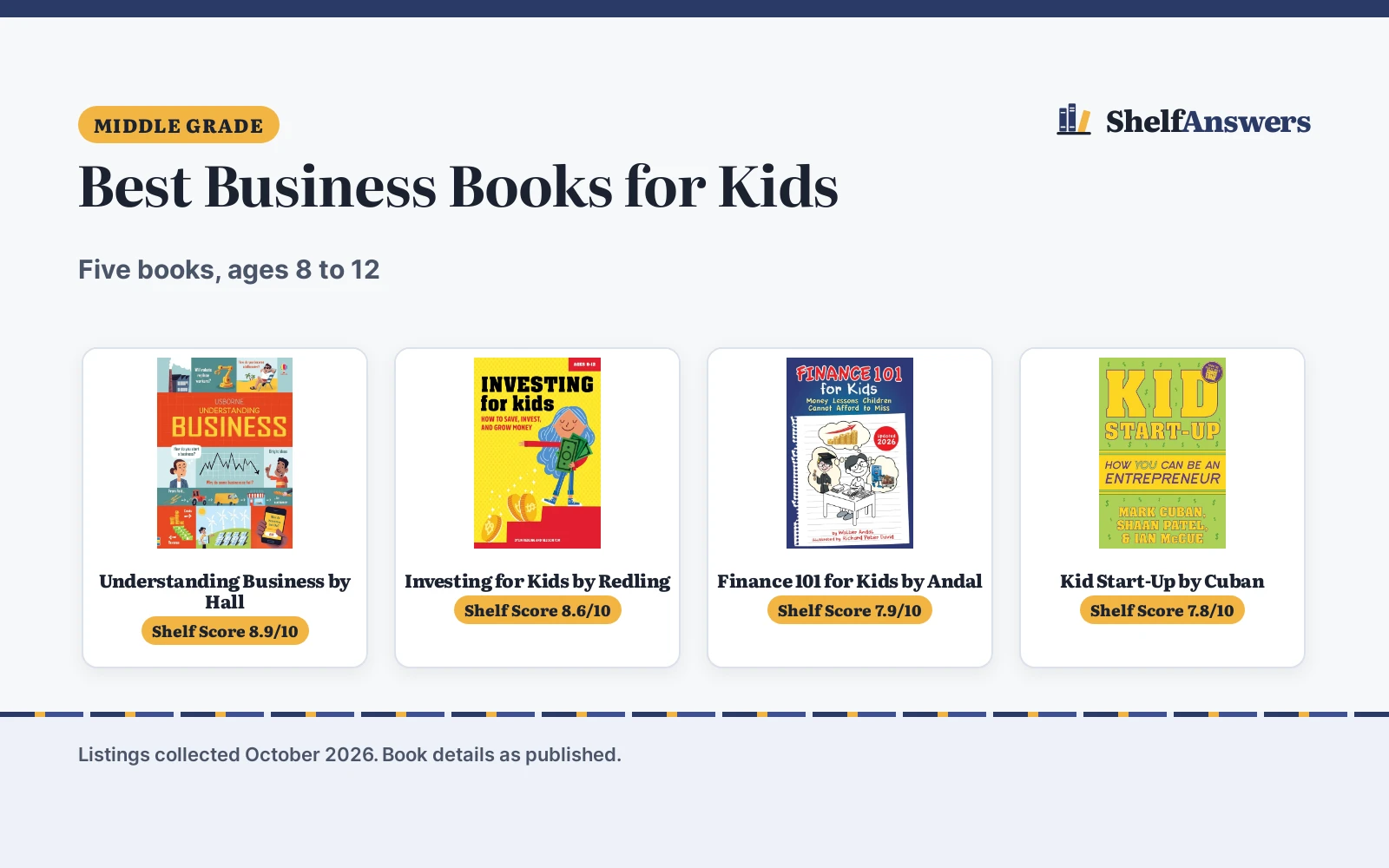
- Best Overall Understanding Business by Hall: Clear infographics on starting a business, supply chains and interest rates Check price
- Best for Investing Investing for Kids by Redling: Covers stocks, bonds and portfolio diversification with activities for ages 8 to 12 Check price
- Best for Money Basics Finance 101 for Kids by Andal: Simple lessons on earning, saving, credit and how the stock market works Check price
- Best for Young Entrepreneurs Kid Start-Up by Cuban: Ten kid-friendly venture ideas from lemonade stands to online craft shops Check price
- Most Business Ideas Think Like a Boss by Roedel: Lists 47 ways for young people to earn extra money online and offline Check price
Compare the picks
| Book | Shelf Score | Author | Pages | Reading age or grade | Published |
|---|---|---|---|---|---|
| Understanding Business by Hall | 8.9/10 | Rose Hall, Lara Bryan | 128 | Ages 10-16, grades 4-6 | March 5, 2024 |
| Investing for Kids by Redling | 8.6/10 | Dylin Redling, Allison Tom | 144 | Ages 8-12 (customers), grades 3-7 | December 15, 2020 |
| Finance 101 for Kids by Andal | 7.9/10 | Walter Andal | 108 | Ages 8-11 (customers) | April 12, 2016 |
| Kid Start-Up by Cuban | 7.8/10 | Mark Cuban, Shaan Patel, Ian McCue | 128 | Ages 9-12 (customers), grades Preschool-2 | August 14, 2018 |
| Think Like a Boss by Roedel | 6.9/10 | Miss Jemma Roedel | 113 | Not stated | December 1, 2021 |
Book details as published on each listing, collected 15 October 2026.
The picks
| # | Product | Shelf Score | Buy |
|---|---|---|---|
| 1 |  Understanding Business by Hall Understanding Business by Hall | 8.9/10 | Buy |
| 2 |  Investing for Kids by Redling Investing for Kids by Redling | 8.6/10 | Buy |
| 3 |  Finance 101 for Kids by Andal Finance 101 for Kids by Andal | 7.9/10 | Buy |
| 4 |  Kid Start-Up by Cuban Kid Start-Up by Cuban | 7.8/10 | Buy |
| 5 |  Think Like a Boss by Roedel Think Like a Boss by Roedel | 6.9/10 | Buy |
Understanding Business by Hall
An illustrated guide introducing entrepreneurship, personal money management, supply chains and interest rates.
Pros
- Published March 5, 2024, making it the most recent release in this comparison
- Uses infographic pictures to explain business and economic topics
- Explains broader economic concepts including global supply chains and interest rates
- Both a grade level of 4 to 6 and a reading age of 10 to 16 years are provided
Cons
- The listing includes a politics blurb in the spec table that belongs to a different title in the series
- At 128 pages, it provides an overview rather than deep instructions for specific businesses
- Reading age of 10 to 16 years stretches beyond the middle grade age group
- The listing notes it includes links to websites to find out more, which requires internet access
Detailed Review
The description presents this guide as an introduction to enterprise and smart consumer habits, using infographic pictures to explain how to start a business, handle money and understand supply chains and interest rates. The listing gives a print length of 128 pages, a publication date of March 5, 2024, grade level 4 to 6 and a reading age of 10 to 16 years. The spec table also contains a stray politics note from the publisher's series template that does not match this guide's business topic.
Who it's for: a middle school student who wants a visual overview of how businesses operate in the wider economy. Who should skip it: a child looking for step-by-step instructions for one specific neighborhood venture.
Its Shelf Score of 8.9/10 comes from fit 32/35, contents and edition 22/25, value 21/25 and reading age or level 9/10.
Book Details
| Author | Rose Hall, Lara Bryan |
|---|---|
| Publisher | Usborne |
| Print length | 128 pages |
| Reading age | 10 - 16 years |
| Published | March 5, 2024 |
Details as published on the retailer listing, collected 15 October 2026. Editions and formats change; check the listing before you buy.
Reading Age and Edition
What this listing states. Grade level 4 to 6 and a reading age of 10 to 16 years, so reading age or level scores 9 of 10. Books carry no warranty, so warranty is not part of the score. See How We Pick.
Reading ages are a guide, not a rule. Listed reading ages and grade levels describe the level a book is aimed at, not whether it suits a particular child. Read the description or a sample first for younger or sensitive readers.
Listed reading ages and grade levels are a guide, not advice about a particular reader. Editions and formats change, so check the listing before you buy. See our Reading Age Disclaimer.
Investing for Kids by Redling
An introduction to stocks, bonds, risk and portfolio diversification featuring character guides and interactive activities.
Pros
- At 144 pages, it is the longest book in this comparison
- Listing gives grade level 3 to 7, which fits middle school readers
- Explores modern investing topics including impact investing and digital trading
- Includes interactive activities and discussions intended for kids and parents together
Cons
- The reading age of 8 to 12 years is marked as from customers rather than publisher data
- Published December 15, 2020, so modern trading discussions do not reflect more recent market shifts
- Focuses primarily on investing and portfolio building rather than starting a small business
- The cartoon Dollar Duo characters may feel too young for older seventh graders
Detailed Review
The description frames this guide as an introduction to building wealth, covering stocks, bonds, risk and portfolio diversification with help from character guides named the Dollar Duo. The listing states a print length of 144 pages, grade level 3 to 7 and a publication date of December 15, 2020, along with a reading age of 8 to 12 years, marked as from customers.
Who it's for: a young reader ready to learn about savings accounts, stocks and basic investing alongside their parents. Who should skip it: a reader who wants ideas for launching an active neighborhood service rather than studying financial markets.
Its Shelf Score of 8.6/10 comes from fit 30/35, contents and edition 21/25, value 21/25 and reading age or level 9/10.
Book Details
| Author | Dylin Redling, Allison Tom |
|---|---|
| Publisher | Callisto Kids |
| Print length | 144 pages |
| Reading age | 8 - 12 years, from customers |
| Grade level | 3 - 7 |
Details as published on the retailer listing, collected 15 October 2026. Editions and formats change; check the listing before you buy.
Reading Age and Edition
What this listing states. Grade level 3 to 7 and a reading age of 8 to 12 years, marked as from customers, so reading age or level scores 9 of 10. Books carry no warranty, so warranty is not part of the score. See How We Pick.
Reading ages are a guide, not a rule. Listed reading ages and grade levels describe the level a book is aimed at, not whether it suits a particular child. Read the description or a sample first for younger or sensitive readers.
Listed reading ages and grade levels are a guide, not advice about a particular reader. Editions and formats change, so check the listing before you buy. See our Reading Age Disclaimer.
Finance 101 for Kids by Andal
A practical financial literacy guide covering the origins of money, saving habits, credit, tariffs and stock market basics.
Pros
- Covers a broad range of topics from the origins of money to credit, foreign exchange and tariffs
- Description highlights real-life examples to help explain personal finance
- Addresses modern topics including cryptocurrency in the updated edition text
- Includes chapters on community giving and generosity alongside earning and saving
Cons
- Publication date is listed as April 12, 2016 in the specs despite the description claiming an updated 2026 edition
- No grade level is stated on the listing
- The reading age of 8 to 11 years is marked as from customers on the listing
- At 108 pages, it is the shortest publication in this group
Detailed Review
The description outlines foundational financial concepts, explaining the history of currency, earning habits, saving, credit risks and basic stock market mechanics. The listing gives a print length of 108 pages and a reading age of 8 to 11 years, marked as from customers, but gives no grade level. A discrepancy appears between the description mentioning an updated 2026 edition with tariffs and cryptocurrency and the spec table listing a publication date of April 12, 2016.
Who it's for: an upper elementary student who wants a concise walk through everyday financial literacy concepts. Who should skip it: a buyer who expects a verified recent printing rather than a listing showing a 2016 publication date.
Its Shelf Score of 7.9/10 comes from fit 29/35, contents and edition 19/25, value 20/25 and reading age or level 7/10.
Book Details
| Author | Walter Andal |
|---|---|
| Publisher | Gatekeeper Press |
| Print length | 108 pages |
| Reading age | 8 - 11 years, from customers |
| Published | April 12, 2016 |
Details as published on the retailer listing, collected 15 October 2026. Editions and formats change; check the listing before you buy.
Reading Age and Edition
What this listing states. Reading age of 8 to 11 years, marked as from customers, so reading age or level scores 7 of 10. Books carry no warranty, so warranty is not part of the score. See How We Pick.
Reading ages are a guide, not a rule. Listed reading ages and grade levels describe the level a book is aimed at, not whether it suits a particular child. Read the description or a sample first for younger or sensitive readers.
Listed reading ages and grade levels are a guide, not advice about a particular reader. Editions and formats change, so check the listing before you buy. See our Reading Age Disclaimer.
Kid Start-Up by Cuban
A guide to finding ideas and launching businesses with ten kid-friendly startup models.
Pros
- Offers ten concrete business ideas from lemonade stands to online art stores
- Focuses directly on starting an enterprise and discovering viable business concepts
- Includes an illustrated format across 128 pages
- Written specifically to encourage entrepreneurial thinking in young readers
Cons
- Listing contains contradictory data: reading age is 9 to 12 years from customers, but grade level is listed as Preschool to 2
- Published August 14, 2018, so online business examples like Etsy may reflect older platform norms
- Does not cover general economic topics such as supply chains or interest rates
- Focuses on launch ideas rather than ongoing bookkeeping or tax basics
Detailed Review
The description encourages young entrepreneurs to solve everyday problems and launch ventures, outlining ten specific business concepts ranging from lemonade stands to online craft shops. The listing states a print length of 128 pages and a publication date of August 14, 2018. It presents a notable contradiction in its reading metrics, pairing grade level Preschool to 2 with a reading age of 9 to 12 years, marked as from customers.
Who it's for: a motivated child who wants actionable ideas for earning money right away through practical projects. Who should skip it: an older teen who needs detailed accounting instruction or guidance on legal business structures.
Its Shelf Score of 7.8/10 comes from fit 30/35, contents and edition 20/25, value 20/25 and reading age or level 4/10.
Book Details
| Author | Mark Cuban, Shaan Patel, Ian McCue |
|---|---|
| Publisher | Diversion Books |
| Print length | 128 pages |
| Reading age | 9 - 12 years, from customers |
| Grade level | Preschool - 2 |
Details as published on the retailer listing, collected 15 October 2026. Editions and formats change; check the listing before you buy.
Reading Age and Edition
What this listing states. Grade level Preschool to 2 and a reading age of 9 to 12 years, marked as from customers, so reading age or level scores 4 of 10. Books carry no warranty, so warranty is not part of the score. See How We Pick.
Reading ages are a guide, not a rule. Listed reading ages and grade levels describe the level a book is aimed at, not whether it suits a particular child. Read the description or a sample first for younger or sensitive readers.
Listed reading ages and grade levels are a guide, not advice about a particular reader. Editions and formats change, so check the listing before you buy. See our Reading Age Disclaimer.
Think Like a Boss by Roedel
A collection of 47 ideas for earning money online and offline alongside basic financial concepts.
Pros
- Lists 47 ideas for making money both online and offline
- Shares profiles of young entrepreneurs who built businesses
- Includes a bonus chapter covering financial upgrades
- Focuses on actionable tasks kids can try without specialized equipment
Cons
- No reading age or grade level is stated anywhere in the listing
- Published December 1, 2021 by an independent publisher without listed editorial notes
- Marketing text makes exaggerated promises about young kids becoming millionaires within a few years
- Does not cover structured investing, banking or macroeconomic principles
Detailed Review
The description collects 47 ideas for earning cash through online and offline activities, profiling young earners and encouraging entrepreneurial initiative. The listing gives a print length of 113 pages and a publication date of December 1, 2021 from an independent publisher, but states neither a reading age nor a grade level. The sales copy relies on heavy promises of becoming a millionaire at a young age, which parents should weigh against the simple project ideas inside.
Who it's for: a child looking for a broad brainstorm list of odd jobs and informal business ideas. Who should skip it: a student who needs structured instruction on banking, investing or economic principles.
Its Shelf Score of 6.9/10 comes from fit 28/35, contents and edition 19/25, value 19/25 and reading age or level 0/10.
Book Details
| Author | Miss Jemma Roedel |
|---|---|
| Publisher | Independently published |
| Print length | 113 pages |
| Published | December 1, 2021 |
Details as published on the retailer listing, collected 15 October 2026. Editions and formats change; check the listing before you buy.
Reading Age and Edition
What this listing states. No reading age or grade level is stated, so that criterion is not scored. Books carry no warranty, so warranty is not part of the score. See How We Pick.
Reading ages are a guide, not a rule. Listed reading ages and grade levels describe the level a book is aimed at, not whether it suits a particular child. Read the description or a sample first for younger or sensitive readers.
Listed reading ages and grade levels are a guide, not advice about a particular reader. Editions and formats change, so check the listing before you buy. See our Reading Age Disclaimer.
As an Amazon Associate I earn from qualifying purchases.
How we scored them
The Shelf Score weighs fit for introducing business concepts, contents and edition, value, and the listed reading age or grade level where one is given. Four of the five picks list a reading age or grade level, though one listing pairs a preschool grade level with a middle grade reading age. Page counts range from 108 to 144 pages, and newer editions with current economic details score higher on contents. How we pick explains the weights.
| Book | Shelf Score | Fit /35 | Contents /25 | Value /25 | Age/level /10 |
|---|---|---|---|---|---|
| Understanding Business by Hall | 8.9 | 32 | 22 | 21 | 9 |
| Investing for Kids by Redling | 8.6 | 30 | 21 | 21 | 9 |
| Finance 101 for Kids by Andal | 7.9 | 29 | 19 | 20 | 7 |
| Kid Start-Up by Cuban | 7.8 | 30 | 20 | 20 | 4 |
| Think Like a Boss by Roedel | 6.9 | 28 | 19 | 19 | 0 |
Scores run from 0 to 10. Reading age or level counts on a list where at least one listing gives one, and a book whose listing gives none then scores zero on it. Where no listing gives one, the score is taken over the other 85 points. Books carry no warranty, so warranty is not scored.
How to choose the best business books for kids
Matching reading age to the child
Understanding the target reading level prevents frustration when introducing economic ideas. Understanding Business provides a listed reading age of 10 to 16 years alongside grade level 4 to 6, while Investing for Kids lists grade level 3 to 7 and a customer-listed reading age of 8 to 12 years. By contrast, Kid Start-Up presents a contradiction on its listing, pairing grade level Preschool to 2 with a 9 to 12 customer reading age. Finance 101 for Kids provides an 8 to 11 reading age from customers without a listed grade level, and Think Like a Boss omits both metrics. For parents seeking broader age-based picks, see our guide to the best books for 10 year olds.
Active business ventures versus financial concepts
Some titles prioritize actionable startup projects, while others explain broader monetary mechanics. Kid Start-Up outlines ten specific ventures such as lemonade stands and online art stores, and Think Like a Boss brainstorms 47 ways to earn cash online and offline. Conversely, Investing for Kids focuses on stocks, bonds and portfolio diversification, and Finance 101 for Kids introduces currency history, credit, tariffs and foreign exchange. Understanding Business bridges both approaches by exploring how to start an enterprise alongside global supply chains and interest rates. Readers interested in adult startup principles can explore our best book for entrepreneurs.
Comparing page counts and publication dates
| Book | Pages | Published |
|---|---|---|
| Understanding Business by Hall | 128 | March 5, 2024 |
| Investing for Kids by Redling | 144 | December 15, 2020 |
| Finance 101 for Kids by Andal | 108 | April 12, 2016 |
| Kid Start-Up by Cuban | 128 | August 14, 2018 |
| Think Like a Boss by Roedel | 113 | December 1, 2021 |
Print lengths in this group stay between 108 and 144 pages, keeping each volume approachable for young readers. Publication dates are especially important when evaluating discussions of digital platforms and currencies. Understanding Business was published March 5, 2024, whereas Finance 101 for Kids has an April 12, 2016 listing date despite mentioning updated 2026 material in its description. For foundational reading recommendations, consult our best book for kids selection and browse our wider collection of middle grade books.
Before you buy
- Check whether the reading age is marked as from customers or provided by the publisher, as customer tags may reflect varying reading skills.
- Review both the grade level and reading age on the listing to catch contradictions, such as Kid Start-Up pairing grade level Preschool to 2 with ages 9 to 12.
- Verify publication dates against descriptions that advertise updated editions, as seen with Finance 101 for Kids listing an April 12, 2016 date alongside 2026 update copy.
- Look for interactive elements or discussion prompts if you plan to read alongside your child, such as the parent-child activities in Investing for Kids.
Frequently Asked Questions
What age group are these business books suitable for?
The listings cover ages from 8 up to 16 years, with most books targeting the 8 to 12 range. Investing for Kids lists ages 8 to 12 and grades 3 to 7, while Understanding Business specifies ages 10 to 16 and grades 4 to 6.
Which book is best for a child who wants to launch a business right away?
Kid Start-Up details ten specific venture ideas, including traditional lemonade stands and modern Etsy art stores. Young entrepreneurs looking for brainstorm ideas can also check Think Like a Boss, which lists 47 ways to earn cash.
Do any of these books teach stock market investing for beginners?
Investing for Kids focuses directly on stocks, bonds and portfolio diversification across 144 pages. Finance 101 for Kids also explains stock market basics and economic forces in a 108-page format.
Is Finance 101 for Kids a current edition?
The book description advertises an updated 2026 edition discussing cryptocurrency and tariffs, though the listing specifications give an original publication date of April 12, 2016. Buyers should check the copyright page of their copy to confirm the printing.
Related lists
See every Middle Grade list and all Kids and Teens lists. Also see our best books for 10 year olds. Also see our best chapter books for kids. Also see our best book for kids.
More lists: browse Business and Money books, entrepreneur guides and picture books.