Best Books for Kids About Healthy Eating (2026): 5 Compared
Five picture books compared for kids about healthy eating by reading age, page count and fit, ranked by Shelf Score for story time.

At a glance
Top picks
As an Amazon Associate I earn from qualifying purchases. How we score
The best books for kids about healthy eating are the ones a picky eater will actually sit through, because the lesson only works if the pages turn. We compared five picture books by reading age, page count and how directly each one teaches healthy eating. Every detail below comes from the Amazon listings.
ShelfAnswers earns a commission when you buy through links on this page, at no extra cost to you. As an Amazon Associate I earn from qualifying purchases. Affiliate disclosure.
Quick picks
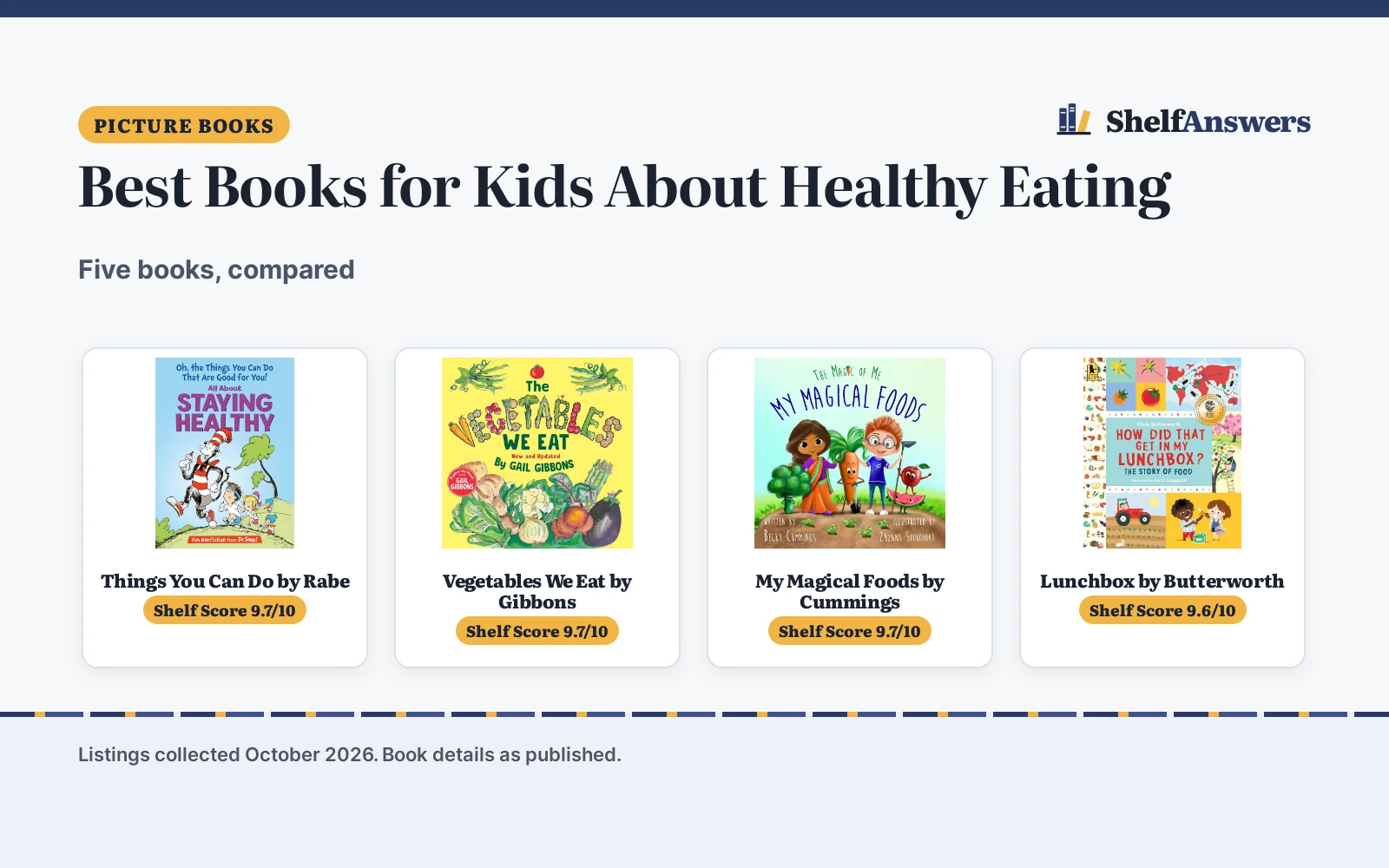
 Best Overall Things You Can Do by Rabe: Ages 2-6, rhyming Cat in the Hat book with recipes, 64 pages Check price on Amazon
 Best Veggie Primer Vegetables We Eat by Gibbons: Ages 2-7, illustrated vegetable primer with diagrams Check price on Amazon
 Best for Picky Eaters My Magical Foods by Cummings: Ages 2-8 rhyming book for picky eaters, snack checklist Check price on Amazon
 Best Food Facts Lunchbox by Butterworth: Ages 3-7, farm-to-lunchbox story with health tips Check price on Amazon
 Best Rainbow Book I Can Eat a Rainbow by Rose: Ages 3-6, rainbow of fruits and veggies with coloring pages Check price on Amazon
The picks
| # | Product | Shelf Score | Buy |
|---|---|---|---|
| 1 | Things You Can Do by Rabe | 9.7/10 | Buy |
| 2 | Vegetables We Eat by Gibbons | 9.7/10 | Buy |
| 3 | My Magical Foods by Cummings | 9.7/10 | Buy |
| 4 | Lunchbox by Butterworth | 9.6/10 | Buy |
| 5 | I Can Eat a Rainbow by Rose | 9.6/10 | Buy |

Things You Can Do by Rabe
For ages 2 to 6, a rhyming Cat in the Hat book about eating healthy and staying active, with recipes.
Pros
- Reading age 2 - 6 years, marked as from customers, and grade level Kindergarten - 4
- 64 pages plus 16 bonus pages of recipes and activities
- Index, glossary and further-learning suggestions stated
Cons
- Published 2001, the oldest of the five
- About staying healthy broadly, with eating healthy as one part
- Covers activity and germs alongside food, so less food focus than the others

Vegetables We Eat by Gibbons
For ages 2 to 7, an illustrated primer on vegetables: how they grow and how many kinds there are.
Pros
- Reading age 2 - 7 years, marked as from customers, and grade level Kindergarten - 3
- Richly illustrated with diagrams and cross sections of vegetables
- Covers how vegetables grow and reach stores
Cons
- Published 2008
- Vegetables only, no fruit
- 32 pages, half the length of the Rabe book

My Magical Foods by Cummings
For ages 2 to 8, a rhyming picture book to get picky eaters curious about fruits and vegetables.
Pros
- Written for ages 2 to 8, the widest age span here
- Rhyming verse aimed at picky eaters, with a healthy snacks checklist
- Shows animals that eat plants, like gorillas and giraffes
Cons
- Reading age in the spec table is 2 - 6 years, marked as from customers, while the description says ages 2 to 8
- 36 pages
- 2020 publication; the Rose book is newer

Lunchbox by Butterworth
For ages 3 to 7, a look at how lunchbox foods get from farm to table, with health tips.
Pros
- Reading age 3 - 7 years, marked as from customers, and grade level Kindergarten - 3
- Traces foods from farm to lunchbox with health tips and food groups
- Back matter includes an index
Cons
- Published 2013
- About food production more than about eating healthy
- 32 pages

I Can Eat a Rainbow by Rose
For ages 3 to 6, a colorful picture book about eating a rainbow of fruits and vegetables.
Pros
- Reading age 3 - 6 years, marked as from customers
- Rainbow-of-foods concept with coloring pages
- Description says it is featured in EFNEP, SNAP and MyPlate
Cons
- 29 pages, the shortest of the five
- Independently published
- No grade level is stated
As an Amazon Associate I earn from qualifying purchases.
More picks to compare
 Monsters Don't Eat Broccoli by HicksFor ages 2 to 4: monsters discover broccoli is not so bad.Check on Amazon
 Eat Your Colors by MillerFor ages 1 to 3: photos introduce the basics of good nutrition.Check on Amazon
 This Is How We Stay Healthy by DKFor preschoolers: staying-healthy skills with a checklist.Check on Amazon
 Fruits by DickmannFor ages 5 to 6: fruits and MyPlate healthy eating.Check on Amazon
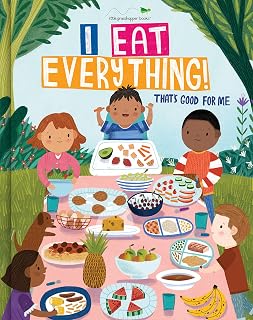 I Eat Everything by Beth TaylorFor ages 1 to 5: animals and kids eating healthy foods.Check on Amazon
Compare the picks
| Book | Shelf Score | Author | Reading age | Pages | Published | Amazon |
|---|---|---|---|---|---|---|
| Things You Can Do by Rabe | 9.7/10 | Tish Rabe | 2-6, from customers | 64 | 2001 | Check price |
| Vegetables We Eat by Gibbons | 9.7/10 | Gail Gibbons | 2-7, from customers | 32 | 2008 | Check price |
| My Magical Foods by Cummings | 9.7/10 | Becky Cummings | 2-6, from customers | 36 | 2020 | Check price |
| Lunchbox by Butterworth | 9.6/10 | Chris Butterworth | 3-7, from customers | 32 | 2013 | Check price |
| I Can Eat a Rainbow by Rose | 9.6/10 | Olena Rose | 3-6, from customers | 29 | 2021 | Check price |
Book details as published on each listing, collected 17 October 2026.
How we scored them
The Shelf Score weighs fit for the reader, contents and edition, value, and the listed reading age or level. All five state a reading age marked as from customers, and three state a grade level. The rhyming Cat in the Hat book leads on contents; the picky-eater and vegetable books follow on fit. How we pick explains the weights.
| Book | Shelf Score | Fit /35 | Contents /25 | Value /25 | Age/level /10 |
|---|---|---|---|---|---|
| Things You Can Do by Rabe | 9.7 | 28 | 22 | 21 | 9 |
| Vegetables We Eat by Gibbons | 9.7 | 29 | 20 | 20 | 9 |
| My Magical Foods by Cummings | 9.7 | 32 | 20 | 20 | 7 |
| Lunchbox by Butterworth | 9.6 | 27 | 20 | 20 | 9 |
| I Can Eat a Rainbow by Rose | 9.6 | 30 | 19 | 19 | 7 |
Scores run from 9.2 to 9.8: each book’s point total is placed on that range, so more points always means a higher score. Reading age or level counts on a list where at least one listing gives one, and a book whose listing gives none then scores zero on it. Where no listing gives one, the score is taken over the other 85 points. Books carry no warranty, so warranty is not scored.
How to choose the best books for kids about healthy eating
Match the reading age
All five reading ages are marked as from customers, not the publisher. The Rabe book states 2 to 6 years, the Gibbons book 2 to 7, the Butterworth book 3 to 7, the Rose book 3 to 6, and the Cummings spec table says 2 to 6 while its description says ages 2 to 8. Grade levels, where stated, run Kindergarten to 4 for the Rabe book and Kindergarten to 3 for the Butterworth and Gibbons books. For older kids, see the middle grade shelf.
Picky eaters vs curious minds
My Magical Foods and I Can Eat a Rainbow are written for picky eaters, with rhymes, animals and a rainbow of foods to make trying things fun. The Vegetables We Eat and How Did That Get in My Lunchbox? teach facts: how vegetables grow and how lunchbox foods get from farm to table. Oh, The Things You Can Do That Are Good for You! covers healthy eating as one part of staying healthy, alongside activity and hand washing. Browse the whole picture books shelf for more read-aloud picks.
What is inside besides the story
The extras decide reread value. The Rabe book adds 16 bonus pages of recipes and activities plus an index and glossary. My Magical Foods includes a healthy snacks checklist. I Can Eat a Rainbow includes coloring pages of fruits and vegetables. How Did That Get in My Lunchbox? includes an index with its health tips.
Before you buy
- Check the reading age: all five are marked as from customers, not the publisher.
- Note the page count: 29 to 64 pages, so these are short reads for story time.
- Watch for age mismatches: the Cummings description says ages 2 to 8 while its spec table says 2 to 6.
Frequently Asked Questions
Which book is best for a picky eater?
My Magical Foods, a rhyming picture book for ages 2 to 8 per the description, with a healthy snacks checklist.
Which books state a grade level?
Oh, The Things You Can Do That Are Good for You! states Kindergarten to 4; How Did That Get in My Lunchbox? and The Vegetables We Eat state Kindergarten to 3.
Which is the longest book?
Oh, The Things You Can Do That Are Good for You!, with 64 pages plus 16 bonus pages of recipes and activities.
Related lists
See every picture books list and all kids and teens lists.
More lists: books for kids about the body, books for kids about manners, books for kids about kindness.