Best Books About Investing (2026): 5 Picks Compared
Five investing books compared for every reader: a 120-page beginner primer on index funds, a value-investing philosophy, and a candid day trading book.

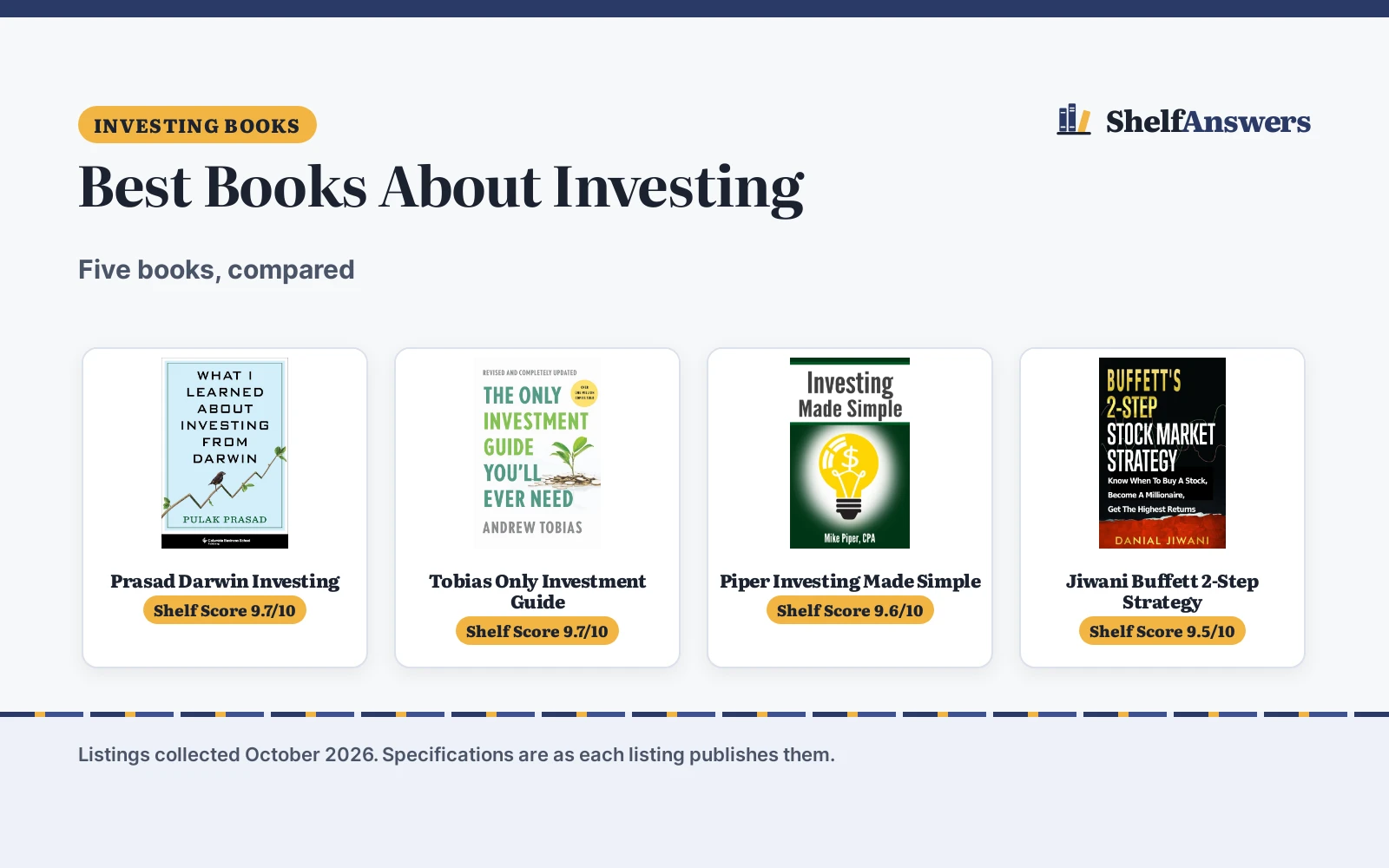
At a glance
Top picks
As an Amazon Associate I earn from qualifying purchases. How we score
Picking the best books about investing starts with the reader in front of you: a beginner who needs index funds explained in plain English, or a patient investor hunting for a philosophy to hold for decades. We compared five books by print length, publisher, publication date and what each description says, so you can match the book to the reader.
ShelfAnswers earns a commission when you buy through links on this page, at no extra cost to you. As an Amazon Associate I earn from qualifying purchases. Affiliate disclosure.
Quick picks
 Best Overall Prasad Darwin Investing: Patient long-term investing, 328 pages Check price on Amazon
 Best Personal Finance Tobias Only Investment Guide: Revised guide, 320 pages, crypto and retirement Check price on Amazon
 Best Quick Primer Piper Investing Made Simple: Index funds and ETFs in 120 pages Check price on Amazon
 Best Beginner Stocks Jiwani Buffett 2-Step Strategy: Buffett-style 2-step strategy, 186 pages Check price on Amazon
 Best Day Trading Cameron How to Day Trade: Candid day trading truth, 217 pages Check price on Amazon
The picks
| # | Product | Shelf Score | Buy |
|---|---|---|---|
| 1 | Prasad Darwin Investing | 9.7/10 | Buy |
| 2 | Tobias Only Investment Guide | 9.7/10 | Buy |
| 3 | Piper Investing Made Simple | 9.6/10 | Buy |
| 4 | Jiwani Buffett 2-Step Strategy | 9.5/10 | Buy |
| 5 | Cameron How to Day Trade | 9.5/10 | Buy |

Prasad Darwin Investing
A 328-page investing philosophy from Columbia Business School Publishing, arguing for patient long-term ownership of high-quality businesses.
Pros
- 328-page philosophy of patient long-term investing
- Draws on evolutionary biology with vivid examples
- From Columbia Business School Publishing, 2023
Cons
- No reading age or grade level stated
- Philosophy-heavy; light on step-by-step tactics
- The description says the strategy rules out most opportunities, which may frustrate active stock pickers

Tobias Only Investment Guide
A 320-page revised personal finance guide from Harper Business, covering savings, the stock market, retirement plans and modern topics like cryptocurrency.
Pros
- 320-page revised guide covering retirement, crypto and NFTs
- From Harper Business, updated April 2022
- Witty, jargon-free style per the description
Cons
- Personal finance breadth means less depth on stock picking
- No reading age or grade level stated
- No series position or bonus material stated
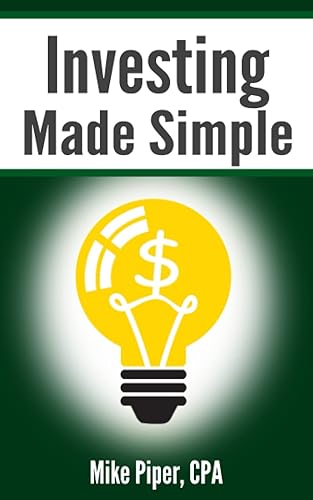
Piper Investing Made Simple
A 120-page plain-English primer on index fund and ETF investing, covering asset allocation, retirement accounts and common investor mistakes.
Pros
- 120-page plain-English primer on index funds and ETFs
- Covers asset allocation, IRAs and 401(k)s
- Short read designed for true beginners
Cons
- Brief by design; not for advanced readers
- No reading age or grade level stated
- The description warns it will not make anyone an expert overnight

Jiwani Buffett 2-Step Strategy
A 186-page beginner book presenting a two-step strategy for deciding which stock to buy and when, aimed at new stock market investors.
Pros
- 186-page beginner strategy in two steps
- Focused on when and what to buy
- Independently published, 2020
Cons
- The description makes large return claims the reader cannot verify
- No reading age or grade level stated
- Buffett-focused; narrow on other strategies

Cameron How to Day Trade
A 217-page candid day trading primer from Warrior Trading that opens with the warning that most traders lose money, with twenty guardrails for beginners.
Pros
- 217-page candid look at day trading for beginners
- Twenty specific guardrails, per the description
- Warns that most traders lose money
Cons
- Day trading, not investing; a partial fit for this list
- No reading age or grade level stated
- Beginner-focused; experienced traders may find it basic
As an Amazon Associate I earn from qualifying purchases.
More picks to compare
 Beardsley Multifamily UnderwritingFor multifamily real estate underwriting: 113 pages.Check on Amazon
 Roberts Rental PropertiesFor rental property beginners: 179 pages, book 2 of 2.Check on Amazon
 Kawaoka Wealth ElevatorFor real estate syndications and tax strategies: 206 pages.Check on Amazon
 Bagwandeen Absolute BeginnersFor absolute beginners: 100 pages on index funds.Check on Amazon
 Bansal Dumb InvestorFor a simple index-fund system: 243 pages.Check on Amazon
Compare the picks
| Book | Shelf Score | Pages | Publisher | Published | Amazon |
|---|---|---|---|---|---|
| Prasad Darwin Investing | 9.7/10 | 328 | Columbia Business School Publishing | 2023 | Check price |
| Tobias Only Investment Guide | 9.7/10 | 320 | Harper Business | 2022 | Check price |
| Piper Investing Made Simple | 9.6/10 | 120 | Not stated | 2023 | Check price |
| Jiwani Buffett 2-Step Strategy | 9.5/10 | 186 | Independently published | 2020 | Check price |
| Cameron How to Day Trade | 9.5/10 | 217 | Warrior Trading | 2023 | Check price |
Specifications are as each listing publishes them, collected 18 October 2026.
How we scored them
The Shelf Score weighs fit for the reader, contents and edition, value, and stated reading level. None of the five listings states a reading age or grade level, so that part of the score is zero for all. How we pick explains the weights.
| Book | Shelf Score | Fit /35 | Contents /25 | Value /25 | Age/level /10 |
|---|---|---|---|---|---|
| Prasad Darwin Investing | 9.7 | 30 | 21 | 20 | n/a |
| Tobias Only Investment Guide | 9.7 | 29 | 21 | 20 | n/a |
| Piper Investing Made Simple | 9.6 | 29 | 19 | 19 | n/a |
| Jiwani Buffett 2-Step Strategy | 9.5 | 28 | 18 | 18 | n/a |
| Cameron How to Day Trade | 9.5 | 23 | 20 | 18 | n/a |
Scores run from 9.2 to 9.8: each book’s point total is placed on that range, so more points always means a higher score. Reading age or level counts on a list where at least one listing gives one, and a book whose listing gives none then scores zero on it. Where no listing gives one, the score is taken over the other 85 points. Books carry no warranty, so warranty is not scored.
How to choose the best books about investing
Start with the reader’s level
A true beginner does best with the shortest, plainest book: Piper’s 120-page primer explains index funds, ETFs, asset allocation and retirement accounts in plain English. A reader who already invests and wants a way of thinking will get more from Prasad’s 328-page Darwinian philosophy or Tobias’s 320-page revised guide.
Check the edition date
Investing books age. Tobias’s revised edition is from April 2022 and covers cryptocurrency, NFTs and the GameStop episode; Piper’s is from April 2023; Prasad’s from May 2023. For anything about taxes or retirement accounts, confirm the current rules elsewhere, since the listings describe the books, not the law.
Before you buy
- Check the format: print lengths here run 120 to 320 pages, so match the book to the reader’s patience.
- Match the book to the reader: Piper’s 120-page primer for beginners, Prasad’s 328-page philosophy for patient investors.
- Day trading is not investing: Cameron’s book fits active traders only.
Frequently Asked Questions
Which investing book should a complete beginner read first?
Piper’s Investing Made Simple: 120 pages, plain English, index funds and ETFs. The Hanif Bagwandeen beginner book in our more picks is another short starting point at 100 pages.
Are these books about day trading or long-term investing?
Mostly long-term investing. Cameron’s How to Day Trade is the exception: it is about active trading, and the description warns that most traders lose money.
Do any of these cover real estate?
No. For property investing, see our best books on real estate investing list.
Related lists
Also see our best books on value investing. Also see our best non fiction books about money. Also see our best books on real estate investing.
More lists: browse business books.