Best Civil Rights History Books (2026): Movement Stories
Civil rights histories compared by years covered, length and edition, from the early movement years and the press to organizing roots and abolitionist biography.

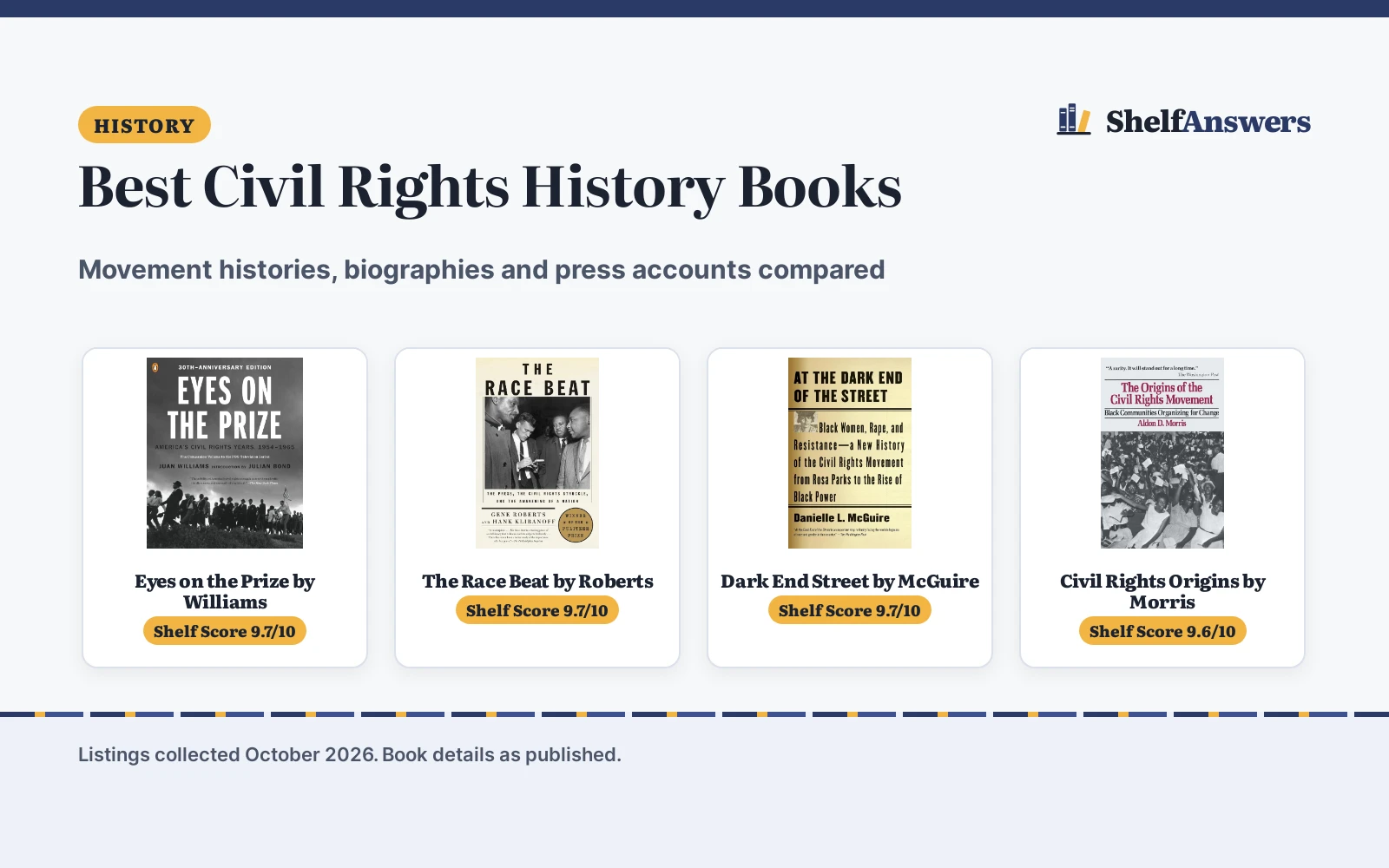
At a glance
Top picks
As an Amazon Associate I earn from qualifying purchases.
A reader opening the story of the movement wants the marches, the organizing and the people behind them, and the best civil rights history books here cover the early years, the press and the roots of the struggle.
ShelfAnswers earns a commission when you buy through links on this page, at no extra cost to you. As an Amazon Associate I earn from qualifying purchases. Affiliate disclosure.
Quick picks
 Best Overall Eyes on the Prize by Williams: Civil rights years 1954 to 1965, 336 pages, anniversary edition. Check price on Amazon
 Best on the Press The Race Beat by Roberts: Press and civil rights struggle, 544 pages, Pulitzer per listing. Check price on Amazon
 Best New History Dark End Street by McGuire: Black women’s resistance from Rosa Parks to Black Power, 416 pages. Check price on Amazon
 Best on Organizing Civil Rights Origins by Morris: Black communities organizing for change, 354 pages. Check price on Amazon
 Best Biography John Brown by Reynolds: Cultural biography of John Brown, 592 pages. Check price on Amazon
The picks
| # | Product | Shelf Score | Buy |
|---|---|---|---|
| 1 | Eyes on the Prize by Williams | 9.7/10 | Buy on Amazon |
| 2 | The Race Beat by Roberts | 9.7/10 | Buy on Amazon |
| 3 | Dark End Street by McGuire | 9.7/10 | Buy on Amazon |
| 4 | Civil Rights Origins by Morris | 9.6/10 | Buy on Amazon |
| 5 | John Brown by Reynolds | 9.6/10 | Buy on Amazon |

Eyes on the Prize by Williams
A history of the early civil rights years, 1954 to 1965, for readers who want the movement from boycott to march, not a biography.
Pros
- Covers 1954 to 1965
- 336 pages
- 30th-anniversary edition
Cons
- Reprint from 2013, not a new release
- Early years only, not later movement years
- No reading age or grade level is stated

The Race Beat by Roberts
A history of the press and the civil rights struggle for readers who want journalism’s role, not a biography.
Pros
- The listing states it won the Pulitzer Prize
- 544 pages, illustrated edition
- Draws on correspondence, notes and interviews
Cons
- Press angle only, not movement organizing
- 2007 edition, an older release
- No reading age or grade level is stated

Dark End Street by McGuire
A new history from Rosa Parks to Black Power, for readers who want Black women’s resistance at the center.
Pros
- 416 pages, illustrated edition
- Reinterprets the movement through Black women’s resistance
- From Rosa Parks to Black Power, per the title
Cons
- The description includes sexual violence, stated plainly
- 2011 publication, an older edition
- No reading age or grade level is stated

Civil Rights Origins by Morris
A history of Black communities organizing for change, for readers who want the organizing roots, not a single-event account.
Pros
- Complete story of the organizing behind the movement
- 354 pages
- Starts with Rosa Parks on December 1, 1955
Cons
- 1986 publication, the oldest full-data pick
- Organizing focus, not a broad narrative
- No reading age or grade level is stated

John Brown by Reynolds
A cultural biography of John Brown for readers who want pre-Civil War roots, not the 1950s movement.
Pros
- 592 pages
- Cultural biography tracing Brown’s impact, per the listing
- Single-person focus, depth on one figure
Cons
- The description includes violence, stated plainly
- Pre-Civil War focus, not the 1950s movement
- No reading age or grade level is stated
As an Amazon Associate I earn from qualifying purchases.
More picks to compare
 Free At Last by BullardIllustrated civil rights history for ages 10 to adult, 112 pages.Check on Amazon
 Voices of Freedom by HamptonOral history from nearly one thousand interviews, 720 pages.Check on Amazon
 Before the Movement by PenningrothHidden history of Black civil rights before the movement, 496 pages.Check on Amazon
 Civil Rights Photo History by KasherPhotographic history of the movement, 1954–68, 256 pages.Check on Amazon
Compare the picks
| Book | Shelf Score | Author | Pages | Published | Edition | Amazon |
|---|---|---|---|---|---|---|
| Eyes on the Prize by Williams | 9.7/10 | Juan Williams | 336 | 2013 | Reprint | View on Amazon |
| The Race Beat by Roberts | 9.7/10 | Gene Roberts, Hank Klibanoff | 544 | 2007 | Illustrated | View on Amazon |
| Dark End Street by McGuire | 9.7/10 | Danielle L. McGuire | 416 | 2011 | Illustrated | View on Amazon |
| Civil Rights Origins by Morris | 9.6/10 | Aldon D. Morris | 354 | 1986 | Not stated | View on Amazon |
| John Brown by Reynolds | 9.6/10 | David S. Reynolds | 592 | 2006 | Reprint | View on Amazon |
Book details as published on each listing, collected 25 October 2026.
How we scored them
The Shelf Score weighs fit, contents and edition, value, and the listed reading age or level where given. None of the picks list a reading age or grade level. How we pick explains the weights.
| Book | Shelf Score | Fit /35 | Contents /25 | Value /25 | Age/level /10 |
|---|---|---|---|---|---|
| Eyes on the Prize by Williams | 9.7 | 32 | 21 | 20 | n/a |
| The Race Beat by Roberts | 9.7 | 30 | 21 | 20 | n/a |
| Dark End Street by McGuire | 9.7 | 30 | 20 | 20 | n/a |
| Civil Rights Origins by Morris | 9.6 | 30 | 20 | 19 | n/a |
| John Brown by Reynolds | 9.6 | 27 | 21 | 20 | n/a |
Scores run from 9.2 to 9.8: each book’s point total is placed on that range, so more points always means a higher score. Reading age or level counts on a list where at least one listing gives one, and a book whose listing gives none then scores zero on it. Where no listing gives one, the score is taken over the other 85 points. Books carry no warranty, so warranty is not scored.
How to choose the best civil rights history books
Start with the years
Eyes on the Prize covers 1954 to 1965, while The Origins of the Civil Rights Movement covers the 1950s and 1960s. John Brown, Abolitionist reaches back before the Civil War, and At the Dark End of the Street runs from Rosa Parks to Black Power. See Civil War books for the earlier war years.
Narrative, biography or press
A narrative suits the movement as a whole, while a biography suits depth on one figure. John Brown, Abolitionist is a cultural biography, and The Race Beat covers the press and the struggle. See American Revolution books for an earlier American struggle.
Check the edition
The Origins of the Civil Rights Movement dates to 1986, while Eyes on the Prize is a reprint from September 3, 2013, and The Race Beat an illustrated edition from September 4, 2007. Check the edition before buying.
Before you buy
- Check the years covered.
- Check the edition and page count.
- Check the description for mature themes.
Frequently Asked Questions
Where should a reader start?
With Eyes on the Prize, which covers 1954 to 1965.
Does The Race Beat cover the movement itself?
It covers the press and the struggle, showing how news stories changed the nation’s thinking.
Is John Brown, Abolitionist about the 1950s movement?
No. It is a cultural biography of an abolitionist whose acts seeded civil rights before the Civil War.
Related lists
See every Nonfiction list.
More lists: Native American history, biographies in history, homeschool unit studies and colonial America.