Best Books on Buddhist Philosophy (2026): 5 Picks Compared
Five books on Buddhist philosophy compared by author, print length, edition and listed reading age, from a classic college intro to a 2025 daily reader.

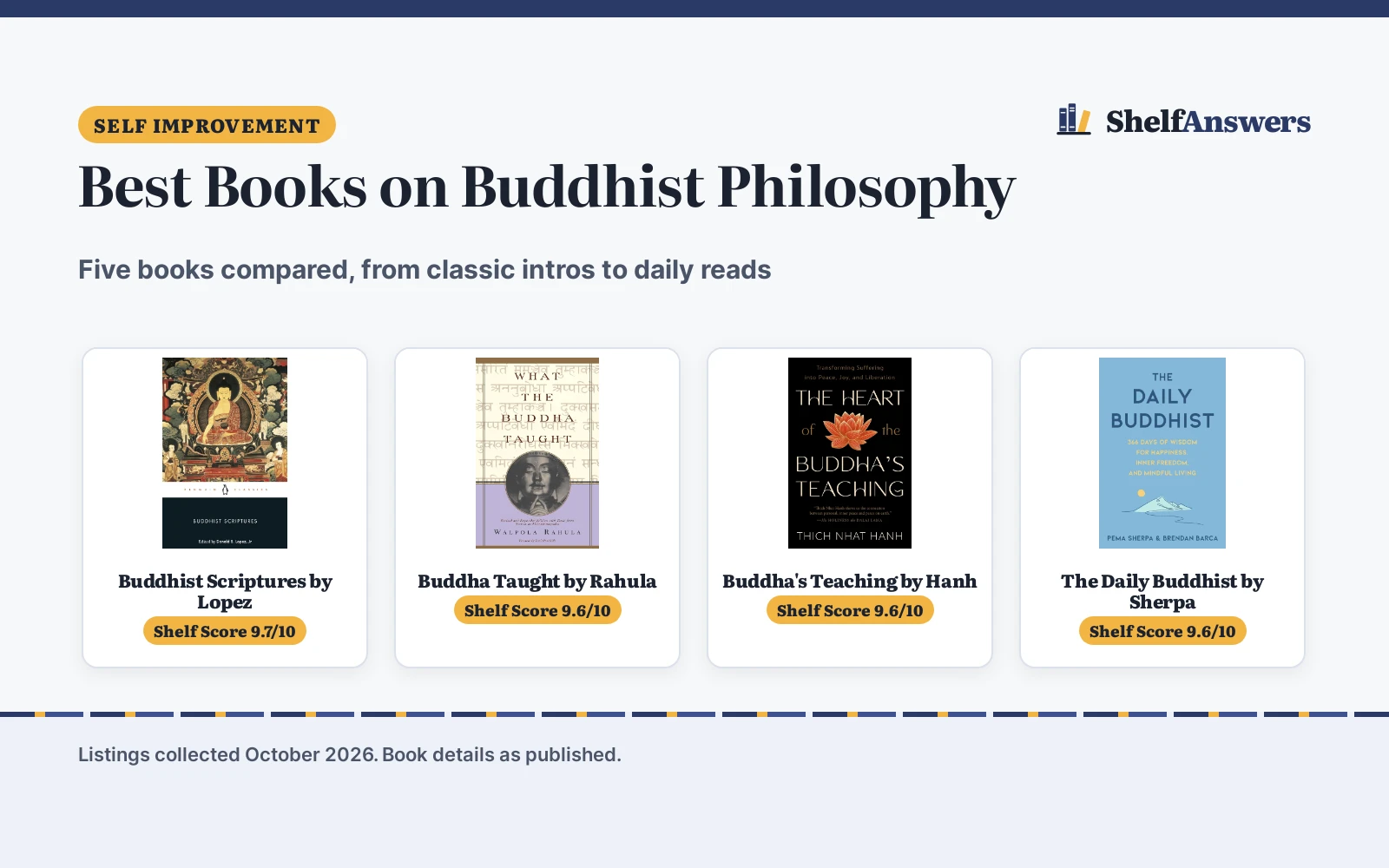
At a glance
Top picks
As an Amazon Associate I earn from qualifying purchases.
Finding the best books on buddhist philosophy starts with the reader: someone curious about the Buddha’s teachings, or a student who needs a reliable introduction for a course. We compared the leading titles by author, print length, publication date and what each description says, so you can match the book to the reader.
ShelfAnswers earns a commission when you buy through links on this page, at no extra cost to you. As an Amazon Associate I earn from qualifying purchases. Affiliate disclosure.
Quick picks
 Best Overall Buddhist Scriptures by Lopez: 608 pages of primary texts with a scholar’s introduction Check price on Amazon
 Best Classic Intro Buddha Taught by Rahula: College-course intro with Sutta and Dhammapada texts Check price on Amazon
 Best Core Teachings Buddha’s Teaching by Hanh: Four Noble Truths and the Eightfold Path, clearly explained Check price on Amazon
 Best Daily Read The Daily Buddhist by Sherpa: 366 daily doses from Buddhist masters across traditions Check price on Amazon
 Best on Happiness Art of Happiness by Dalai Lama: The Dalai Lama on happiness, loss and everyday life Check price on Amazon
The picks
| # | Product | Shelf Score | Buy |
|---|---|---|---|
| 1 | Buddhist Scriptures by Lopez | 9.7/10 | Buy on Amazon |
| 2 | Buddha Taught by Rahula | 9.6/10 | Buy on Amazon |
| 3 | Buddha's Teaching by Hanh | 9.6/10 | Buy on Amazon |
| 4 | The Daily Buddhist by Sherpa | 9.6/10 | Buy on Amazon |
| 5 | Art of Happiness by Dalai Lama | 9.5/10 | Buy on Amazon |

Buddhist Scriptures by Lopez
For the reader who wants the primary texts themselves, with a scholar's introduction and chapter prefaces.
Pros
- 608 pages of scripture from Pali, Sanskrit, Tibetan, Chinese and Japanese sources
- Informative introduction, chapter prefaces, glossary and further reading
- Many texts presented in English for the first time
Cons
- Reading age 18 years and up, so not for younger readers
- An anthology, not a single guided introduction
- 2004 first edition; no newer edition stated

Buddha Taught by Rahula
For the newcomer who wants one compact, college-course introduction to the Buddha's teachings.
Pros
- Revised edition with Sutta and Dhammapada texts translated by the author
- 16 illustrations plus a bibliography, glossary and index
- Compact 192 pages, popular in colleges and universities
Cons
- 1994 publication date; an older edition
- No reading age or grade level stated
- Scholarly tone may not suit a casual reader

Buddha's Teaching by Hanh
For the reader who wants a clear walk through the Four Noble Truths and the Noble Eightfold Path.
Pros
- Revised edition with added material and new insights
- Covers the Four Noble Truths, the Noble Eightfold Path and the Three Dharma Seals
- 305 pages from a widely taught Buddhist teacher
Cons
- 1999 publication date; an older edition
- No reading age or grade level stated
- One teacher's presentation, not a survey of schools

The Daily Buddhist by Sherpa
For the reader who wants one page of Buddhist wisdom to sit with each morning.
Pros
- 366 daily entries drawing on Nagarjuna, Santideva, Milarepa and others
- 432 pages, the longest book here
- Published 2025: the most current edition here
Cons
- Cover credits one author; the listing names two
- Daily format, not a cover-to-cover introduction
- No reading age or grade level stated

Art of Happiness by Dalai Lama
For the reader who wants conversations on happiness, loss and everyday life.
Pros
- 336 pages of conversations on happiness, loss and relationships
- Pairs the Dalai Lama with psychiatrist Howard Cutler
- 2020 trade paperback edition
Cons
- A happiness guide rather than a philosophy text
- No reading age or grade level stated
- Conversation format, not systematic teaching
As an Amazon Associate I earn from qualifying purchases.
More picks to compare
 The Philosophy of Zen Buddhism by HanFor readers comparing Zen Buddhism with Western philosophy, 120 pages.Check on Amazon
 Philosophy of a Buddhist LifeFor modern readers wanting mindfulness and compassion guidance, Book 1 of 6.Check on Amazon
 Buddhist Philosophy: Essential ReadingsFor students wanting primary texts with scholarly introductions, 457 pages.Check on Amazon
 365 Days of BuddhismFor readers wanting a daily one-page guide to Buddhist philosophy.Check on Amazon
 Indian Madhyamaka Buddhist PhilosophyFor readers studying Nagarjuna and Madhyamaka philosophy.Check on Amazon
Compare the picks
| Book | Shelf Score | Author | Pages | Published | Amazon |
|---|---|---|---|---|---|
| Buddhist Scriptures by Lopez | 9.7/10 | Donald Lopez | 608 | August 31, 2004 | View on Amazon |
| Buddha Taught by Rahula | 9.6/10 | Walpola Rahula | 192 | January 11, 1994 | View on Amazon |
| Buddha’s Teaching by Hanh | 9.6/10 | Thich Nhat Hanh | 305 | June 8, 1999 | |
| The Daily Buddhist by Sherpa | 9.6/10 | Pema Sherpa | 432 | May 27, 2025 | View on Amazon |
| Art of Happiness by Dalai Lama | 9.5/10 | Dalai Lama | 336 | July 21, 2020 | View on Amazon |
Book details as published on each listing, collected 23 October 2026.
How we scored them
The Shelf Score weighs fit for the reader, contents and edition, value, and the listed reading age or level where one is given. One of the five listings gives a reading age (18 years and up); none gives a grade level. How we pick explains the weights.
| Book | Shelf Score | Fit /35 | Contents /25 | Value /25 | Age/level /10 |
|---|---|---|---|---|---|
| Buddhist Scriptures by Lopez | 9.7 | 29 | 22 | 21 | 7 |
| Buddha Taught by Rahula | 9.6 | 32 | 22 | 20 | 0 |
| Buddha’s Teaching by Hanh | 9.6 | 32 | 21 | 20 | 0 |
| The Daily Buddhist by Sherpa | 9.6 | 28 | 22 | 21 | 0 |
| Art of Happiness by Dalai Lama | 9.5 | 27 | 20 | 20 | 0 |
Scores run from 9.2 to 9.8: each book’s point total is placed on that range, so more points always means a higher score. Reading age or level counts on a list where at least one listing gives one, and a book whose listing gives none then scores zero on it. Where no listing gives one, the score is taken over the other 85 points. Books carry no warranty, so warranty is not scored.
How to choose the best books on buddhist philosophy
Start with the reader’s goal
A newcomer fits What the Buddha Taught: a classic introduction, popular in colleges, at 192 pages. A reader who wants a daily habit fits The Daily Buddhist, with 366 entries drawn from masters across traditions. For a broader shelf, see our best books about philosophy.
Check the edition and the date
The Heart of the Buddha’s Teaching is a revised edition with added material from 1999, and What the Buddha Taught is a revised edition from 1994. The Daily Buddhist is the most current, published in 2025, while Buddhist Scriptures is the 2004 first edition. For more starting points, see our best intro to philosophy books.
Decide between primary texts and guides
Buddhist Scriptures collects 608 pages of primary texts in translation, with a scholar’s introduction and chapter prefaces. The Art of Happiness interprets instead, pairing the Dalai Lama with a psychiatrist for conversations on happiness and loss.
Before you buy
- Check the edition: the Heart listing is the revised edition with added material, and the Buddhist Scriptures listing is the 2004 first edition.
- Match the length to the reader: 192 pages for What the Buddha Taught, 608 for Buddhist Scriptures.
- Compare the reading age with the reader: only the Buddhist Scriptures listing states one (18 years and up).
Frequently Asked Questions
Where should a beginner start?
What the Buddha Taught: a classic introduction, popular in colleges, with Sutta and Dhammapada texts in a revised 192-page edition.
Which book has the primary texts?
Buddhist Scriptures: 608 pages of texts from Pali, Sanskrit, Tibetan, Chinese and Japanese sources. The listing gives a reading age of 18 years and up.
Which is the most recent?
The Daily Buddhist, published May 27, 2025: 366 daily entries across 432 pages, from Nagarjuna to the Buddha.
Related lists
See every self improvement list and all nonfiction lists.
More lists: eastern philosophy books, philosophy for personal growth and japanese philosophy books.