Best Books on Japanese Philosophy (2026): 5 Picks Compared
Five books on Japanese philosophy compared by contents, edition and fit, from a 13th-century hermit's poem to the jisei death-poem tradition.

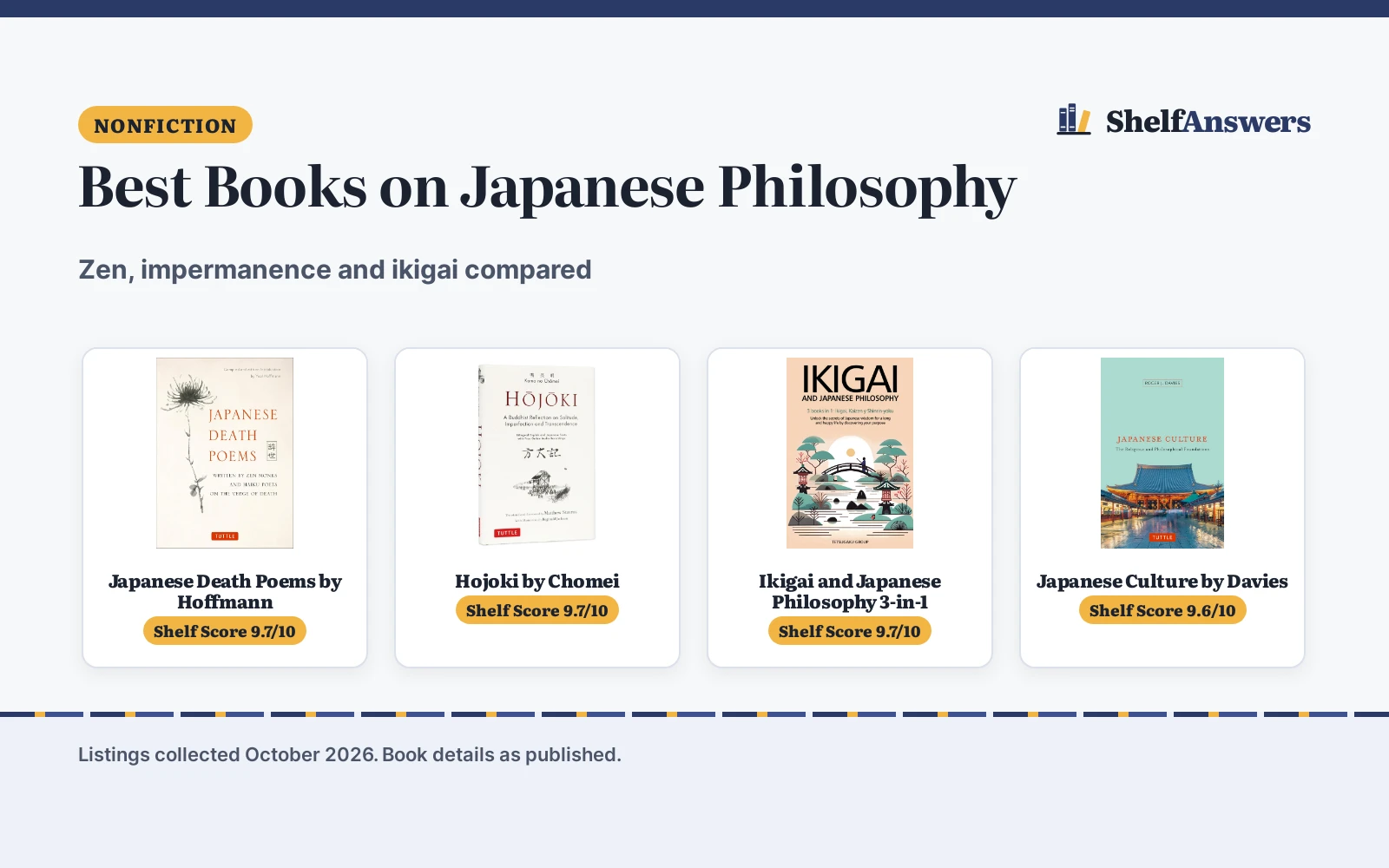
At a glance
Top picks
As an Amazon Associate I earn from qualifying purchases.
The best books on japanese philosophy meet readers who want more than a slogan: a clear look at impermanence, purpose and quiet daily practice. This list compares the listings on fit, contents and edition, and who each book suits.
ShelfAnswers earns a commission when you buy through links on this page, at no extra cost to you. As an Amazon Associate I earn from qualifying purchases. Affiliate disclosure.
Quick picks
 Best Overall Japanese Death Poems by Hoffmann: Death poems across centuries, with commentary and haiku in two languages. Check price on Amazon
 Best for Zen Buddhism Hojoki by Chomei: A 13th-century hermit on impermanence, bilingual with audio. Check price on Amazon
 Best Overview Japanese Culture by Davies: One readable volume on Shintoism, Buddhism, Zen and Confucianism. Check price on Amazon
 For the Present Moment The Book of Ichigo Ichie by García: A thin-listed pick on the present moment; check the listing first. Check price on Amazon
 For Ikigai Readers Ikigai and Japanese Philosophy 3-in-1: Three ikigai titles in one volume; title-only listing. Check price on Amazon
The picks
| # | Product | Shelf Score | Buy |
|---|---|---|---|
| 1 | Japanese Death Poems by Hoffmann | 9.7/10 | Buy on Amazon |
| 2 | Hojoki by Chomei | 9.7/10 | Buy on Amazon |
| 3 | Ikigai and Japanese Philosophy | 9.7/10 | Buy on Amazon |
| 4 | Japanese Culture by Davies | 9.6/10 | Buy on Amazon |
| 5 | Ichigo Ichie | 9.5/10 | Buy on Amazon |

Japanese Death Poems by Hoffmann
Fits readers curious about the jisei farewell-poem tradition and how Japanese culture has faced mortality.
Pros
- Hundreds of death poems, many in English for the first time.
- Commentary on many poets' deaths, plus Zen ideas about death.
- Three hundred twenty haiku in translated English and romanized Japanese.
Cons
- Centers on death; for readers ready for that theme.
- A poetry collection, not an intro to philosophy's schools.
- A 2018 reprint; check for a newer printing.

Hojoki by Chomei
Fits readers wanting a short classic on impermanence in bilingual text with audio.
Pros
- Bilingual text puts the original Classical Japanese beside the translation.
- This edition pairs the bilingual text with online audio recordings.
- Stated print length of 192 pages; one focused volume.
Cons
- One 13th-century poem, not a survey of philosophy.
- A classical voice, not modern commentary.
- No reading age or grade level stated.

Ikigai and Japanese Philosophy
Three books in one on ikigai and Japanese philosophy, suited to readers who want a full survey in one volume.
Pros
- Three books in one volume
- 148 pages, published January 13, 2025
- Covers ikigai plus wider Japanese philosophy
Cons
- No named author is stated, only the TETSUGAKU GROUP brand
- Compilation format may lack a single authorial voice
- Readers wanting one author's view should pick a single-author title

Japanese Culture by Davies
Fits beginners wanting an overview of Shintoism, Buddhism, Zen and Confucianism.
Pros
- Shintoism, Buddhism, Taoism, Zen, Confucianism and Western influence in one volume.
- Endnotes and discussion activities suit classroom or group study.
- Book 2 of the two-book Japanese Mind series.
Cons
- Broad coverage; readers wanting deep Zen may want a narrower title.
- 160 pages keeps each tradition brief.
- 2016 edition; check for a newer printing.

Ichigo Ichie
A guide to ichigo ichie, the Japanese art of making the most of every moment.
Pros
- Teaches the ichigo ichie concept from the authors of Ikigai
- 208 pages from Penguin Life, published December 31, 2019
- Covers the five senses, coincidences and finding purpose
Cons
- No reading age is stated
- 208 pages is the shortest of the philosophy books here
- No exercises or workbook format, all prose
As an Amazon Associate I earn from qualifying purchases.
More picks to compare
 Shibui by IshidaFits readers interested in aging gracefully through a Japanese lens, with watercolor illustrations.Check on Amazon
 Ikigai by MyakanoFits readers wanting a step-by-step ikigai guide for purpose and daily goals.Check on Amazon
 Japanese Philosophy 5-in-1Fits readers wanting ikigai, kaizen and wabi-sabi in one 375-page volume.Check on Amazon
 Nishitani Keiji by UnnoFits serious students of Nishitani Keiji's work on emptiness and nothingness.Check on Amazon
 Philosophy as MetanoeticsFits readers ready for a dense wartime work on self-critique and absolute nothingness.Check on Amazon
Compare the picks
| Book | Shelf Score | Author | Pages | Published | Amazon |
|---|---|---|---|---|---|
| Japanese Death Poems by Hoffmann | 9.7/10 | Yoel Hoffmann | 368 | April 3, 2018 | View on Amazon |
| Hojoki by Chomei | 9.7/10 | Kamo no Chomei | 192 | May 7, 2024 | View on Amazon |
| Japanese Culture by Davies | 9.6/10 | Roger J. Davies | 160 | August 9, 2016 | View on Amazon |
| The Book of Ichigo Ichie by García | 9.5/10 | Héctor García | Not stated | Not stated | |
| Ikigai and Japanese Philosophy 3-in-1 | 9.7/10 | TETSUGAKU GROUP | Not stated | Not stated |
Book details as published on each listing, collected 23 October 2026.
How we scored them
The Shelf Score weighs fit for the reader, contents and edition, value, and the listed reading age or level where one is given. No pick lists a reading age or grade level. How we pick explains the weights.
| Book | Shelf Score | Fit /35 | Contents /25 | Value /25 | Age/level /10 |
|---|---|---|---|---|---|
| Japanese Death Poems by Hoffmann | 9.7 | 30 | 21 | 21 | n/a |
| Hojoki by Chomei | 9.7 | 29 | 21 | 20 | n/a |
| Japanese Culture by Davies | 9.6 | 28 | 20 | 19 | n/a |
Scores run from 9.2 to 9.8: each book’s point total is placed on that range, so more points always means a higher score. Reading age or level counts on a list where at least one listing gives one, and a book whose listing gives none then scores zero on it. Where no listing gives one, the score is taken over the other 85 points. Books carry no warranty, so warranty is not scored.
How to choose the best books on japanese philosophy
Start with fit, not fame
New readers get more from Japanese Culture by Davies, which surveys the schools in one volume, than from a single-subject title. Readers drawn to Zen may prefer Hojoki or the death-poem collection. For wider reading, see eastern philosophy books.
Check the edition and the extras
Compare what is inside: the Hojoki edition adds online audio to its bilingual text, while the death-poems volume is a 2018 reprint. For one more direction, see books about philosophy.
Before you buy
- Check the publication date and edition for a newer printing.
- Confirm series order: Japanese Culture is Book 2 of 2.
- Note which listings state extras, and which state almost nothing.
Frequently Asked Questions
Where should a beginner start?
Start with Japanese Culture by Davies, which surveys Shintoism, Buddhism, Zen and Confucianism in one volume.
Which pick suits a reader interested in Zen?
Hojoki reflects on impermanence, and Japanese Death Poems covers Zen ideas about death alongside translated verse.
Do any of these books list a reading age?
No listing states a reading age or grade level; match each book to the reader from its contents.
Related lists
See every self-improvement list and all nonfiction lists.
More lists: eastern philosophy books, intro to philosophy books, books about philosophy and self help books japanese.