Best Ya Biographies About Scientists (2026)
Five YA biographies about scientists compared: Einstein, Katherine Johnson and more, by reading age, grade level, length and contents.
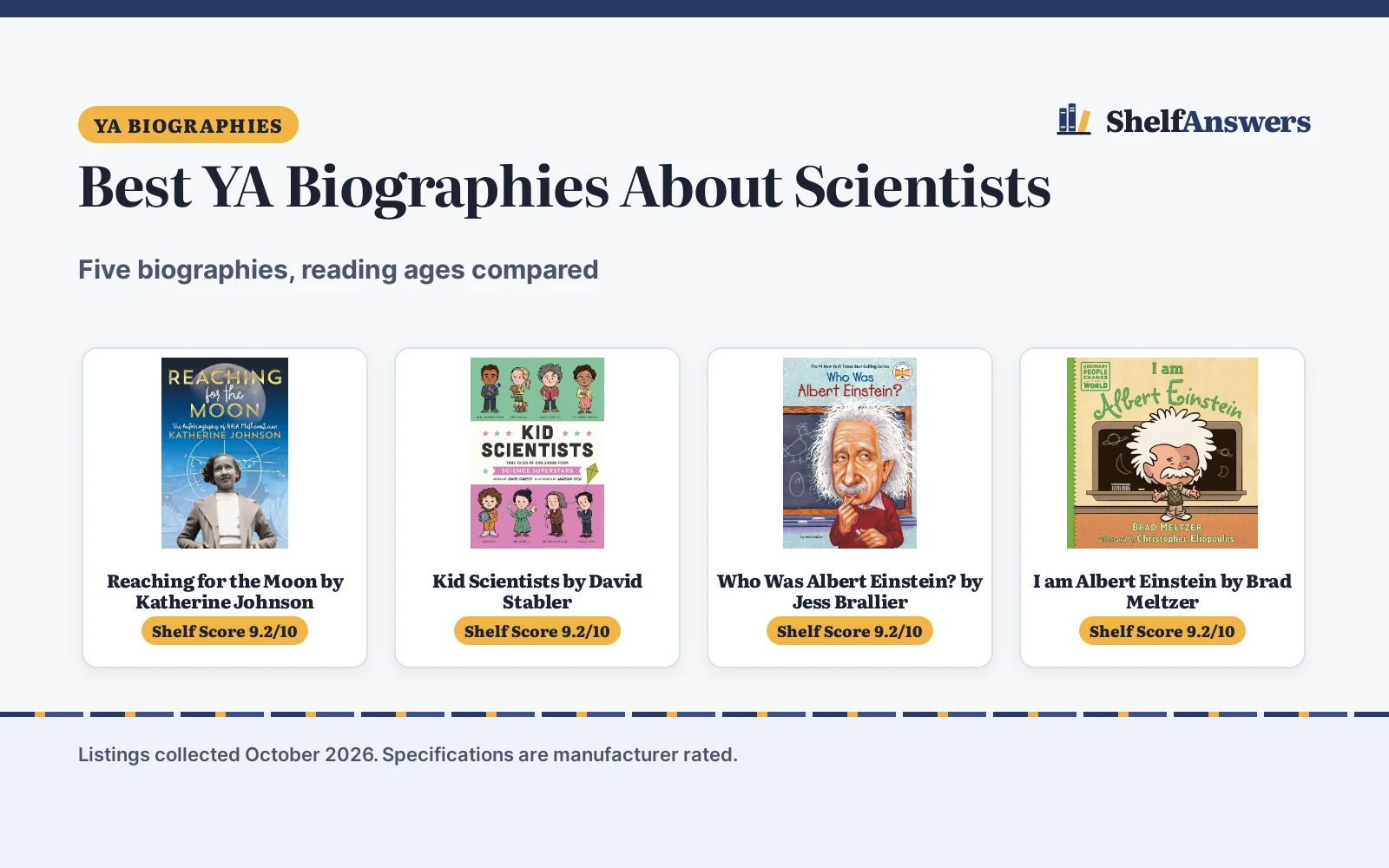
At a glance
Top picks
As an Amazon Associate I earn from qualifying purchases.
A teen who loves science usually finds the subject through a person first, and the best ya biographies about scientists turn curiosity about the stars, numbers or inventions into a reading habit. We compared five biographies by listed reading age, grade level, print length and what each description says, so you can match the book to the teen reader.
ShelfAnswers earns a commission when you buy through links on this page, at no extra cost to you. As an Amazon Associate I earn from qualifying purchases. Affiliate disclosure.
Quick picks
 Best Overall Reaching for the Moon by Katherine Johnson: The Katherine Johnson autobiography: reading age 10 and up, 272 pages, a woman scientist’s own story. Check price on Amazon
 Best Big Picture The Scientists by John Gribbin: 646 illustrated pages telling the history of science through its greatest lives. Check price on Amazon
 Best for Young Readers Kid Scientists by David Stabler: True childhood tales from science superstars, reading age 7 – 10, illustrated. Check price on Amazon
 Best First Biography Who Was Albert Einstein? by Jess Brallier: 112 illustrated pages on Einstein, reading age 7 – 10, from the Who Was series. Check price on Amazon
 Best for Little Kids I am Albert Einstein by Brad Meltzer: 40-page picture-book Einstein biography, reading age 5 – 8. Check price on Amazon
The picks

Reaching for the Moon by Katherine Johnson
The autobiography of NASA mathematician Katherine Johnson, aimed at readers 10 years and up.
Pros
- The subject's own autobiography
- Reading age 10 years and up, grade level 5 - 6
- A woman scientist as the central figure
Cons
- 272 pages is a commitment for a reluctant reader
- Reprint edition, not the original hardcover
- No illustrations noted in the listing

Kid Scientists by David Stabler
True tales of childhood from science superstars, in an illustrated 208-page volume for young readers.
Pros
- True childhood tales from famous scientists
- Reading age 7 - 10 years, grade level 3 - 7
- Illustrated edition from Quirk Books
Cons
- Aimed below teen level
- Childhood focus, not full life stories
- 208 pages covers many lives briefly

Who Was Albert Einstein? by Jess Brallier
An illustrated 112-page biography of Albert Einstein for young readers, from the Who Was series.
Pros
- Reading age 7 - 10 years, grade level 3 - 7
- Illustrated, accessible format
- Part of the popular Who Was series
Cons
- Aimed below teen level
- 112 pages is a quick read
- One scientist only

I am Albert Einstein by Brad Meltzer
A 40-page picture-book biography of Albert Einstein for young children, from the Ordinary People Change the World series.
Pros
- Reading age 5 - 8 years for the youngest readers
- Part of the Ordinary People Change the World series
- Short 40-page format for read-alouds
Cons
- Aimed well below teen level
- 40 pages is the briefest book here
- One scientist only

The Scientists by John Gribbin
A history of science told through the lives of its greatest people, in an illustrated 646-page volume.
Pros
- Covers the whole history of science
- 646 illustrated pages from an established author
- Many scientists in one volume
Cons
- 646 pages is the longest book here
- No reading age or grade level listed
- Adult crossover, not written for teens
As an Amazon Associate I earn from qualifying purchases.
More picks to compare
 Scientists Who Changed History by DK320 pages of visual history from DK, covering the scientists who changed the field.Check on Amazon
 Born Curious by Martha Freeman20 girls who grew up to be scientists, reading age 7 – 12 years, grade level 2 – 7.Check on Amazon
 Ordinary Genius by Stephanie Sammartino McPhersonThe story of Albert Einstein, reading age 10 – 15 years, grade level 4 – 9.Check on Amazon
 Lives of the Scientists by Kathleen KrullExperiments and explosions from scientists' lives, reading age 10 – 12 years, grade level 5 – 7.Check on Amazon
 Atomic Women by Roseanne MontilloThe untold stories of the women behind the atomic age, reading age 12 years and up.Check on Amazon
Compare the picks
| Book | Author | Pages | Reading Age | Grade Level | Best For | Amazon |
|---|---|---|---|---|---|---|
| Reaching for the Moon | Katherine Johnson | 272 pages | 10 years and up | 5 – 6 | Teen readers | |
| The Scientists | John Gribbin | 646 pages | Not stated | Not stated | Science history | |
| Kid Scientists | David Stabler | 208 pages | 7 – 10 years | 3 – 7 | Childhood tales | |
| Who Was Albert Einstein? | Jess Brallier | 112 pages | 7 – 10 years | 3 – 7 | Young readers | |
| I am Albert Einstein | Brad Meltzer | 40 pages | 5 – 8 years | Kindergarten – 4 | Youngest readers |
Book details as published on each listing, collected 22 October 2026.
How we scored them
The Shelf Score weighs fit for a teen reader interested in science, contents and edition, value, and the listed reading age or grade level. Four of the five listings give a reading age and a grade level; The Scientists gives neither, so it scores on contents and edition instead. How we pick explains the weights.
| Book | Shelf Score | Fit /35 | Contents /25 | Value /25 | Age/level /10 |
|---|---|---|---|---|---|
| Reaching for the Moon by Katherine Johnson | 9.2 | 10 | 10 | 10 | 4 |
| Kid Scientists by David Stabler | 9.2 | 9 | 10 | 9 | 3 |
| Who Was Albert Einstein? by Jess Brallier | 9.2 | 9 | 9 | 9 | 3 |
| I am Albert Einstein by Brad Meltzer | 9.2 | 8 | 9 | 9 | 3 |
| The Scientists by John Gribbin | 9.2 | 9 | 10 | 10 | 0 |
Scores run from 9.2 to 9.8: each book’s point total is placed on that range, so more points always means a higher score. Reading age or level counts on a list where at least one listing gives one, and a book whose listing gives none then scores zero on it. Where no listing gives one, the score is taken over the other 85 points. Books carry no warranty, so warranty is not scored.
How to choose the best ya biographies about scientists
Match the reading age to the reader
Reading age here runs from 5 – 8 years on I am Albert Einstein to 10 years and up on Reaching for the Moon. For a teen, the Johnson autobiography is the natural fit: reading age 10 years and up with a grade level of 5 – 6. Younger siblings can start with Who Was Albert Einstein? at reading age 7 – 10 or Kid Scientists at the same range. The Scientists lists no reading age, so treat it as the adult crossover of the group.
One life or many
Three books follow one scientist: Who Was Albert Einstein?, I am Albert Einstein and Reaching for the Moon, the Katherine Johnson autobiography. Two cover many: Kid Scientists tells true tales of childhood from science superstars, and The Scientists tells the history of science through the lives of its greatest people across 646 pages. A reader hooked on one figure will read deeper; a reader who likes variety will finish a collection faster. For more teen nonfiction, browse kids and teens books.
Check the length against the reader’s stamina
Print length runs from 40 pages on I am Albert Einstein to 646 pages on The Scientists. The 40-page Meltzer book suits a reluctant reader or a read-aloud; the 112-page Who Was Albert Einstein? and 208-page Kid Scientists suit middle-grade readers; the 272-page Johnson autobiography suits a teen; the 646-page Gribbin is a long commitment for the most dedicated.
Before you buy
- Check the format: The Scientists is an illustrated history at 646 pages, not a single-life biography.
- Reaching for the Moon is the subject’s own autobiography, written with the NASA mathematician herself.
- For a series, confirm the series position on the listing: I am Albert Einstein is part of the Ordinary People Change the World series.
- Match the grade level, 5 – 6 on the Johnson book and 3 – 7 on the Who Was and Kid Scientists books, to the reader’s grade.
Frequently Asked Questions
What is the best biography of a scientist for teens?
Reaching for the Moon, the autobiography of NASA mathematician Katherine Johnson, fits teens best here: reading age 10 years and up, grade level 5 – 6, and 272 pages. For a longer read, The Scientists covers the history of science through its greatest lives in 646 pages.
Are there biographies of women scientists for teens?
Reaching for the Moon is the autobiography of Katherine Johnson, the NASA mathematician. In the more-picks section, Born Curious profiles 20 girls who grew up to be scientists, and Atomic Women tells the stories of the women behind the atomic age.
Which book suits a younger sibling?
Who Was Albert Einstein? at reading age 7 – 10 and 112 pages, or Kid Scientists at the same reading age with true tales of scientists’ childhoods. I am Albert Einstein, at reading age 5 – 8 and 40 pages, suits the youngest readers.
Is there a single book covering many scientists?
Two: Kid Scientists with true tales of childhood from science superstars, and The Scientists, a 646-page history of science told through the lives of its greatest people. The DK Scientists Who Changed History in more picks covers the same ground visually in 320 pages.
Related: kids and teens books and the young adult books shelf.