Best Self Help Books Japanese (2026): 5 Compared by Theme
Five self help books rooted in Japanese ideas, from decluttering and mindfulness to learning kanji, compared by theme, tone, reading age and stated specs.
At a glance
Top picks
As an Amazon Associate I earn from qualifying purchases.
A quieter shelf, a calmer mind: the best self help books japanese readers return to share a love of small daily practices. We compared five books rooted in Japanese ideas, from decluttering and mindfulness to learning the language itself, by theme, tone, reading age and stated specs, using only what each listing publishes.
ShelfAnswers earns a commission when you buy through links on this page, at no extra cost to you. As an Amazon Associate I earn from qualifying purchases. Affiliate disclosure.
Quick picks
 Best Overall Kondō Tidying Up: The Japanese decluttering classic, reading age 16+ Check price on Amazon
 Best for Beginners Learn Japanese Manga: Manga-style Japanese lessons with native-speaker audio Check price on Amazon
 Best Mindfulness Ichigo Ichie: The art of making the most of every moment Check price on Amazon
 Best Gift Japanese Contentments: Illustrated tour of ikigai, wabi-sabi and more Check price on Amazon
 Most Thorough Kanji Learner’s Course: 2,300 characters with mnemonics and graded reading sets Check price on Amazon
The picks
| # | Product | Shelf Score | Buy |
|---|---|---|---|
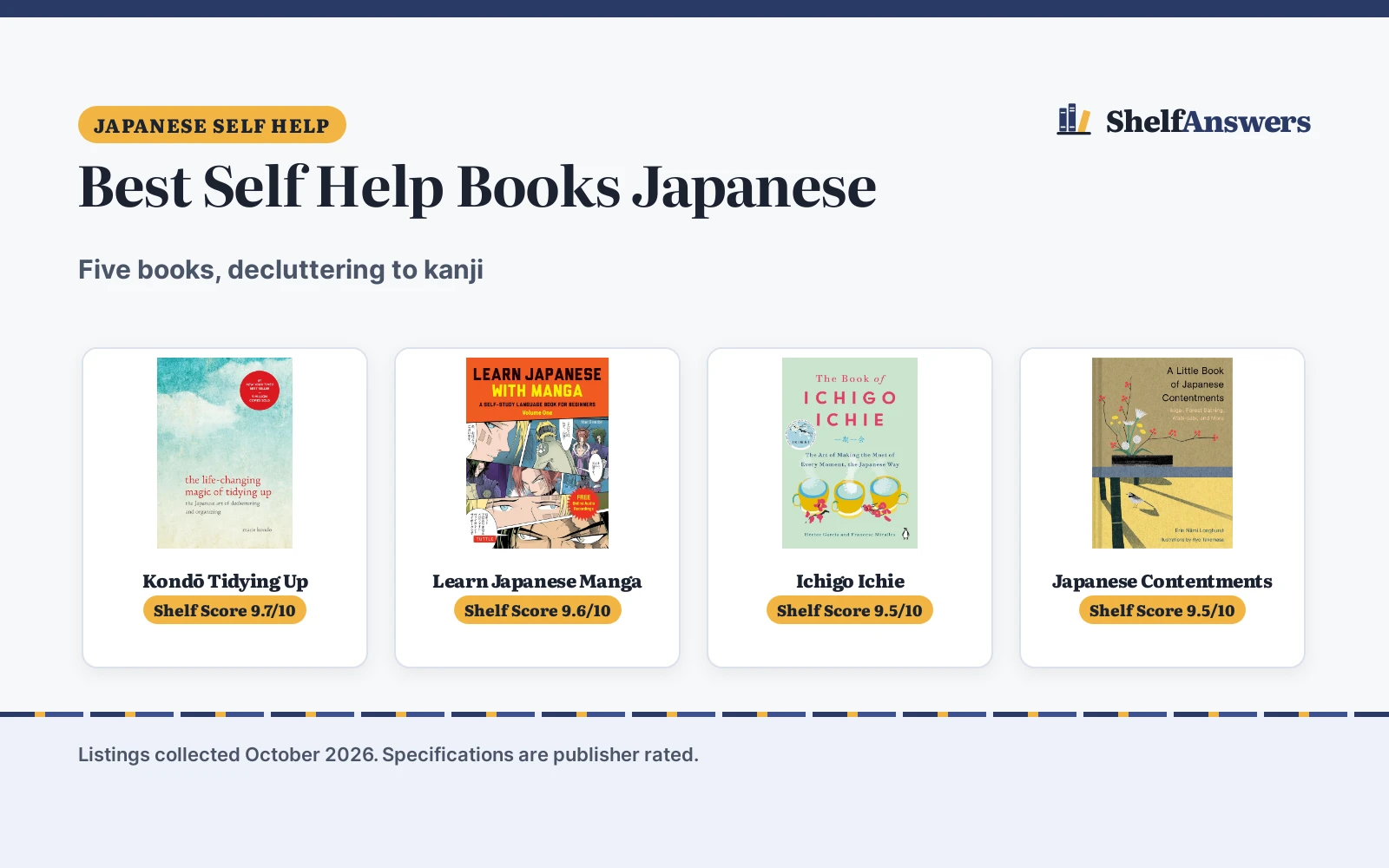
| 1 | Kondō Tidying Up | 9.7/10 | Buy on Amazon |
| 2 | Learn Japanese Manga | 9.6/10 | Buy on Amazon |
| 3 | Ichigo Ichie | 9.5/10 | Buy on Amazon |
| 4 | Japanese Contentments | 9.5/10 | Buy on Amazon |
| 5 | Kanji Learner's Course | 9.5/10 | Buy on Amazon |

Kondō Tidying Up
The Japanese decluttering classic: a category-by-category method for organizing a home once and for all.
Pros
- Teaches the category-by-category KonMari method with detailed guidance
- 224 pages from Ten Speed Press, published October 14, 2014
- Reading age 16 years and up is stated
Cons
- No workbook or exercises are stated, only the method itself
- Book 1 of a 3-book series, so the follow-ups are separate
- No illustrations or photos are stated

Learn Japanese Manga
A manga-style self-study book for beginners to read, write and speak everyday Japanese.
Pros
- Teaches all 92 hiragana and katakana plus 160 essential kanji
- Native-speaker audio is included for every word and phrase
- Seven manga stories with exercises, quizzes and a built-in dictionary
Cons
- Mature language is noted, so it is not for younger readers
- Book 1 of 2, so the story continues in a second volume
- 352 pages is a long commitment for casual learners

Ichigo Ichie
A guide to ichigo ichie, the Japanese art of making the most of every moment.
Pros
- Teaches the ichigo ichie concept from the authors of Ikigai
- 208 pages from Penguin Life, published December 31, 2019
- Covers the five senses, coincidences and finding purpose
Cons
- No reading age is stated
- 208 pages is the shortest of the philosophy books here
- No exercises or workbook format, all prose

Japanese Contentments
An illustrated tour of Japanese philosophies for a more mindful life, from ikigai to wabi-sabi.
Pros
- Covers ikigai, wabi-sabi, forest bathing, ikebana and more
- Illustrated edition of 288 pages from Chronicle Books
- Includes exercises for habits and daily contentment
Cons
- No reading age is stated
- Illustrated format means less text per page than the others
- Concepts are introduced briefly rather than taught in depth

Kanji Learner's Course
A complete step-by-step course for mastering 2,300 kanji characters.
Pros
- Covers 2,300 characters with mnemonics and vocabulary
- 720 pages from Kodansha USA, published December 6, 2013
- Graded reading sets and dictionary cross-references are listed
Cons
- No reading age is stated
- 720 pages is a major commitment for casual readers
- A study system, not a casual read
As an Amazon Associate I earn from qualifying purchases.
More picks to compare
 Ganbatte!50 short chapters on resilience, the Japanese way, from Tuttle.Check on Amazon
 ShibuiThe Japanese art of finding beauty in aging, with watercolor illustrations.Check on Amazon
 A Year of Ikigai365 daily reads on finding purpose through Japanese wisdom.Check on Amazon
Compare the picks
| Book | Shelf Score | Approach | Pages | Reading age | Amazon |
|---|---|---|---|---|---|
| Kondō Tidying Up | 9.7/10 | Decluttering | 224 | 16+ years | View on Amazon |
| Learn Japanese Manga | 9.6/10 | Language study | 352 | 16+ | View on Amazon |
| Ichigo Ichie | 9.5/10 | Mindfulness | 208 | Not stated | View on Amazon |
| Japanese Contentments | 9.5/10 | Philosophy | 288 | Not stated | View on Amazon |
| Kanji Learner’s Course | 9.5/10 | Language study | 720 | Not stated |
22 October 2026
How we scored them
The Shelf Score weighs fit, contents and edition, value and reading age. For self help books from Japan, fit means how directly the book teaches a Japanese practice or idea the reader can use. Two of the five state a reading age. See self-improvement books for more lists in this category.
| Book | Shelf Score | Fit /35 | Contents /25 | Value /25 | Age/level /10 |
|---|---|---|---|---|---|
| Kondō Tidying Up | 9.7 | 32 | 21 | 21 | 7 |
| Learn Japanese Manga | 9.6 | 28 | 20 | 20 | 7 |
| Ichigo Ichie | 9.5 | 30 | 20 | 20 | 0 |
| Japanese Contentments | 9.5 | 29 | 21 | 19 | 0 |
| Kanji Learner’s Course | 9.5 | 28 | 21 | 20 | 0 |
Scores run from 9.2 to 9.8: each book’s point total is placed on that range, so more points always means a higher score. Reading age or level counts on a list where at least one listing gives one, and a book whose listing gives none then scores zero on it. Where no listing gives one, the score is taken over the other 85 points. Books carry no warranty, so warranty is not scored.
How to choose the best self help books japanese
Practice or philosophy
The Kondō book teaches a category-by-category method for decluttering a home, with guidance on which items spark joy. The Ichigo Ichie book and the Contentments book teach ways of thinking: treasuring each moment, finding purpose, and noticing beauty in imperfection. Pick the practice book if you want steps, and the philosophy books if you want a change of view.
Learning the language itself
Two picks teach Japanese directly. The Kanji Learner’s Course covers 2,300 characters with mnemonics and graded reading sets, while the Manga volume teaches all 92 hiragana and katakana plus 160 essential kanji through manga stories with native-speaker audio. The Manga book notes it contains some mature language and is best for ages 16 and up.
Check the reading age and length
Only two listings state a reading age: the Kondō book lists 16 years and up, and the Manga book is best for ages 16 and up. Page counts run from 208 for Ichigo Ichie to 720 for the Kanji course, so match the length to how much of a project you want.
Before you buy
- Read the stated page count and publication date before ordering a series volume.
- Note that the Manga book lists mature language and a 16 and up recommendation.
- The Kanji course pairs with the graded reading sets and dictionary the listing names.
Frequently Asked Questions
Are these books only for beginners?
The Kondō and Ichigo Ichie books are general reads, while the Manga volume states no prior knowledge of Japanese is needed. The Kanji course is a complete literacy system for committed learners.
Which of these books states a reading age?
The Kondō book states 16 years and up, and the Manga book is best for ages 16 and up. The other three listings state no reading age.
Which book is the longest?
The Kanji Learner’s Course lists 720 pages, followed by the Manga volume at 352 pages and the Contentments book at 288 pages.
Related lists
See every self-improvement list and all nonfiction lists. Also see our best self help books for habits.
More lists: browse self-improvement books and nonfiction books.