Best Nonfiction Books for Kids (2026): 5 Picks by Reading Level
Five nonfiction books for kids compared by grade level, reading age and page count, from animal trivia and space guides to true stories about inventions and science.

At a glance
Top picks
As an Amazon Associate I earn from qualifying purchases. How we score
When a young reader finishes a school project or starts asking questions about the natural world, finding the best nonfiction books for kids comes down to matching their curiosity with the right format. We compared titles for elementary students and early readers by listed reading age, grade level, print length and subject matter to help you choose the right volume. Whether a child prefers bite-sized animal trivia or an illustrated science biography, these selections offer factual reading without textbook dryness.
ShelfAnswers earns a commission when you buy through links on this page, at no extra cost to you. As an Amazon Associate I earn from qualifying purchases. Affiliate disclosure.
Quick picks
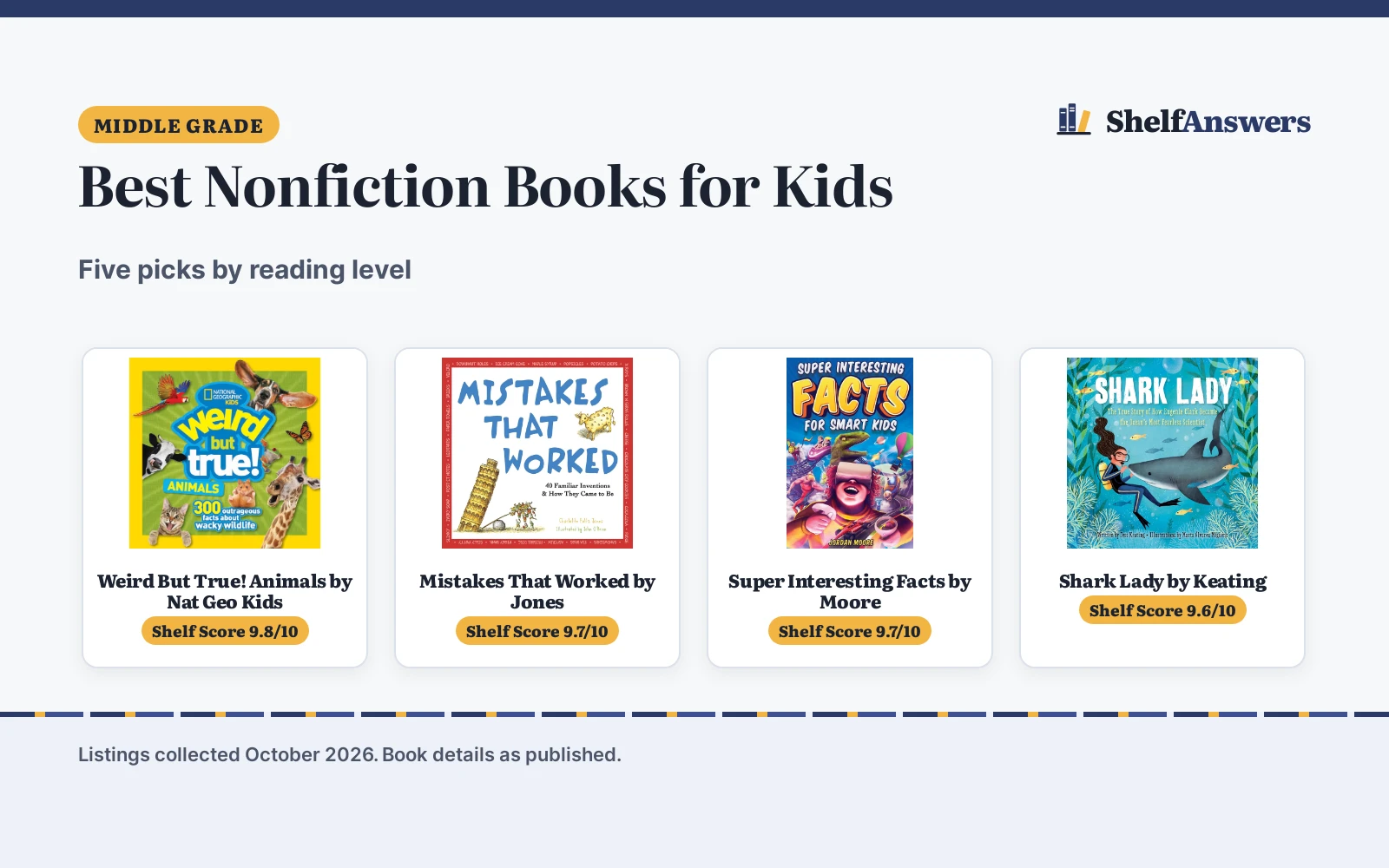
 Best Overall Weird But True! Animals by Nat Geo Kids: Animals and 300 wacky facts across 208 illustrated pages for ages 6 to 10 Check price on Amazon
 Best STEM History Mistakes That Worked by Jones: Stories of 40 accidental inventions with cartoons for grade 3 to 7 readers Check price on Amazon
 Best Fact Collection Super Interesting Facts by Moore: 1272 facts across 12 themed chapters for readers ages 8 to 11 Check price on Amazon
 Best Biography Shark Lady by Keating: Inspiring ocean scientist biography with timeline for ages 3 to 7 Check price on Amazon
 Best for Early Readers Planets by Carney: Level 2 reader about solar system planets for ages 4 to 7 Check price on Amazon
The picks
| # | Product | Shelf Score | Buy |
|---|---|---|---|
| 1 | Weird But True! Animals by Nat Geo Kids | 9.8/10 | Buy |
| 2 | Mistakes That Worked by Jones | 9.7/10 | Buy |
| 3 | Super Interesting Facts by Moore | 9.7/10 | Buy |
| 4 | Shark Lady by Keating | 9.6/10 | Buy |
| 5 | Planets by Carney | 9.6/10 | Buy |

Weird But True! Animals by Nat Geo Kids
This illustrated fact book suits elementary readers who enjoy surprising animal trivia and wildlife photographs.
Pros
- Listing gives 208 pages filled with 300 animal facts and color photographs
- Grade level 3 to 7 and listed reading age of 6 to 10 years cover a wide elementary span
- Illustrated format breaks information into short bites that suit reluctant readers
Cons
- The reading age of 6 to 10 years is marked as from customers rather than stated by the publisher
- Bite-sized trivia layout does not provide continuous narrative reading
- The 2018 publication date means it is not the most recent calendar release

Mistakes That Worked by Jones
This history collection suits curious kids in grades 3 to 7 who want to learn how accidental discoveries became everyday items.
Pros
- The description details the origins of 40 familiar inventions alongside cartoons and historical facts
- Grade level 3 to 7 aligns with the customer-listed reading age of 8+ years
- Print length of 96 pages offers substantial reading without overwhelming middle grade students
Cons
- Reading age of 8+ years is marked as from customers rather than publisher stated
- The listing publication date is May 1, 1994, making it an older reissue
- Focuses specifically on invention anecdotes rather than broader scientific principles

Super Interesting Facts by Moore
This general trivia volume suits readers ages 8 to 11 who enjoy sharing quirky facts about science, history and geography.
Pros
- The description states it contains 1272 facts divided across 12 themed chapters
- Listed reading age of 8 to 11 years fits upper elementary students well
- Print length of 144 pages offers plenty of material across space, science and world history
Cons
- No grade level is stated on the listing
- Reading age of 8 to 11 years is marked as from customers
- The broad variety of potluck topics means it lacks deep focus on any single subject

Shark Lady by Keating
This illustrated biography suits younger elementary children who want an inspiring story about marine biology and ocean exploration.
Pros
- The description states it includes a biographical timeline of Eugenie Clark along with shark facts
- Picture book format with 40 illustrated pages makes science accessible to early readers
- The listing states it was named a Best Children's Book of 2017 by Parents magazine
Cons
- The listing gives grade level Kindergarten to 4, which extends beyond the customer-listed reading age of 3 to 7 years
- Reading age of 3 to 7 years is marked as from customers
- At 40 pages, it is a brief picture book biography rather than an in-depth reference text

Planets by Carney
This early reader suits kindergarten to third grade students who are beginning to read independently about the solar system.
Pros
- Level 2 reader format features bright illustrations and simple sentences tailored for developing readers
- The description states it introduces all planets and dwarf planets in the solar system
- Grade level Kindergarten to 3 aligns well with early elementary science study
Cons
- Print length is limited to 32 pages, providing only a basic overview of planetary science
- Reading age of 4 to 7 years is marked as from customers
- Designed specifically for early reading practice rather than older kids seeking comprehensive space facts
As an Amazon Associate I earn from qualifying purchases.
More picks to compare
 Sea Turtles by MarshLevel 2 reader about ocean reptiles and long-distance swimmers for independent young readers.Check on Amazon
 Captivating History by MooreShort true historical stories for curious readers ages 8 to 12.Check on Amazon
 Strangest Mysteries by EverNest PressUnsolved real-world cases and detective challenges for curious readers ages 8 to 12.Check on Amazon
 Mind-Blowing Facts by HablibuBite-sized science and space facts safe to share with kids and teens.Check on Amazon
 Weirdest Animals by Nat Geo KidsFact-filled guide covering unusual wildlife behaviors for animal lovers ages 8 to 12.Check on Amazon
Compare the picks
| Book | Shelf Score | Author | Pages | Reading age or grade | Amazon |
|---|---|---|---|---|---|
| Weird But True! Animals by Nat Geo Kids | 9.8/10 | National Geographic Kids | 208 | 6 to 10 / grade 3 to 7 | Check price |
| Mistakes That Worked by Jones | 9.7/10 | Charlotte Foltz Jones | 96 | 8+ / grade 3 to 7 | Check price |
| Super Interesting Facts by Moore | 9.7/10 | Jordan Moore | 144 | 8 to 11 / Not stated | Check price |
| Shark Lady by Keating | 9.6/10 | Jess Keating | 40 | 3 to 7 / Kindergarten to 4 | Check price |
| Planets by Carney | 9.6/10 | Elizabeth Carney, Nat Geo Kids | 32 | 4 to 7 / Kindergarten to 3 | Check price |
Book details as published on each listing, collected 16 October 2026.
How we scored them
The Shelf Score weighs fit for young readers, contents and edition, value, and the listed reading age or grade level where one is provided. All five picks state a reading age marked by Amazon as from customers, and four of the five state a grade level, though the listing for Shark Lady pairs a Kindergarten to grade 4 band with a 3 to 7 years reading age. How we pick explains the weights.
| Book | Shelf Score | Fit /35 | Contents /25 | Value /25 | Age/level /10 |
|---|---|---|---|---|---|
| Weird But True! Animals by Nat Geo Kids | 9.8 | 32 | 22 | 22 | 9 |
| Mistakes That Worked by Jones | 9.7 | 30 | 21 | 21 | 9 |
| Super Interesting Facts by Moore | 9.7 | 30 | 21 | 21 | 7 |
| Shark Lady by Keating | 9.6 | 29 | 20 | 20 | 8 |
| Planets by Carney | 9.6 | 28 | 19 | 19 | 9 |
Scores run from 9.2 to 9.8: each book’s point total is placed on that range, so more points always means a higher score. Reading age or level counts on a list where at least one listing gives one, and a book whose listing gives none then scores zero on it. Where no listing gives one, the score is taken over the other 85 points. Books carry no warranty, so warranty is not scored.
How to choose the best nonfiction books for kids
Check reading age and grade level together
Amazon listings separate customer-reported reading ages from publisher grade bands. For example, Weird But True! Animals lists ages 6 to 10 alongside grade level 3 to 7, which helps narrow the target reader. When browsing broader middle grade books, verify both metrics so the text matches your child’s independent reading ability.
Choose between narrative stories and trivia collections
Nonfiction spans several formats, from bite-sized facts to biographical storytelling. A volume like Super Interesting Facts organizes 1272 facts into themed chapters, whereas Shark Lady tells a continuous biographical narrative across 40 illustrated pages. Readers who want deeper reference material can also explore a dedicated science encyclopedia for kids.
Assess page count and layout for reluctant readers
A 208-page collection like Weird But True! Animals works well for browsing because each page features standalone trivia snippets. In contrast, Planets covers its subject in 32 pages using simple sentences designed for early readers who might stall in heavier volumes. Match the physical format to how your child prefers to consume factual information.
Before you buy
- Check the listed grade level against customer reading ages, noting where ranges differ such as Kindergarten to grade 4 on Shark Lady.
- Confirm the format and page count, distinguishing between 32-page early readers like Planets and 208-page trivia volumes.
- Verify publication dates on the listing, as titles like Mistakes That Worked are reissues of older editions.
Frequently Asked Questions
What age is appropriate for Weird But True! Animals?
The listing gives a reading age of 6 to 10 years, marked as from customers, and grade level 3 to 7. Its 208 pages of illustrated trivia suit independent elementary readers.
How many inventions are featured in Mistakes That Worked?
The listing subtitle states the book covers 40 familiar inventions across 96 pages. It provides historical anecdotes and cartoons for readers at grade level 3 to 7.
Is Planets suitable for a beginning reader?
Yes, the listing identifies Planets as a Level 2 reader with 32 pages for grade level Kindergarten to 3. It features simple sentences and bright illustrations for kids reading with minimal assistance.
Related lists
See every middle grade list and all kids and teens lists.
More lists: browse picture books, young adult books and best book for kids.