Best Books for Learning Value Investing (2026): 5 Picks by Approach
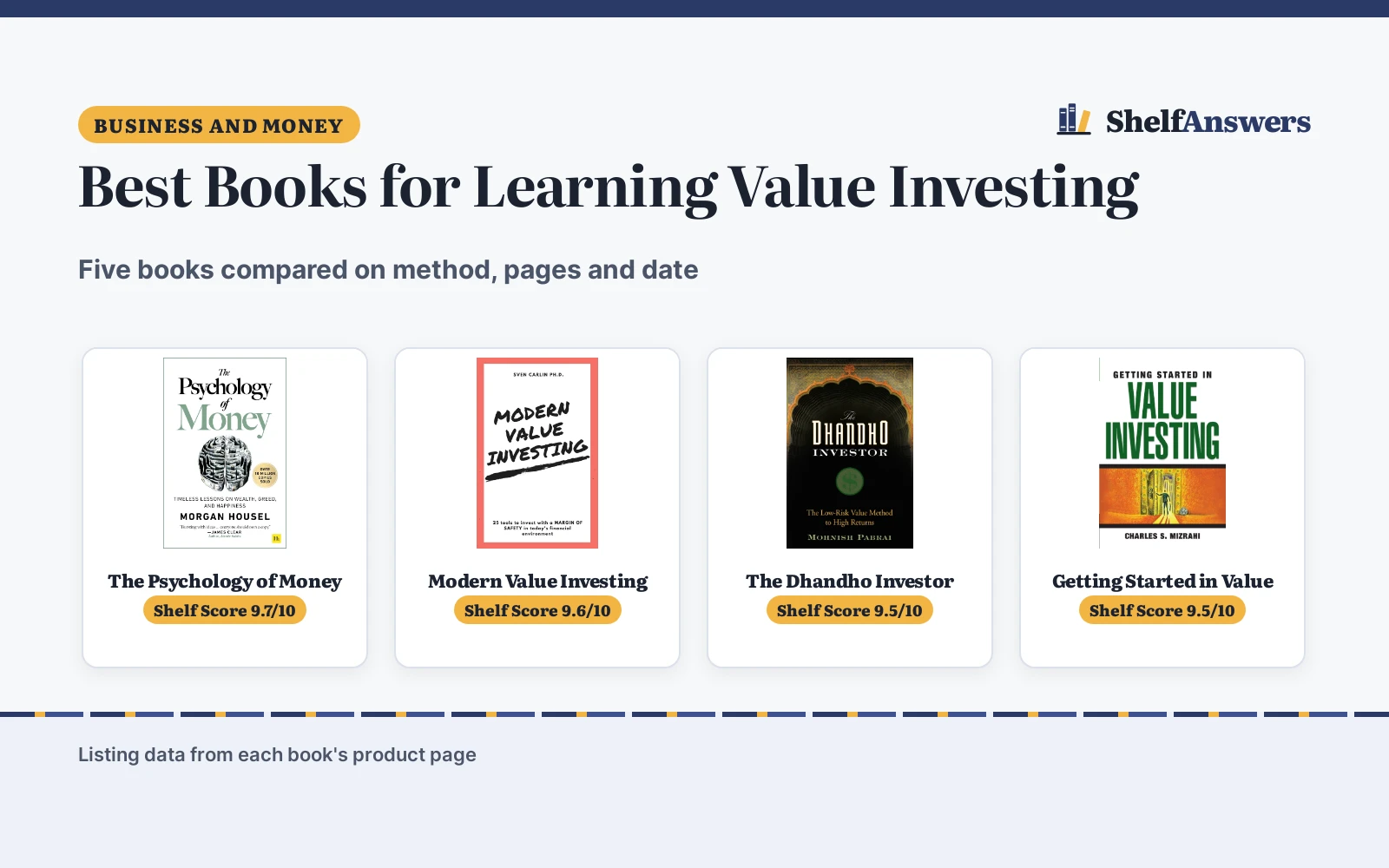
Five value investing books compared on method and length: Carlin's 25 tools, Pabrai's Dhandho, Mizrahi's starter guide, an 8-step beginner book and Housel on psychology.

At a glance
Top picks
As an Amazon Associate I earn from qualifying purchases.
The best books for learning value investing teach a method, not a mood: value a business, demand a margin of safety, and wait. We compared five on stated pages, date and approach. Four teach the method; the fifth teaches temperament.
ShelfAnswers earns a commission when you buy through links on this page, at no extra cost to you. As an Amazon Associate I earn from qualifying purchases. Affiliate disclosure.
Quick picks
 Best method book Modern Value Investing: 25 tools around a margin of safety, 291 pages. Check price on Amazon
 Best single framework The Dhandho Investor: The Dhandho method, in 208 pages. Check price on Amazon
 Best first book Getting Started in Value: A getting-started guide, by its title. Check price on Amazon
 Best step-by-step The 8-Step Beginner’s Guide: 8 steps for beginners, from 2020. Check price on Amazon
 Best on behaviour The Psychology of Money: Wealth, greed and happiness, in short lessons. Check price on Amazon
The picks
| # | Product | Shelf Score | Buy |
|---|---|---|---|
| 1 | The Psychology of Money by Housel | 9.7/10 | Buy on Amazon |
| 2 | Modern Value Investing | 9.6/10 | Buy on Amazon |
| 3 | The Dhandho Investor | 9.5/10 | Buy on Amazon |
| 4 | Getting Started in Value | 9.5/10 | Buy on Amazon |
| 5 | The 8-Step Beginner’s Guide | 9.5/10 | Buy on Amazon |

The Psychology of Money by Housel
Nineteen short stories exploring the behavioral habits and personal biases that drive financial decisions.
Pros
- Contains 19 short stories explaining behavioral patterns around money and business choices
- Examines real-world factors including personal history, ego, pride and incentives
- Published September 8, 2020 by Harriman House with 256 pages
- Accessible storytelling format that makes complex behavioral finance concepts clear
Cons
- Does not provide spreadsheets, formulas or technical accounting systems
- Focuses on broad financial behavior rather than daily startup operations
- No grade level or reading age is listed
- Published September 8, 2020, so readers wanting newer market commentary should look for later releases

Modern Value Investing
Twenty-five tools for investing with a margin of safety, at 291 pages.
Pros
- 25 tools, a structured method
- 291 pages, the longest main pick
- From 2018, the most current method here
Cons
- A workbook in spirit
- No publisher is stated
- Its today dates from 2018

The Dhandho Investor
Pabrai's low-risk value method, one framework in 208 pages from Wiley.
Pros
- One clear framework
- 208 pages, one focused read
- From Wiley
Cons
- From 2007; its examples are of that time
- One investor's method only
- Low-risk is the author's framing
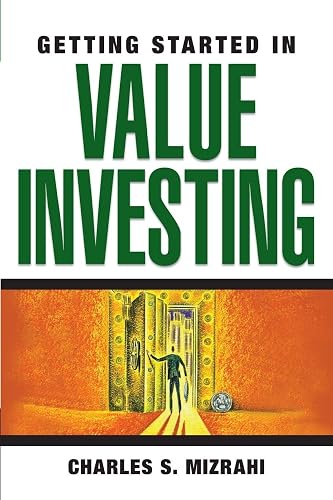
Getting Started in Value
A getting-started guide to value investing, at 208 pages.
Pros
- For beginners, by its title
- 208 pages, starter length
- One author, start to finish
Cons
- From November 9, 2007
- No publisher is stated
- A starter book only

The 8-Step Beginner’s Guide
An 8-step beginner's guide, at 196 pages, with a 20 for 20 stock list.
Pros
- 8 steps, the clearest structure
- From 2020, the newest main pick
- 196 pages, the shortest here
Cons
- Its stock picks date from 2020
- Independently published
- Method mixed with a list
As an Amazon Associate I earn from qualifying purchases.
More picks to compare
 Strategic Value InvestingTechniques of leading value investors, at 336 pages, from 2014.Check on Amazon
 Financial Statement AnalysisStatement analysis for value investors, at 432 pages, from 2025.Check on Amazon
Compare the picks
| Book | Shelf Score | Author | Pages | Published | Publisher | Amazon |
|---|---|---|---|---|---|---|
| Modern Value Investing | 9.6/10 | Sven Carlin | 291 | April 23, 2018 | Not stated | View on Amazon |
| The Dhandho Investor | 9.5/10 | Mohnish Pabrai | 208 | April 6, 2007 | Wiley | View on Amazon |
| Getting Started in Value | 9.5/10 | Charles S. Mizrahi | 208 | November 9, 2007 | Not stated | View on Amazon |
| The 8-Step Beginner’s Guide | 9.5/10 | Freeman Publications | 196 | June 11, 2020 | Independently published | View on Amazon |
| The Psychology of Money | 9.7/10 | Morgan Housel | Not stated | Not stated | Not stated |
Book details as published on each listing, collected 22 October 2026.
How we scored them
The Shelf Score weighs fit, contents and edition, and value. Fit rewards a teachable method with stated structure. Two books date from 2007, so their examples predate the financial crisis; the methods are what is bought. How we pick explains the weights.
| Book | Shelf Score | Fit /35 | Contents /25 | Value /25 | Age/level /10 |
|---|---|---|---|---|---|
| Modern Value Investing | 9.6 | 30 | 20 | 18 | n/a |
| The Dhandho Investor | 9.5 | 29 | 19 | 16 | n/a |
| Getting Started in Value | 9.5 | 29 | 18 | 16 | n/a |
| The 8-Step Beginner’s Guide | 9.5 | 28 | 16 | 15 | n/a |
Scores run from 9.2 to 9.8: each book’s point total is placed on that range, so more points always means a higher score. Reading age or level counts on a list where at least one listing gives one, and a book whose listing gives none then scores zero on it. Where no listing gives one, the score is taken over the other 85 points. Books carry no warranty, so warranty is not scored.
How to choose the best books for learning value investing
Start with one method, read whole
Pick one framework and finish it: Carlin’s tools, Pabrai’s Dhandho, or Mizrahi’s guide. Three half-read methods teach less than one whole one. Our best books to learn investing and trading list covers trading too.
Mind the dates on examples and picks
The 2007 books teach with pre-crisis examples. The 8-Step guide’s 20 stocks were chosen in 2020, so read them as an illustration, not a portfolio.
Before you buy
- Two listings state no publisher; check the edition line.
- The Psychology of Money is behaviour, not valuation.
- The extras’ statement analysis book is the next step.
Frequently Asked Questions
Which book is best for a complete beginner?
Getting Started in Value Investing, or the 8-Step guide for structure.
Which book is the most current?
Modern Value Investing, from 2018. The 8-Step guide is newer, from 2020.
Do I need the psychology book as well?
The half the methods assume: patience. Read it second.
What comes after these?
Penman’s statement analysis book, in the extras, at 432 pages.
Related lists
See every nonfiction list. Also see our best books to learn investing and trading.
More lists: browse business books, self-improvement books and history and biography books.