Best Dinosaur Encyclopedia for Kids (2026): 5 Picks Compared
Five dinosaur encyclopedias for kids compared by reading age, grade level and page count, from tactile pop-ups to comprehensive reference guides.

At a glance
Top picks
As an Amazon Associate I earn from qualifying purchases. How we score
When an elementary reader starts asking about prehistoric fossils and bone structures, choosing the best dinosaur encyclopedia for kids depends on matching their reading stage to the right level of visual detail. We compared five books by listed reading age, grade level, print length and visual format so you can find the right match for your young paleontologist.
ShelfAnswers earns a commission when you buy through links on this page, at no extra cost to you. As an Amazon Associate I earn from qualifying purchases. Affiliate disclosure.
Quick picks
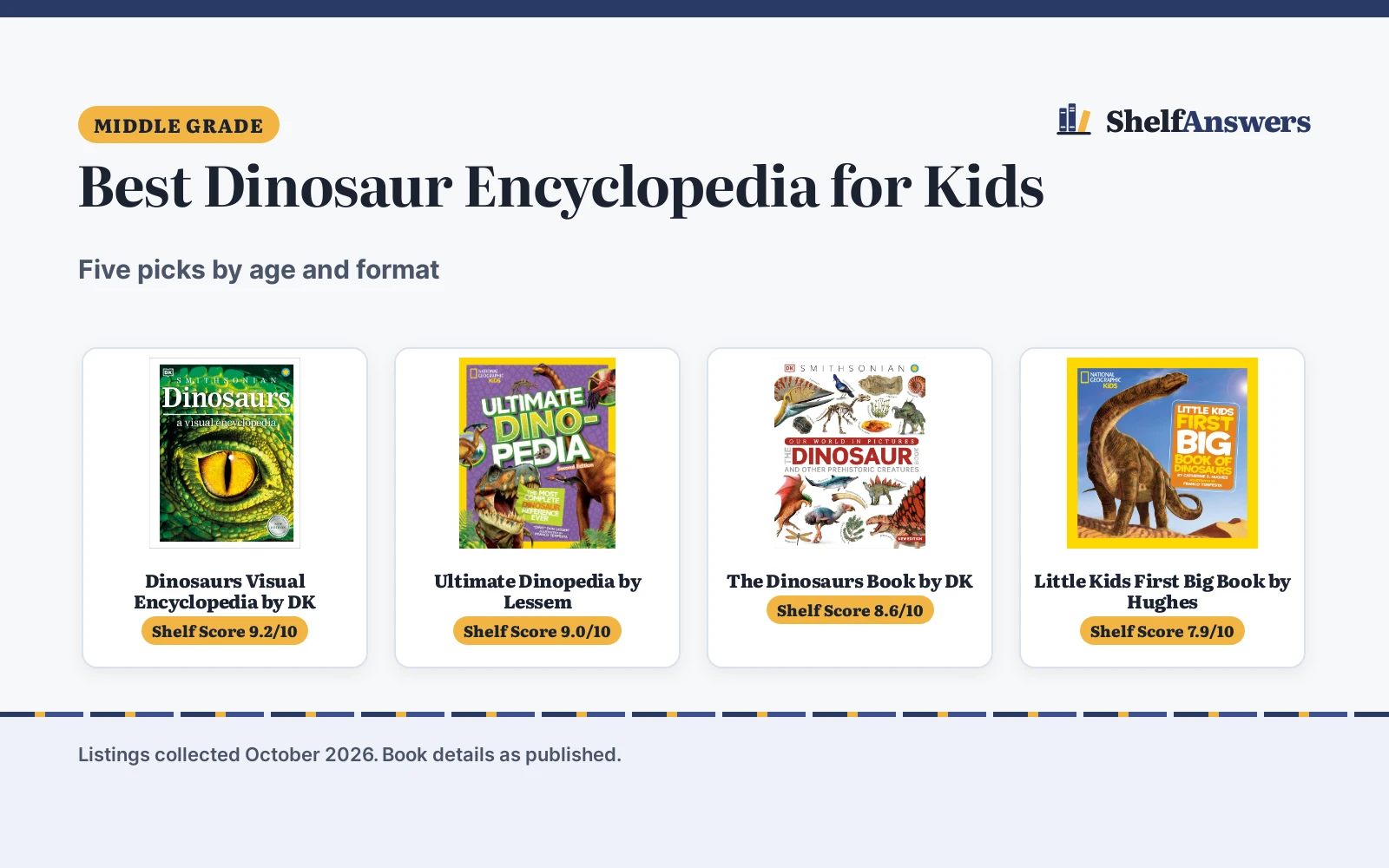
 Best Overall Dinosaurs Visual Encyclopedia by DK: Curriculum topics and 304 pages created with the Smithsonian Check price on Amazon
 Best Comprehensive Guide Ultimate Dinopedia by Lessem: Profiles for over 600 dinosaurs with paleontologist field reports Check price on Amazon
 Best Visual Reference The Dinosaurs Book by DK: More than 1,000 images and quick-reference stat panels across 208 pages Check price on Amazon
 Best for Younger Kids Little Kids First Big Book by Hughes: Big type, simple text and parent tips for preschool to grade 3 Check price on Amazon
 Best Pop-Up Book Encyclopedia Prehistorica by Sabuda: Six spreads featuring large pop-ups and paper engineering booklets Check price on Amazon
The picks
| # | Product | Shelf Score | Buy |
|---|---|---|---|
| 1 | Dinosaurs Visual Encyclopedia by DK | 9.8/10 | Buy |
| 2 | Ultimate Dinopedia by Lessem | 9.8/10 | Buy |
| 3 | The Dinosaurs Book by DK | 9.7/10 | Buy |
| 4 | Little Kids First Big Book by Hughes | 9.6/10 | Buy |
| 5 | Encyclopedia Prehistorica by Sabuda | 9.5/10 | Buy |

Dinosaurs Visual Encyclopedia by DK
A 304-page visual guide to prehistoric life, created with the Smithsonian Institution to cover fossils, habitats and over 100 species.
Pros
- The listing states the content was created in association with the Smithsonian Institution
- Substantial print length of 304 pages offers broad coverage across more than 100 prehistoric species
- The description notes alignment with curriculum topics in geography, biology and science
- Grade level 4 to 7 fits elementary and middle grade students seeking detailed reference material
Cons
- The reading age of 4 to 9 years is marked as from customers rather than stated by the publisher
- The customer reading age of 4 to 9 years sits lower than the listed grade level of 4 to 7
- The description mentions horse-eating birds and crocodile-sized millipedes, which may startle very young readers
- At 304 pages, the volume may feel dense for readers who struggle with longer nonfiction text

Ultimate Dinopedia by Lessem
A 296-page reference profiling more than 600 dinosaurs, complete with fieldwork reports from paleontologists and a dinosaur dictionary.
Pros
- The description lists coverage of more than 600 dinosaurs, including 10 profiles of recently discovered species
- Print length of 296 pages provides a comprehensive reference volume with a dedicated Dino Dictionary
- Includes reports from paleontologists presenting fieldwork insights and discoveries
- Grade level 2 to 5 offers an accessible reading range for elementary students
Cons
- The reading age of 4 to 8 years is marked as from customers rather than set by the publisher
- The 2nd edition was published in October 2017, so it does not capture discoveries after that date
- The customer reading age of 4 to 8 years stops earlier than the upper grade level of 5
- At 296 pages, the large reference size can be cumbersome for younger readers to hold alone

The Dinosaurs Book by DK
A 208-page visual overview packed with over 1,000 illustrations, diagrams and quick-reference panels on prehistoric creatures.
Pros
- Features more than 1,000 images, diagrams and visual reconstructions across 208 pages
- Recent publication date of October 3, 2023, reflects updated research on feathered dinosaurs
- At-a-glance stat panels summarize facts quickly for visual learners
- Grade level 4 to 7 matches upper elementary and middle school research needs
Cons
- The reading age of 3 to 8 years is marked as from customers and conflicts with the listed grade level 4 to 7
- A picture-heavy and text-light design may not provide enough depth for students needing detailed prose
- Part of the Our World in Pictures series, so readers may want additional companion volumes
- The description mentions examining stomach contents and predator defense, which sensitive readers might dislike

Little Kids First Big Book by Hughes
A 128-page introductory dinosaur book with large type, colorful spreads, interactive questions and parent tips for early readers.
Pros
- Features large type and simple text specifically designed for beginning readers
- Includes interactive prompts in every chapter to keep young children engaged
- Parent tips help carry learning activities beyond the pages of the book
- Grade level Preschool to 3 offers an approachable starting point for early learners
Cons
- The reading age of 3 to 5 years is marked as from customers rather than publisher verified
- Print length of 128 pages is substantially shorter than DK and National Geographic reference volumes
- Published in October 2011, making it an older edition in the series
- Focuses on introductory concepts, so older children in middle grade will quickly outgrow the content

Encyclopedia Prehistorica by Sabuda
A 12-page pop-up exploration of prehistoric creatures featuring six intricate three-dimensional spreads and informational booklets.
Pros
- Intricate paper engineering provides six large pop-up spreads alongside smaller pop-up booklets
- Engaging tactile presentation captures the attention of reluctant readers
- Includes historical anecdotes, such as a Victorian dinner held inside a dinosaur model
- Grade level Kindergarten to 4 spans early elementary reading stages
Cons
- Brief print length of 12 pages limits the depth of scientific and classification facts
- Delicate three-dimensional pop-up paper elements can tear or bend easily during handling
- Publication date of July 12, 2005, represents an older title without recent fossil findings
- The reading age of 3+ years is marked as from customers, while paper mechanisms require gentle use
As an Amazon Associate I earn from qualifying purchases.
More picks to compare
 Children's Encyclopedia of DinosaursDino-mad kids aged 8 and up, with full-color photographs and clear annotations.Check on Amazon
 The Amazing World of DinosaursKids aged 8-12 who want a full-color dinosaur encyclopedia with 224 pages.Check on Amazon
 Complete Dinosaur Encyclopedia by DixonReader wanting a large illustrated reference covering 1000 dinosaurs and prehistoric creatures.Check on Amazon
Compare the picks
| Book | Shelf Score | Author | Pages | Reading age or grade | Amazon |
|---|---|---|---|---|---|
| Dinosaurs Visual Encyclopedia by DK | 9.8/10 | DK | 304 | 4 – 9 / grade 4 to 7 | Check price |
| Ultimate Dinopedia by Lessem | 9.8/10 | Don Lessem, National Geographic Kids | 296 | 4 – 8 / grade 2 to 5 | Check price |
| The Dinosaurs Book by DK | 9.7/10 | DK | 208 | 3 – 8 / grade 4 to 7 | Check price |
| Little Kids First Big Book by Hughes | 9.6/10 | Catherine D. Hughes | 128 | 3 – 5 / grade Preschool to 3 | Check price |
| Encyclopedia Prehistorica by Sabuda | 9.5/10 | Robert Sabuda, Matthew Reinhart | 12 | 3+ / grade Kindergarten to 4 | Check price |
Book details as published on each listing, collected 16 October 2026.
How we scored them
The Shelf Score weighs fit for a young reader, contents and edition, value, and the listed reading age or grade level. All five listings give a reading age, marked by Amazon as from customers, and all five give a grade level, though customer reading ages often lean younger than the publisher’s listed grade bands. How we pick explains the weights.
| Book | Shelf Score | Fit /35 | Contents /25 | Value /25 | Age/level /10 |
|---|---|---|---|---|---|
| Dinosaurs Visual Encyclopedia by DK | 9.8 | 33 | 22 | 22 | 9 |
| Ultimate Dinopedia by Lessem | 9.8 | 32 | 22 | 22 | 9 |
| The Dinosaurs Book by DK | 9.7 | 30 | 21 | 21 | 9 |
| Little Kids First Big Book by Hughes | 9.6 | 28 | 19 | 20 | 9 |
| Encyclopedia Prehistorica by Sabuda | 9.5 | 26 | 18 | 18 | 9 |
Scores run from 9.2 to 9.8: each book’s point total is placed on that range, so more points always means a higher score. Reading age or level counts on a list where at least one listing gives one, and a book whose listing gives none then scores zero on it. Where no listing gives one, the score is taken over the other 85 points. Books carry no warranty, so warranty is not scored.
How to choose the best dinosaur encyclopedia for kids
Balance listed grade level with visual density
Listed age ranges on these volumes often span a wide developmental spectrum. For instance, Dinosaurs: A Visual Encyclopedia lists grade level 4 to 7 across 304 pages, while Little Kids First Big Book of Dinosaurs targets Preschool to 3 with large type across 128 pages. Matching the page count and type size to your child’s stamina prevents reader fatigue, especially when transitioning to middle grade books.
Decide between taxonomic depth and tactile novelty
Consider whether your young learner wants a traditional reference volume or an interactive visual display. National Geographic Kids Ultimate Dinopedia profiles more than 600 species with fieldwork notes, whereas Encyclopedia Prehistorica Dinosaurs uses 12 pages of three-dimensional pop-up spreads. If your child enjoys exploring broader wildlife topics alongside prehistoric creatures, browse our guide to the best animal encyclopedia for kids.
Before you buy
- Check the publication date and edition on the listing, as titles like National Geographic Kids Ultimate Dinopedia are in their 2nd edition while older releases date back to 2005.
- Compare the publisher grade level against the customer-listed reading age to ensure the font size and text density suit your child.
- Confirm the book format before ordering, noting whether the title is a standard hardcover reference or a delicate 12-page pop-up volume.
Frequently Asked Questions
What age is appropriate for Dinosaurs: A Visual Encyclopedia?
The listing gives grade level 4 to 7 and a customer-marked reading age of 4 to 9 years, while the description recommends it for children aged 9 to 12. Its 304 pages and curriculum topics make it well suited for upper elementary and middle school students.
How many dinosaurs are profiled in National Geographic Kids Ultimate Dinopedia?
The description states the 2nd edition features more than 600 dinosaurs, including 10 profiles of recently discovered species. It spans 296 pages with entries arranged in a dedicated Dino Dictionary.
Is Encyclopedia Prehistorica Dinosaurs a full reference book?
No, the listing gives a print length of 12 pages arranged across six large pop-up spreads. It serves as an interactive pop-up showcase rather than an exhaustive species catalog.
Related lists
See every middle grade list and all kids and teens lists.
More lists: browse space encyclopedias, general encyclopedias, and animal encyclopedias.