Best Encyclopedia for Kids (2026): 5 Top Reference Books
Five encyclopedias for kids compared by grade level, reading age, page count and format, from comprehensive visual reference books to focused history and science box sets.

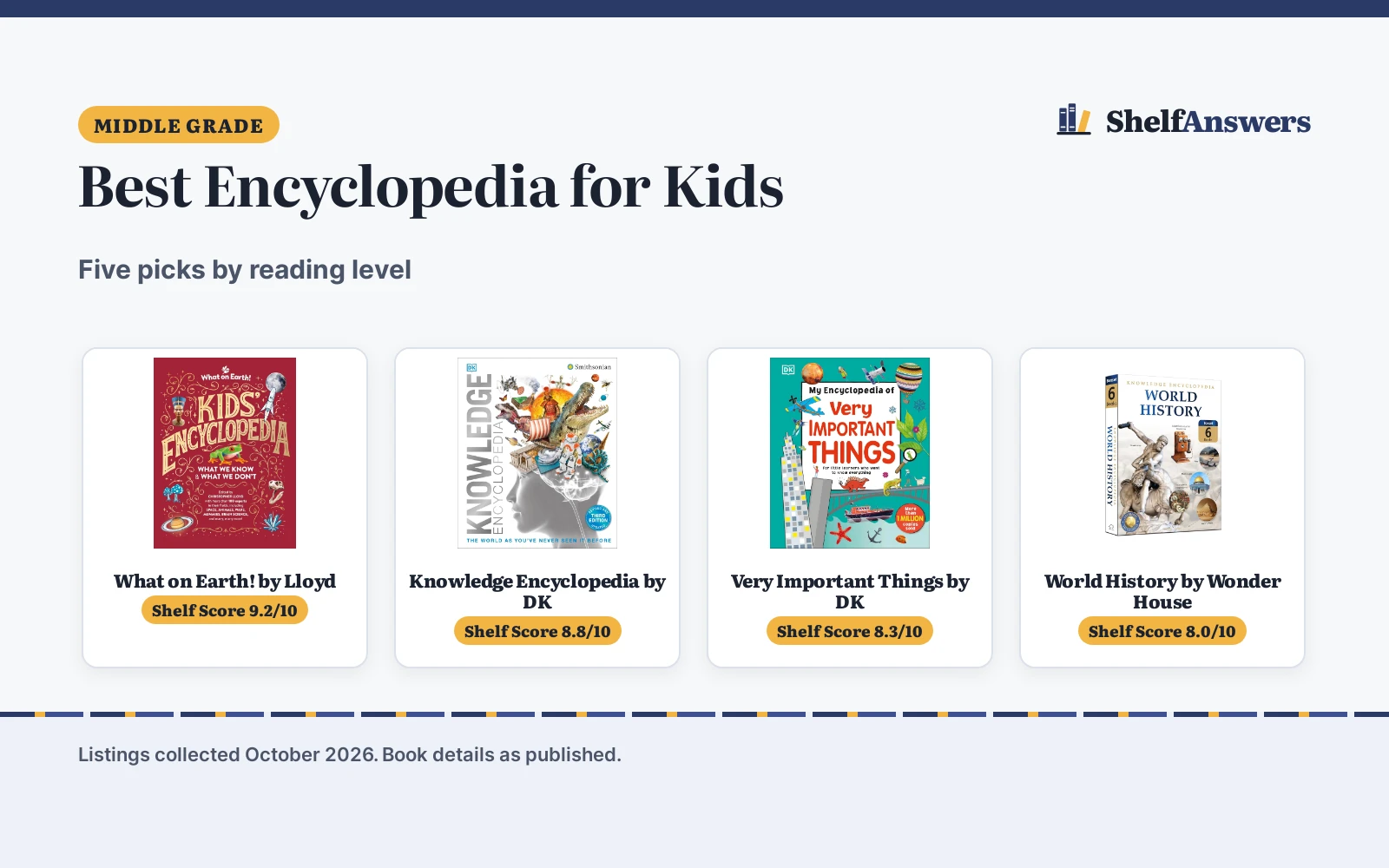
At a glance
Top picks
As an Amazon Associate I earn from qualifying purchases. How we score
When a curious child starts asking why volcanoes erupt or how cells make energy, finding the best encyclopedia for kids turns sudden questions into independent reading. We compared titles by listed reading age, grade level, page count and format from single volumes to boxed collections, so you can match the right book to your young learner.
ShelfAnswers earns a commission when you buy through links on this page, at no extra cost to you. As an Amazon Associate I earn from qualifying purchases. Affiliate disclosure.
Quick picks
 Best Overall What on Earth! by Lloyd: 424 pages of Britannica-backed facts organized chronologically Check price on Amazon
 Best Visual Encyclopedia Knowledge Encyclopedia by DK: 360 pages of 3D CGI cross-sections and detailed diagrams Check price on Amazon
 Best for Early Learners Very Important Things by DK: 224 pages with padded cover and ribbon marker for ages 5 to 9 Check price on Amazon
 Best History Box Set World History by Wonder House: Six-book box set exploring major world eras with maps and glossaries Check price on Amazon
 Best Science Box Set Science Encyclopedia by Wonder House: Six-book STEM box set covering evolution, chemistry, and diagrams Check price on Amazon
The picks
| # | Product | Shelf Score | Buy |
|---|---|---|---|
| 1 | What on Earth! by Lloyd | 9.8/10 | Buy |
| 2 | Knowledge Encyclopedia by DK | 9.8/10 | Buy |
| 3 | Very Important Things by DK | 9.7/10 | Buy |
| 4 | World History by Wonder House | 9.6/10 | Buy |
| 5 | Science Encyclopedia by Wonder House | 9.5/10 | Buy |

What on Earth! by Lloyd
A chronological reference book created with Encyclopaedia Britannica that covers Earth, space, history, animals and science.
Pros
- Chronological organization guides young readers from the planet's origins through history into modern times
- Developed in collaboration with Encyclopaedia Britannica with contributions from 100 experts
- Print length of 424 pages provides over 1,000 illustrations, photographs and maps
- Updated second edition carries a publication date of September 2, 2025
Cons
- Reading age of 5 to 9 years is marked as from customers rather than stated by the publisher
- Listing spec table contains an odd note stating perfect for 0 to 3 years old
- At 424 pages, the heavy volume may be unwieldy for smaller children to hold independently
- Does not use traditional alphabetical A to Z reference organization

Knowledge Encyclopedia by DK
A visual reference volume using detailed 3D CGI imagery to explore space, the human body, history and science.
Pros
- Features intricate 3D CGI illustrations that show cutaways of cells, machines and natural phenomena
- Covers a broad spectrum of subjects ranging from Viking raiders to robotics and chemical reactions
- Print length of 360 pages provides extensive coverage for upper elementary and middle schoolers
- Updated edition published on October 10, 2023 with modern scientific developments
Cons
- Reading age of 6 to 11 years is marked as from customers
- Part of the larger Knowledge Encyclopedia series, so children may request additional companion volumes
- Grade level 4 to 7 may prove challenging for younger readers reading below third grade
- The dense visual format packed with facts may overwhelm children who prefer simple layouts

Very Important Things by DK
An introductory reference book for early learners exploring animals, planets, geography and daily life.
Pros
- Padded cover with foil finish and built-in ribbon bookmark suited for small hands
- Combines colorful illustrations, games and striking photography for early learners
- Recent publication date of April 29, 2025 by DK Children
- The listing states it was shortlisted for the School Library Association Information Book Award 2017
Cons
- Reading age of 3 to 6 years is marked as from customers, while the description targets ages 5 to 9
- At 224 pages, it is less comprehensive on advanced topics than larger reference books
- Part of the My Very Important Encyclopedias series, which encourages buying more titles
- Grade level span from Kindergarten to 4 is broad for an early childhood title

World History by Wonder House
A six-book boxed set covering major world history eras from ancient civilizations to the industrial revolution.
Pros
- Divides world history into six separate volumes covering eras from ancient times through modern revolutions
- Includes maps, labeled illustrations and reference content for school research projects
- Extensive glossary of difficult terms helps readers build historical vocabulary
- Box set format keeps each individual historical era in a slender, easy-to-handle volume
Cons
- Focuses exclusively on world history rather than covering all general encyclopedia subjects
- Print length of 192 pages is shared across all 6 books in the collection
- The description notes coverage of global conflicts and wars, which parents may wish to review
- Publication date is March 12, 2021

Science Encyclopedia by Wonder House
A six-book STEM box set that explains scientific principles from evolution to chemistry using diagrams.
Pros
- Collects six specialized science books into one boxed library for STEM exploration
- Features well-labeled diagrams explaining topics such as the theory of evolution and chemical reactions
- Includes a glossary of difficult words to support independent learning and vocabulary
- Dividing topics across six volumes makes individual topics less intimidating to explore
Cons
- Contradiction in listing: description claims perfect for ages 7 and above, but reading age states 12 to 14 years
- Grade level 7 to 9 and reading age 12 to 14 years target junior high rather than elementary students
- Print length of 192 pages is divided across all 6 books in the boxed set
- Covers only science topics rather than general encyclopedia subjects across history and humanities
As an Amazon Associate I earn from qualifying purchases.
More picks to compare
 DK Children's Encyclopedia by DKFor curious kids; covers over 250 topics with illustrations and photographs.Check on Amazon
 National Geographic Little Kids FirstFor early learners, ages 4-8, with more than 700 photos and illustrations.Check on Amazon
 100,000 Whys for Kids by Elliott WonderFor curious kids ages 6 to 13 who ask big questions.Check on Amazon
 Countries of the World by DKFor kids aged 9-12 who enjoy world geography, with a profile of each nation.Check on Amazon
 Mini Explorers Animal Habitat SetFor young animal lovers aged 3-6, in a box set of 4 hardcover books.Check on Amazon
Compare the picks
| Book | Shelf Score | Author | Pages | Reading age or grade | Amazon |
|---|---|---|---|---|---|
| What on Earth! by Lloyd | 9.8/10 | Christopher Lloyd, Jack Tite, Mark Ruffle | 424 | 5 to 9 / grade 3 to 7 | Check price |
| Knowledge Encyclopedia by DK | 9.8/10 | DK | 360 | 6 to 11 / grade 4 to 7 | Check price |
| Very Important Things by DK | 9.7/10 | DK | 224 | 3 to 6 / Kindergarten to 4 | Check price |
| World History by Wonder House | 9.6/10 | Wonder House Books | 192 | 10 to 17 / grade 5 to 12 | Check price |
| Science Encyclopedia by Wonder House | 9.5/10 | Wonder House Books | 192 | 12 to 14 / grade 7 to 9 | Check price |
Book details as published on each listing, collected 16 October 2026.
How we scored them
The Shelf Score weighs fit for a young reader, contents and edition, overall value, and the listed reading age or grade level. All five listings provide both a reading age and a grade level, though three mark the reading age as from customers, and the Science Knowledge Encyclopedia listing shows an age contradiction between its description and spec table. How we pick explains the weights.
| Book | Shelf Score | Fit /35 | Contents /25 | Value /25 | Age/level /10 |
|---|---|---|---|---|---|
| What on Earth! by Lloyd | 9.8 | 32 | 24 | 22 | 9 |
| Knowledge Encyclopedia by DK | 9.8 | 30 | 22 | 21 | 9 |
| Very Important Things by DK | 9.7 | 29 | 21 | 20 | 9 |
| World History by Wonder House | 9.6 | 27 | 20 | 21 | 8 |
| Science Encyclopedia by Wonder House | 9.5 | 26 | 19 | 21 | 5 |
Scores run from 9.2 to 9.8: each book’s point total is placed on that range, so more points always means a higher score. Reading age or level counts on a list where at least one listing gives one, and a book whose listing gives none then scores zero on it. Where no listing gives one, the score is taken over the other 85 points. Books carry no warranty, so warranty is not scored.
How to choose the best encyclopedia for kids
Check both reading age and grade level
Listing numbers give you a practical starting point, but they often reflect different sources. Amazon marks the reading age for What on Earth! and Knowledge Encyclopedia as from customers, while grade levels indicate classroom curricula. When evaluating middle grade books, look for agreement between the stated grade range and your child’s current fluency.
Decide between a single volume and a themed box set
A comprehensive single volume like What on Earth! at 424 pages or Knowledge Encyclopedia at 360 pages provides an expansive, all-in-one journey across many subjects. In contrast, boxed sets like the World History collection divide 192 total pages into six slim booklets that are less intimidating for children to hold. If your reader prefers exploring broader reading topics beyond reference guides, our guide to the best book for kids covers additional formats.
Choose visual diagrams or chronological storytelling
Different encyclopedias organize knowledge in fundamentally different ways. DK relies heavily on 3D CGI cutaways and graphic models that let readers inspect human cells or spacecraft in cross-section. What on Earth! arranges topics chronologically from the start of time to the present, helping children build historical and scientific perspective as they read.
Before you buy
- Verify whether the reading age is marked as from customers or stated directly by the publisher on the listing table.
- Check the publication date and edition, noting whether the volume has been updated with recent scientific developments.
- Confirm the format to ensure you are selecting either a comprehensive single-volume encyclopedia or a multi-book boxed set.
Frequently Asked Questions
What reading age is Knowledge Encyclopedia for?
The Knowledge Encyclopedia listing gives a reading age of 6 to 11 years, marked as from customers, and a grade level of 4 to 7. The description also notes it is suited for children aged 9 and older who can manage complex subjects.
How many pages are in What on Earth! Kids’ Encyclopedia?
The listing gives a print length of 424 pages for this second edition, which was published on September 2, 2025. It contains over 1,000 illustrations, photographs and maps.
Is My Encyclopedia of Very Important Things suitable for younger children?
Yes, the listing gives a customer-marked reading age of 3 to 6 years and a grade level of Kindergarten to 4, while the description recommends it for ages 5 to 9. It features 224 pages with a padded cover and ribbon bookmark designed for early learners.
Related lists
See every middle grade list and all kids and teens lists.
More lists: browse chapter books for kids, books for 10 year olds, fantasy books for kids and picture books.