Best Books for Preschoolers (2026): 5 Picture Books Compared
Five picture books for preschoolers compared by print length, listed reading age, grade level and format, from rhyming read-alouds to funny modern favorites.

On this page
Whether preparing an early learner for story time or winding down before bedtime, the best books for preschoolers turn shared reading into an interactive conversation. We compared five picture books across page length, customer reading ages, listed grade levels and story formats to help families find titles that match their child’s attention span. Each listing offers a distinct approach to early engagement, from rhyming alphabet verse to comedic read-alouds. Here is how published details compare across the selections.
ShelfAnswers earns a commission when you buy through links on this page, at no extra cost to you. As an Amazon Associate I earn from qualifying purchases. Affiliate disclosure.
Quick picks
- Best Alphabet Book Chicka Chicka Boom Boom by Martin Jr.: A rhythmic 36-page alphabet chant with bold art for preschool letter recognition Check price
- Best Rhyming Story The Gruffalo by Donaldson: A clever 32-page rhyming tale about a cunning mouse and an imaginary woodland beast Check price
- Best for Creativity The Day the Crayons Quit by Daywalt: A funny 40-page story told through letters from disgruntled crayons exploring colors Check price
- Best for Silly Humor The Book With No Pictures by Novak: A hilarious 48-page script of goofy sounds and nonsense words designed to be read aloud Check price
- Best Interactive Fun How to Catch a Unicorn by Wallace: A vibrant 40-page rhyming zoo adventure packed with kid-made traps and playful rhymes Check price
Compare the picks
| Book | Shelf Score | Author | Pages | Reading age or grade | Published |
|---|---|---|---|---|---|
| Chicka Chicka Boom Boom by Martin Jr. | 9.2/10 | Bill Martin Jr., John Archambault | 36 | 1 – 4 years (Preschool and up) | August 28, 2012 |
| The Gruffalo by Donaldson | 8.9/10 | Julia Donaldson | 32 | 2 – 5 years (Preschool – 2) | February 7, 2005 |
| The Day the Crayons Quit by Daywalt | 8.8/10 | Drew Daywalt | 40 | 3 – 6 years (Preschool – 3) | June 27, 2013 |
| The Book With No Pictures by Novak | 7.8/10 | B. J. Novak | 48 | 3 – 6 years (Kindergarten – 3) | September 30, 2014 |
| How to Catch a Unicorn by Wallace | 7.3/10 | Adam Wallace | 40 | 3 – 6 years (Kindergarten – 6) | March 5, 2019 |
Book details as published on each listing, collected 15 October 2026.
The picks
| # | Product | Shelf Score | Buy |
|---|---|---|---|
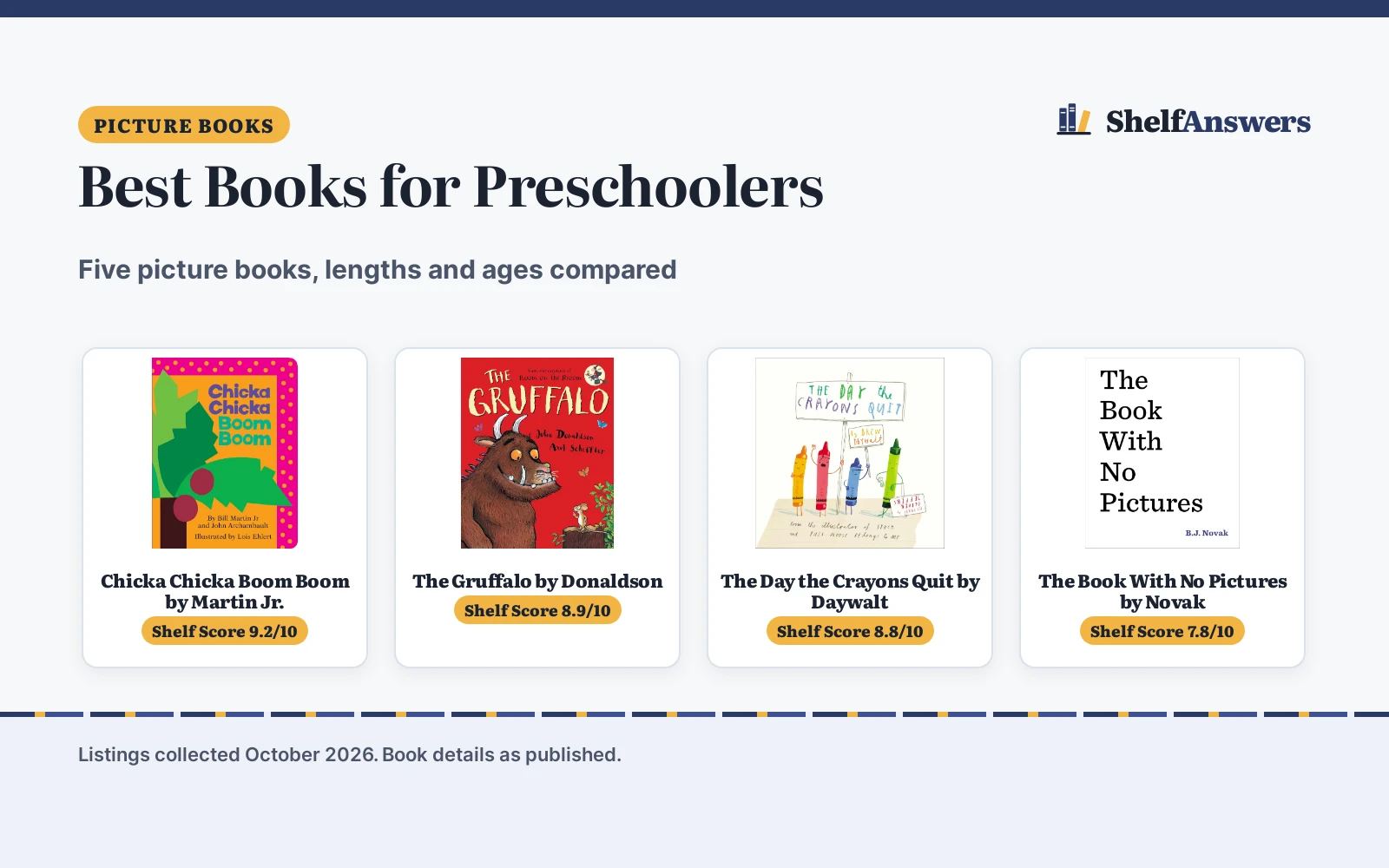
| 1 |  Chicka Chicka Boom Boom by Martin Jr. Chicka Chicka Boom Boom by Martin Jr. | 9.2/10 | Buy |
| 2 |  The Gruffalo by Donaldson The Gruffalo by Donaldson | 8.9/10 | Buy |
| 3 |  The Day the Crayons Quit by Daywalt The Day the Crayons Quit by Daywalt | 8.8/10 | Buy |
| 4 |  The Book With No Pictures by Novak The Book With No Pictures by Novak | 7.8/10 | Buy |
| 5 |  How to Catch a Unicorn by Wallace How to Catch a Unicorn by Wallace | 7.3/10 | Buy |
Chicka Chicka Boom Boom by Martin Jr.
A rhythmic alphabet chant where letters race up a coconut tree, paired with bold cut-paper illustrations.
Pros
- Bouncy rhyming alphabet chant that introduces letter recognition and phonics
- Illustrated with bold, high-contrast artwork by Caldecott Honor recipient Lois Ehlert
- Sturdy 36-page board book format sized for small hands
- Listing includes a grade level of Preschool and up that matches early learners
Cons
- Reading age of 1 - 4 years is marked as from customers rather than publisher guidance
- Publication date is August 28, 2012, making it an older edition
- Focused entirely on uppercase letters climbing the coconut tree before tumbling down
- Board book format is heavier and bulkier than a standard paperback
Detailed Review
The description presents this as an energetic alphabet adventure where lowercase letters race to the top of a coconut tree until their collective weight brings them tumbling down. The listing gives a print length of 36 pages in a board book format, grade level Preschool and up, a customer-listed reading age of 1 - 4 years, and a publication date of August 28, 2012. The text pairs rhyming verse by Bill Martin Jr. and John Archambault with cut-paper art by Caldecott Honor illustrator Lois Ehlert to introduce basic letter shapes and phonics.
Who it's for: parents, librarians and teachers introducing early phonics and letter recognition through a rhythmic chant. Who should skip it: families seeking an intricate plot or advanced storyline beyond an alphabet rhyme.
Its Shelf Score of 9.2/10 comes from fit 33/35, contents and edition 22/25, value 22/25 and reading age or level 9/10.
Book Details
| Author | Bill Martin Jr., John Archambault |
|---|---|
| Print length | 36 pages |
| Reading age | 1 - 4 years, from customers |
| Grade level | Preschool and up |
| Publisher | Little Simon |
Details as published on the retailer listing, collected 15 October 2026. Editions and formats change; check the listing before you buy.
Reading Age and Edition
What this listing states. Grade level Preschool and up and a reading age of 1 - 4 years, marked as from customers, so reading age or level scores 9 of 10. Books carry no warranty, so warranty is not part of the score. See How We Pick.
Reading ages are a guide, not a rule. Listed reading ages and grade levels describe the level a book is aimed at, not whether it suits a particular child. Read the description or a sample first for younger or sensitive readers.
Listed reading ages and grade levels are a guide, not advice about a particular reader. Editions and formats change, so check the listing before you buy. See our Reading Age Disclaimer.
The Gruffalo by Donaldson
A clever rhyming woodland tale of a quick-witted mouse who invents an imaginary beast to frighten forest predators.
Pros
- Engaging rhyming text by Julia Donaldson featuring repetitive, memorable verse
- Characterful illustrations by Axel Scheffler across 32 pages
- Listing provides both a grade level of Preschool - 2 and a customer reading age of 2 - 5 years
- Clever storyline where a small mouse outsmarts predators with an invented monster
Cons
- Published February 7, 2005, making it the oldest release among these picks
- The reading age of 2 - 5 years is marked as from customers
- Plot involves predators attempting to eat the mouse, which may frighten very timid toddlers
- First book of a series, so readers may want follow-ups like The Gruffalo's Child
Detailed Review
The description follows a clever mouse strolling through a forest who invents a frightening horned beast to scare away a fox, an owl and a snake. The listing gives a print length of 32 pages, grade level Preschool - 2, a reading age of 2 - 5 years marked as from customers, and a publication date of February 7, 2005 from Dial Books. The story features Julia Donaldson's repetitive rhyming structure alongside illustrations by Axel Scheffler, serving as the first installment in a series.
Who it's for: preschoolers who enjoy rhythmic storytelling, animal characters and humorous trickster narratives. Who should skip it: very sensitive toddlers who might feel uneasy about forest predators threatening to eat the mouse.
Its Shelf Score of 8.9/10 comes from fit 32/35, contents and edition 22/25, value 21/25 and reading age or level 9/10.
Book Details
| Author | Julia Donaldson |
|---|---|
| Print length | 32 pages |
| Reading age | 2 - 5 years, from customers |
| Grade level | Preschool - 2 |
| Publisher | Dial Books |
Details as published on the retailer listing, collected 15 October 2026. Editions and formats change; check the listing before you buy.
Reading Age and Edition
What this listing states. Grade level Preschool - 2 and a reading age of 2 - 5 years, marked as from customers, so reading age or level scores 9 of 10. Books carry no warranty, so warranty is not part of the score. See How We Pick.
Reading ages are a guide, not a rule. Listed reading ages and grade levels describe the level a book is aimed at, not whether it suits a particular child. Read the description or a sample first for younger or sensitive readers.
Listed reading ages and grade levels are a guide, not advice about a particular reader. Editions and formats change, so check the listing before you buy. See our Reading Age Disclaimer.
The Day the Crayons Quit by Daywalt
A witty story told through handwritten letters from frustrated crayons seeking a break from coloring.
Pros
- Original humorous narrative told through written protest letters from Duncan's crayons
- Illustrated by Oliver Jeffers with colorful childlike crayon drawings across 40 pages
- Listing states it won the E.B. White Read-Aloud Award
- Listing provides a grade level of Preschool - 3 that aligns with early childhood classrooms
Cons
- Customer-listed reading age of 3 - 6 years spans through early elementary
- Epistolary letter format requires an adult to read longer blocks of dialogue aloud
- Publication date is June 27, 2013, so check for newer companion editions
- 40 pages may challenge toddlers with very short sitting attention spans
Detailed Review
The description depicts a boy named Duncan opening his crayon box to find handwritten letters of grievance from crayons that feel tired, pigeonholed or neglected. The listing gives a print length of 40 pages, grade level Preschool - 3, a reading age of 3 - 6 years marked as from customers, and a publication date of June 27, 2013 from Philomel Books. Oliver Jeffers supplies childlike illustrations to accompany Drew Daywalt's comic letters, and the listing notes it won the E.B. White Read-Aloud Award.
Who it's for: older preschoolers and kindergarteners who appreciate dry humor, color names and creative dialogue. Who should skip it: younger toddlers who lack the attention span for multi-paragraph letters read aloud without continuous action.
Its Shelf Score of 8.8/10 comes from fit 30/35, contents and edition 22/25, value 21/25 and reading age or level 9/10.
Book Details
| Author | Drew Daywalt |
|---|---|
| Print length | 40 pages |
| Reading age | 3 - 6 years, from customers |
| Grade level | Preschool - 3 |
| Publisher | Philomel Books |
Details as published on the retailer listing, collected 15 October 2026. Editions and formats change; check the listing before you buy.
Reading Age and Edition
What this listing states. Grade level Preschool - 3 and a reading age of 3 - 6 years, marked as from customers, so reading age or level scores 9 of 10. Books carry no warranty, so warranty is not part of the score. See How We Pick.
Reading ages are a guide, not a rule. Listed reading ages and grade levels describe the level a book is aimed at, not whether it suits a particular child. Read the description or a sample first for younger or sensitive readers.
Listed reading ages and grade levels are a guide, not advice about a particular reader. Editions and formats change, so check the listing before you buy. See our Reading Age Disclaimer.
The Book With No Pictures by Novak
An inventive text-only picture book that makes adults read ridiculous sounds and absurd phrases aloud.
Pros
- Clever read-aloud premise that forces the adult reader to say every ridiculous word on the page
- Generates immediate laughter with silly sound effects like BLORK and goofy songs
- 48 pages of large, expressive typography that emphasizes vocal inflection
- Customer-listed reading age of 3 - 6 years fits the preschool humor window
Cons
- Contains zero illustrations, which may disappoint visual preschoolers who want pictures
- Grade level is listed as Kindergarten - 3, contradicting the preschool reader target
- Success depends entirely on the reading performance and energy of the adult
- Published September 30, 2014, with no illustrations to examine independently
Detailed Review
The description introduces a comedic concept where the adult reader must say every word printed on the page, including silly songs and nonsense sound effects. The listing gives 48 pages, a publication date of September 30, 2014 from Rocky Pond Books, and a customer-listed reading age of 3 - 6 years, though the grade level is listed as Kindergarten - 3. B. J. Novak relies entirely on typography and performance rather than artwork, creating a contradiction between its preschool reading age and early elementary grade level.
Who it's for: parents and educators eager to deliver an animated, comical vocal performance that gets children laughing. Who should skip it: independent preschool browsers who want colorful illustrations to look at on their own.
Its Shelf Score of 7.8/10 comes from fit 28/35, contents and edition 21/25, value 20/25 and reading age or level 5/10.
Book Details
| Author | B. J. Novak |
|---|---|
| Print length | 48 pages |
| Reading age | 3 - 6 years, from customers |
| Grade level | Kindergarten - 3 |
| Publisher | Rocky Pond Books |
Details as published on the retailer listing, collected 15 October 2026. Editions and formats change; check the listing before you buy.
Reading Age and Edition
What this listing states. Grade level Kindergarten - 3 and a reading age of 3 - 6 years, marked as from customers, so reading age or level scores 5 of 10. Books carry no warranty, so warranty is not part of the score. See How We Pick.
Reading ages are a guide, not a rule. Listed reading ages and grade levels describe the level a book is aimed at, not whether it suits a particular child. Read the description or a sample first for younger or sensitive readers.
Listed reading ages and grade levels are a guide, not advice about a particular reader. Editions and formats change, so check the listing before you buy. See our Reading Age Disclaimer.
How to Catch a Unicorn by Wallace
A lively rhyming chase through a zoo as children set inventive traps to catch an elusive unicorn.
Pros
- Fast-paced rhyming story featuring colorful zoo traps and STEAM concepts
- Vibrant illustrations and 40 pages of mythical creature adventure
- Published March 5, 2019, one of the newer releases in this comparison
- Part of the How to Catch series with familiar recurring kid characters
Cons
- Grade level is listed as Kindergarten - 6, which extends far beyond preschool
- Description specifies ages 4-10, conflicting with the customer reading age of 3 - 6 years
- Customer-listed reading age of 3 - 6 years is marked as from customers
- Rhymes and chaotic zoo chase prioritize energy over foundational early learning
Detailed Review
The description outlines a fast-paced zoo chase where a group of children construct traps and apply early science concepts to catch an elusive unicorn. The listing gives 40 pages, a publication date of March 5, 2019 from Sourcebooks Wonderland, and a customer-listed reading age of 3 - 6 years, yet the listing sets the grade level at Kindergarten - 6 and the description highlights ages 4-10. This mismatch between the customer reading age and the wider grade range means the rhyming story skews slightly older than typical preschool board books.
Who it's for: preschoolers who love unicorns, zoo animals and high-energy rhyming capers with colorful artwork. Who should skip it: buyers looking for foundational preschool skills or titles strictly calibrated for the youngest toddlers.
Its Shelf Score of 7.3/10 comes from fit 26/35, contents and edition 20/25, value 20/25 and reading age or level 4/10.
Book Details
| Author | Adam Wallace |
|---|---|
| Print length | 40 pages |
| Reading age | 3 - 6 years, from customers |
| Grade level | Kindergarten - 6 |
| Publisher | Sourcebooks Wonderland |
Details as published on the retailer listing, collected 15 October 2026. Editions and formats change; check the listing before you buy.
Reading Age and Edition
What this listing states. Grade level Kindergarten - 6 and a reading age of 3 - 6 years, marked as from customers, so reading age or level scores 4 of 10. Books carry no warranty, so warranty is not part of the score. See How We Pick.
Reading ages are a guide, not a rule. Listed reading ages and grade levels describe the level a book is aimed at, not whether it suits a particular child. Read the description or a sample first for younger or sensitive readers.
Listed reading ages and grade levels are a guide, not advice about a particular reader. Editions and formats change, so check the listing before you buy. See our Reading Age Disclaimer.
As an Amazon Associate I earn from qualifying purchases.
How we scored them
The Shelf Score weighs fit for early childhood reading, contents and edition, format value, and the listed reading age or grade level where one is given. All five listings publish customer reading ages, and all five state a grade level ranging from preschool up to elementary grades. Customer reading ages that match preschool earn full points for level alignment, while listings with broad elementary grade ranges receive lower calibration. How we pick explains the weights.
| Book | Shelf Score | Fit /35 | Contents /25 | Value /25 | Age/level /10 |
|---|---|---|---|---|---|
| Chicka Chicka Boom Boom by Martin Jr. | 9.2 | 33 | 22 | 22 | 9 |
| The Gruffalo by Donaldson | 8.9 | 32 | 22 | 21 | 9 |
| The Day the Crayons Quit by Daywalt | 8.8 | 30 | 22 | 21 | 9 |
| The Book With No Pictures by Novak | 7.8 | 28 | 21 | 20 | 5 |
| How to Catch a Unicorn by Wallace | 7.3 | 26 | 20 | 20 | 4 |
Scores run from 0 to 10. Reading age or level counts on a list where at least one listing gives one, and a book whose listing gives none then scores zero on it. Where no listing gives one, the score is taken over the other 85 points. Books carry no warranty, so warranty is not scored.
How to choose the best books for preschoolers
Check listed reading age and grade level
Amazon listings frequently display reading age recommendations marked as from customers alongside publisher grade levels. For example, Chicka Chicka Boom Boom pairs a grade level of Preschool and up with a customer-listed reading age of 1 – 4 years, and The Gruffalo states Preschool – 2 with a customer reading age of 2 – 5 years. By contrast, How to Catch a Unicorn lists a broad grade level of Kindergarten – 6 and a description age range of 4-10, even though its customer reading age is 3 – 6 years. Checking both attributes ensures a title aligns with early childhood rather than older elementary grades. For families with infants, compare our guide to the best book for babies.
Consider format and print length
| Book | Pages | Format | Listed Grade Level |
|---|---|---|---|
| Chicka Chicka Boom Boom | 36 | Board book | Preschool and up |
| The Gruffalo | 32 | Illustrated edition | Preschool – 2 |
| The Day the Crayons Quit | 40 | First edition | Preschool – 3 |
| The Book With No Pictures | 48 | 1st edition | Kindergarten – 3 |
| How to Catch a Unicorn | 40 | Hardcover | Kindergarten – 6 |
Page length directly impacts how comfortably a young child sits through a complete reading. Shorter 32-page and 36-page selections like The Gruffalo and Chicka Chicka Boom Boom move quickly, making them suitable for active toddlers and brief story times. Longer 48-page books such as The Book With No Pictures demand sustained attention and vocal enthusiasm from the reader. For additional options across formats, browse our curated collection of picture books.
Rhyming verse versus interactive humor
Preschool titles generally lean toward rhythmic cadence or comedic engagement. Bouncy chants like Chicka Chicka Boom Boom support letter recognition and early phonics through repetition and bold artwork. In contrast, narrative comedies like The Day the Crayons Quit and The Book With No Pictures rely on clever dialogue and absurd sound effects to provoke laughter. As children grow into independent readers, you can explore broader recommendations in our overview of the best book for kids.
Before you buy
- Check whether the reading age is marked “from customers” or supported by a listed grade level on the product page.
- Verify the format on the listing, since board books provide thick pages for small hands while hardcovers feature standard paper leaves.
- Look at the publication date to confirm edition details, such as the 2012 board book release of Chicka Chicka Boom Boom or the 2005 edition of The Gruffalo.
- Confirm series position if you want the first installment, such as starting with The Gruffalo before seeking out The Gruffalo’s Child.
Frequently Asked Questions
What is the best book for preschoolers learning the alphabet?
Chicka Chicka Boom Boom is a 36-page board book featuring a rhythmic alphabet chant by Bill Martin Jr. and John Archambault. The listing gives a customer reading age of 1 – 4 years and a grade level of Preschool and up, making it a direct fit for letter recognition.
What reading age is listed for The Gruffalo?
The listing gives a customer-listed reading age of 2 – 5 years and a grade level of Preschool – 2 for The Gruffalo. At 32 pages, it offers a rhyming story illustrated by Axel Scheffler that fits preschool read-aloud sessions.
Can a preschooler enjoy The Book With No Pictures?
The listing gives a customer reading age of 3 – 6 years, though the grade level is listed as Kindergarten – 3. Because the 48-page book relies on an adult reading goofy words and sound effects aloud, preschoolers who enjoy silly comedy can follow along easily.
What is the difference between board books and picture books for preschoolers?
Board books such as Chicka Chicka Boom Boom feature sturdy cardboard pages designed for smaller hands. Standard picture books like The Day the Crayons Quit offer 40 pages with paper leaves and jacketed covers suited for shared reading.
Is How to Catch a Unicorn suitable for preschool ages?
The listing gives a customer reading age of 3 – 6 years, but its grade level is listed as Kindergarten – 6 and the description highlights children ages 4-10. It works well for older preschoolers who enjoy fast-paced rhyming zoo adventures, while younger toddlers may prefer simpler storylines.
Related lists
See every picture books list and all kids and teens lists. Also see our best book for kids. Also see our best book for babies. Also see our best book for toddlers.
More lists: browse middle grade books, young adult books and books for 10 year olds.