Best Children’s Books for Learning Japanese (2026): 4 Top Picks
Four children's books for learning Japanese compared by reading age, grade level, and language features, from picture dictionaries to beginner short story collections.

At a glance
Top picks
As an Amazon Associate I earn from qualifying purchases. How we score
For an elementary reader eager to explore new characters or a parent introducing a second language at home, finding the best children’s books for learning japanese starts with matching the format to where your learner is beginning. We compared four titles by listed reading age, grade level, page count, and instructional features like furigana and audio to help you choose the right starting point.
ShelfAnswers earns a commission when you buy through links on this page, at no extra cost to you. As an Amazon Associate I earn from qualifying purchases. Affiliate disclosure.
Quick picks
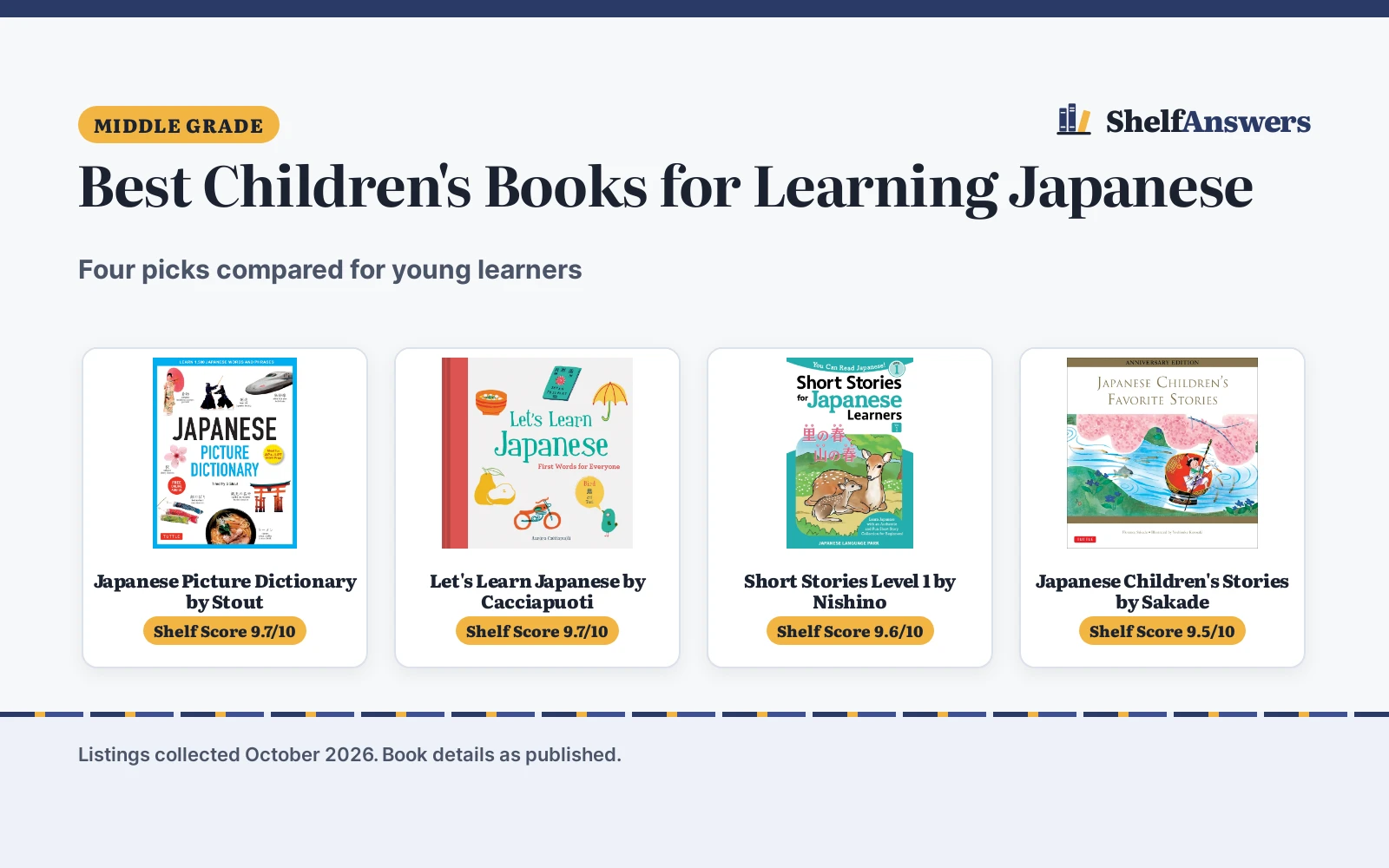
 Best Overall Japanese Picture Dictionary by Stout: Comprehensive visual dictionary with 1,500 words and companion audio Check price on Amazon
 Best for Young Beginners Let’s Learn Japanese by Cacciapuoti: Illustrated 48-page primer introducing basic words and Japanese characters Check price on Amazon
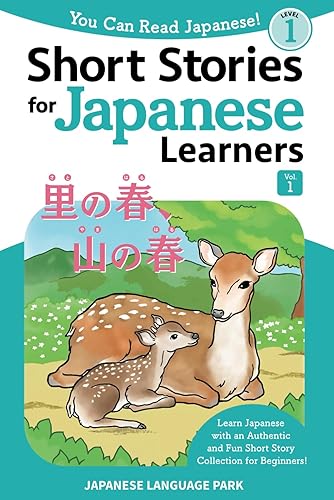
 Best for Reading Practice Short Stories Level 1 by Nishino: Short stories with furigana, vocabulary lists, and comprehension exercises Check price on Amazon
 Best Folktales Japanese Children’s Stories by Sakade: Hardcover collection of 20 classic Japanese folktales with watercolor art Check price on Amazon
The picks
| # | Product | Shelf Score | Buy |
|---|---|---|---|
| 1 | Japanese Picture Dictionary by Stout | 9.7/10 | Buy |
| 2 | Let's Learn Japanese by Cacciapuoti | 9.7/10 | Buy |
| 3 | Short Stories Level 1 by Nishino | 9.6/10 | Buy |
| 4 | Japanese Children's Stories by Sakade | 9.5/10 | Buy |

Japanese Picture Dictionary by Stout
This visual reference organizes 1,500 Japanese words and phrases across 40 themes with photographs and companion online audio, making it well suited for beginning learners ages 10 and up.
Pros
- The listing states it includes 1,500 words and phrases across 40 themes with color photographs and example sentences.
- Companion online audio recordings by native speakers provide pronunciation models for all vocabulary.
- Each entry provides Japanese script, Romanized text, and English definitions to help beginners read.
Cons
- The reading age of 10+ years is marked as from customers rather than stated by the publisher.
- No grade level is stated on the listing.
- The 96-page volume focuses on vocabulary and phrases rather than extended grammar exercises.

Let's Learn Japanese by Cacciapuoti
This 48-page illustrated primer introduces young children to basic vocabulary and the three Japanese writing systems alongside playful artwork.
Pros
- The listing states a reading age of 4 years and up with a grade level of Preschool and up.
- Illustrations pair vocabulary words with all three Japanese writing systems including kanji, hiragana, and katakana.
- The 48-page length makes it easy for preschoolers and early elementary readers to handle.
Cons
- Print length of 48 pages is brief and does not include advanced conversational phrases.
- The listing does not mention audio recordings to hear native pronunciation.
- The description notes it covers basic words, so developing readers will quickly outgrow the material.
Short Stories Level 1 by Nishino
Designed for students who already know hiragana, this 143-page reader features beginner short stories with furigana, vocabulary lists, and comprehension exercises with answers.
Pros
- Chapters stay between 400 and 700 characters to keep reading practice manageable for novices.
- Includes furigana over kanji and katakana, English translations, and comprehension questions with answers.
- Print length of 143 pages provides substantial reading material across diverse cultural topics.
Cons
- Neither a reading age nor a grade level is stated on the listing.
- The description notes the reader requires prior knowledge of hiragana and basic grammar.
- The listing does not state whether companion audio recordings are included.

Japanese Children's Stories by Sakade
This 112-page hardcover collection shares 20 traditional Japanese folktales accompanied by watercolor illustrations by Yoshisuke Kurosaki.
Pros
- Collects 20 traditional folktales including The Toothpick Warriors and The Rabbit Who Crossed the Sea.
- Features original watercolor illustrations by Yoshisuke Kurosaki throughout the 112 pages.
- The hardcover anniversary format offers durable construction for shared family storytelling.
Cons
- The listing contains a contradiction: the customer-listed reading age of 1 to 7 years conflicts with grade level 3 to 8.
- The text presents English translations of folktales rather than structured Japanese vocabulary lessons.
- No Japanese script or language practice exercises are included in the collection.
As an Amazon Associate I earn from qualifying purchases.
More picks to compare
 Learn Japanese for Kids by Tiny TalksFor babies and kids up to age 10 learning over 320 basic bilingual words.Check on Amazon
 Japan's Sounds A to Z by HuertaFor children ages 4 to 8 exploring Japanese onomatopoeia and sounds through rhymes.Check on Amazon
 Japanese for Kids by OtohataFor children ages 3 to 10 wanting over 200 basic words with audio.Check on Amazon
 Unboring Japan History by HistoriesFor readers ages 8 to 14 wanting visual history and culture of Japan.Check on Amazon
 Japanese Phrases Workbook by PetersFor children ages 4 to 10 practicing daily phrases with a 5-week workbook.Check on Amazon
Compare the picks
| Book | Shelf Score | Author | Pages | Reading age or grade | Amazon |
|---|---|---|---|---|---|
| Japanese Picture Dictionary by Stout | 9.7/10 | Timothy G. Stout | 96 | 10+ years (from customers) | Check price |
| Let’s Learn Japanese by Cacciapuoti | 9.7/10 | Aurora Cacciapuoti | 48 | 4+ / Preschool and up | |
| Short Stories Level 1 by Nishino | 9.6/10 | Japanese Language Park, Yumi Nishino | 143 | Not stated (Level 1) | Check price |
| Japanese Children’s Stories by Sakade | 9.5/10 | Florence Sakade | 112 | 1 to 7 (customers) / grade 3 to 8 |
Book details as published on each listing, collected 17 October 2026.
How we scored them
The Shelf Score weighs fit for young learners, contents and edition, value, and the listed reading age or grade level where provided. Three of the four picks publish a reading age, with two of those marked by Amazon as from customers, and two state a grade level, though the Japanese Children’s Favorite Stories listing presents a customer-listed reading age of 1 to 7 years alongside grade level 3 to 8. How we pick explains the weights.
| Book | Shelf Score | Fit /35 | Contents /25 | Value /25 | Age/level /10 |
|---|---|---|---|---|---|
| Japanese Picture Dictionary by Stout | 9.7 | 32 | 21 | 21 | 8 |
| Let’s Learn Japanese by Cacciapuoti | 9.7 | 30 | 20 | 20 | 9 |
| Short Stories Level 1 by Nishino | 9.6 | 29 | 21 | 20 | 7 |
| Japanese Children’s Stories by Sakade | 9.5 | 26 | 19 | 19 | 4 |
Scores run from 9.2 to 9.8: each book’s point total is placed on that range, so more points always means a higher score. Reading age or level counts on a list where at least one listing gives one, and a book whose listing gives none then scores zero on it. Where no listing gives one, the score is taken over the other 85 points. Books carry no warranty, so warranty is not scored.
How to choose the best children’s books for learning japanese
Match the format to your child’s reading stage
Younger learners and preschoolers thrive with visual guides like Let’s Learn Japanese, which spans 48 illustrated pages covering introductory words. Older elementary readers ready for sentence patterns benefit from comprehensive references like Japanese Picture Dictionary, or structured workbooks for learning Japanese that reinforce daily study habits.
Check for furigana and pronunciation audio
Japanese uses three distinct writing scripts, so beginners need phonetic support. Short Stories for Japanese Learners includes furigana over kanji characters alongside English translations, while Japanese Picture Dictionary provides online native audio recordings. If your student is also browsing broader chapter literature, explore our recommended middle grade books.
Before you buy
- Check whether online pronunciation audio is included: the Japanese Picture Dictionary listing includes companion audio downloads, whereas Let’s Learn Japanese does not list audio support.
- Look for prerequisite language skills: the Short Stories for Japanese Learners description notes that readers should already know hiragana and basic grammar.
- Compare the reading age and grade level: Japanese Children’s Favorite Stories lists grade level 3 to 8 despite a customer-marked reading age of 1 to 7 years.
Frequently Asked Questions
What is the best age to start learning Japanese with these books?
The titles here range from preschool options like Let’s Learn Japanese, listed for ages 4 and up, to Japanese Picture Dictionary with a customer-listed reading age of 10+ years. Choose a title matching your child’s current reading fluency and attention span.
Do these Japanese books include answer keys for exercises?
Short Stories for Japanese Learners includes reading comprehension exercises with answers in the book. The other titles focus on vocabulary and stories rather than test questions.
Does a beginner need to know hiragana before reading these books?
Let’s Learn Japanese and Japanese Picture Dictionary introduce basic vocabulary with Romanized text for absolute beginners. In contrast, the Short Stories for Japanese Learners description specifically states that readers should have hiragana down before beginning.
Related lists
See every middle grade list and all kids and teens lists.
More lists: explore picture books, young adult books, preschool books, and books for learning to read.