Best Children’s Books for Emotional Intelligence (2026)
Five children's books for emotional intelligence compared by listed reading age, format, and themes, from rhyming anger picture books to toddler board books.

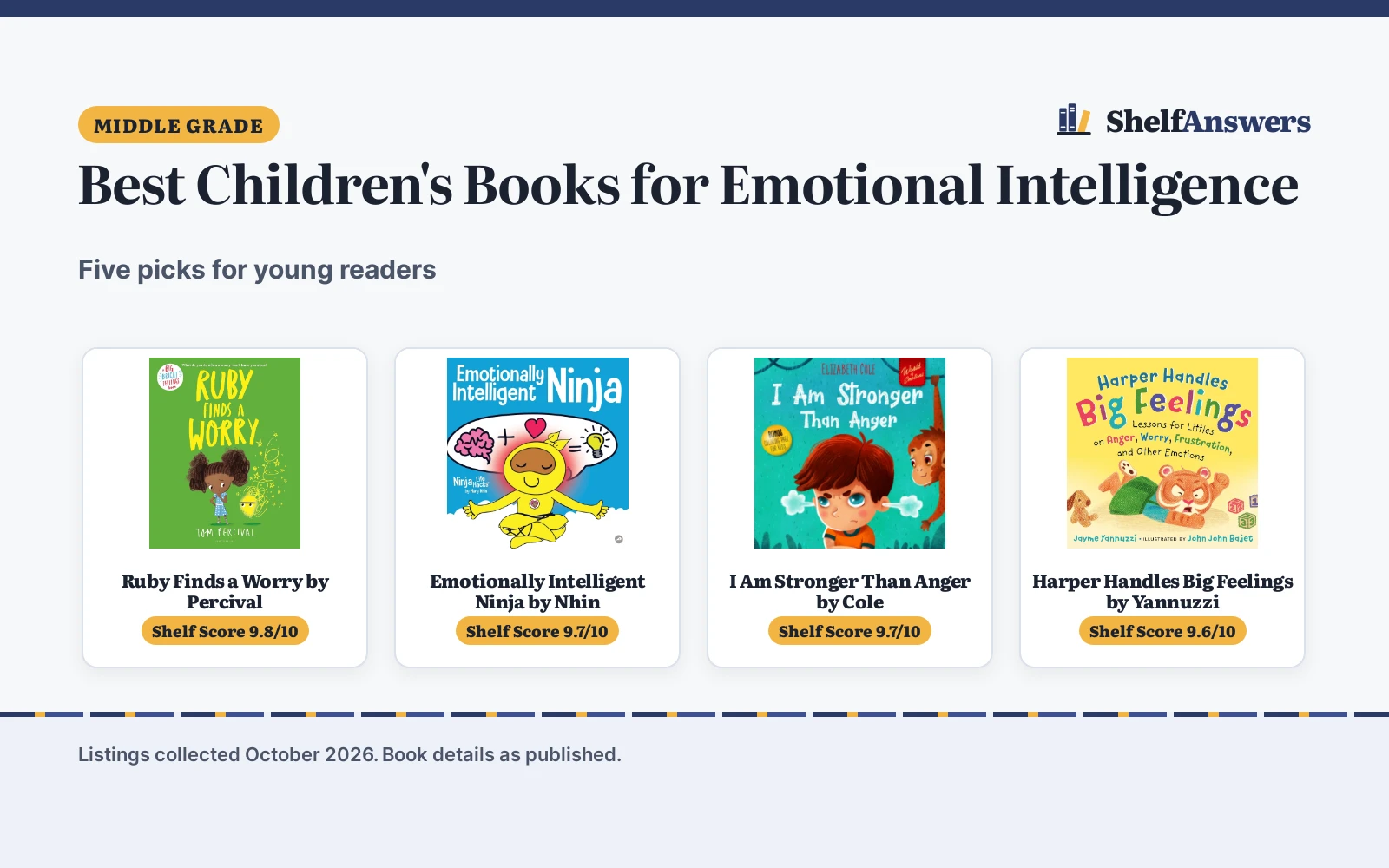
At a glance
Top picks
As an Amazon Associate I earn from qualifying purchases. How we score
When young children experience emotions too intense for their words, finding the best children’s books for emotional intelligence gives parents and teachers shared stories to guide them through outbursts and worry. This guide helps families support toddlers and early elementary readers as they learn to recognize feelings, self-soothe, and build empathy. We compared picture books and board books across listed reading ages, grade levels, print lengths, and calming strategies published on each listing.
ShelfAnswers earns a commission when you buy through links on this page, at no extra cost to you. As an Amazon Associate I earn from qualifying purchases. Affiliate disclosure.
Quick picks
 Best Overall Ruby Finds a Worry by Percival: A gentle picture book on sharing worries, for ages 4 to 6. Check price on Amazon
 Best for School-Age Kids Emotionally Intelligent Ninja by Nhin: Comic-style introduction to emotional intelligence for ages 3 to 11. Check price on Amazon
 Best for Anger Management I Am Stronger Than Anger by Cole: Rhyming zoo animal story with calming steps, for ages 3 to 6. Check price on Amazon
 Best for Preschoolers Harper Handles Big Feelings by Yannuzzi: Tiger story with a repeating calming rhyme, for ages 3 to 5. Check price on Amazon
 Best Board Book How Do I Feel? by DK: Durable 16-page board book explaining four feelings for toddlers. Check price on Amazon
The picks
| # | Product | Shelf Score | Buy |
|---|---|---|---|
| 1 | Ruby Finds a Worry by Percival | 9.8/10 | Buy |
| 2 | Emotionally Intelligent Ninja by Nhin | 9.7/10 | Buy |
| 3 | I Am Stronger Than Anger by Cole | 9.7/10 | Buy |
| 4 | Harper Handles Big Feelings by Yannuzzi | 9.6/10 | Buy |
| 5 | How Do I Feel? by DK | 9.5/10 | Buy |

Ruby Finds a Worry by Percival
A picture book following a young girl whose growing worry shrinks once she shares her feelings, suited for preschoolers coping with anxiety.
Pros
- Lists both a grade level of Preschool and up and a reading age of 4 to 6 years.
- Narrative uses a tangible character to show young children how talking about worries helps manage them.
- Part of the Big Bright Feelings series, giving families companion titles on other emotions.
Cons
- Reading age of 4 to 6 years is marked as from customers rather than stated by the publisher.
- The listing indicates this is a reprint edition rather than a newly released volume.
- At 32 pages, it is a short picture book that focuses primarily on worry rather than a broad emotional spectrum.

Emotionally Intelligent Ninja by Nhin
A comedic story introducing emotional intelligence and coping strategies through pint-size ninja characters, suited for elementary school children.
Pros
- Focuses directly on identifying emotions and developing emotional intelligence skills.
- Comic-style format and 38-page length keep early readers engaged.
- Listing states a wide reading age range of 3 to 11 years.
Cons
- Book 36 of 134 in the Ninja Life Hacks series, which can feel overwhelming to collect.
- No grade level is stated on the listing to help narrow reading placement.
- Grow Grit Press LLC is an independent press rather than a major trade publisher.

I Am Stronger Than Anger by Cole
A lightly rhyming picture book that teaches self-regulation and calming techniques through zoo animal encounters, suited for preschoolers prone to outbursts.
Pros
- Teaches specific calming techniques and self-regulation skills for managing temper outbursts.
- Includes a bonus coloring page alongside the lightly rhyming story.
- Print length of 32 pages provides a standard picture book read for bedtime or circle time.
Cons
- Reading age of 3 to 6 years is marked as from customers rather than publisher-assigned.
- No grade level is stated on the listing.
- The listing states it is independently published.

Harper Handles Big Feelings by Yannuzzi
A story about a tiger facing preschool show-and-tell that uses a recurring calming rhyme, suited for toddlers learning emotional awareness.
Pros
- Published recently by Z Kids with a July 8, 2025 publication date.
- Uses an easy calming rhyme that repeats throughout the narrative to reinforce coping skills.
- Covers a broad range of emotions including excitement, anger, sadness, pride, and jealousy.
Cons
- At 28 pages, it has the shortest story length among the narrative picks.
- Reading age of 3 to 5 years is marked as from customers.
- No grade level is stated on the listing.

How Do I Feel? by DK
A board book introducing four foundational emotions with personified character shapes, suited for toddlers building emotional vocabulary.
Pros
- Board book format with 16 pages is durable for very young toddlers.
- Uses four clear character figures representing Happiness, Anger, Sadness, and Pride.
- Connects physical bodily sensations like stomping or jumping to specific emotional states.
Cons
- The listing contains an internal contradiction, listing an age range of 3 to 5 years alongside a reading age of 2 to 3 years marked as from customers.
- At 16 pages, it offers very brief content compared to the full-length picture books.
- No grade level is stated on the listing.
As an Amazon Associate I earn from qualifying purchases.
More picks to compare
 A Little SPOT of Emotion by AlberFor children ages 3 and up using plush toys to identify feelings.Check on Amazon
 Emotionally Intelligent Ninja by NhinFor readers from baby to 12 years learning emotional intelligence through comedic stories.Check on Amazon
 Feelings Workbook by StephensonFor children ages 6 to 10 practicing calming exercises and self-regulation on worksheets.Check on Amazon
 Emotional Intelligence by MindJoyFor children ages 4 to 8 learning about emotions through 14 illustrated stories.Check on Amazon
Compare the picks
| Book | Shelf Score | Author | Pages | Reading age or grade | Amazon |
|---|---|---|---|---|---|
| Ruby Finds a Worry by Percival | 9.8/10 | Tom Percival | 32 | 4 to 6 / Preschool and up | Check price |
| Emotionally Intelligent Ninja by Nhin | 9.7/10 | Mary Nhin | 38 | 3 to 11 / Not stated | Check price |
| I Am Stronger Than Anger by Cole | 9.7/10 | Elizabeth Cole | 32 | 3 to 6 / Not stated | Check price |
| Harper Handles Big Feelings by Yannuzzi | 9.6/10 | Jayme Yannuzzi | 28 | 3 to 5 / Not stated | Check price |
| How Do I Feel? by DK | 9.5/10 | DK | 16 | 2 to 3 / Not stated | Check price |
Book details as published on each listing, collected 17 October 2026.
How we scored them
The Shelf Score weighs fit for young readers learning emotional awareness, contents and edition, value, and listed reading ages or levels. All five picks state a reading age, with four marked by Amazon as from customers, while only Ruby Finds a Worry publishes a grade level. The How Do I Feel? listing contains an internal contradiction, listing an age range of 3 to 5 years alongside a customer reading age of 2 to 3 years. How we pick explains the weights.
| Book | Shelf Score | Fit /35 | Contents /25 | Value /25 | Age/level /10 |
|---|---|---|---|---|---|
| Ruby Finds a Worry by Percival | 9.8 | 33 | 22 | 21 | 9 |
| Emotionally Intelligent Ninja by Nhin | 9.7 | 32 | 21 | 20 | 7 |
| I Am Stronger Than Anger by Cole | 9.7 | 30 | 20 | 20 | 7 |
| Harper Handles Big Feelings by Yannuzzi | 9.6 | 29 | 20 | 19 | 7 |
| How Do I Feel? by DK | 9.5 | 28 | 18 | 18 | 5 |
Scores run from 9.2 to 9.8: each book’s point total is placed on that range, so more points always means a higher score. Reading age or level counts on a list where at least one listing gives one, and a book whose listing gives none then scores zero on it. Where no listing gives one, the score is taken over the other 85 points. Books carry no warranty, so warranty is not scored.
How to choose the best children’s books for emotional intelligence
Consider listed reading ages and format
Matching book format to developmental stage prevents frustration during shared reading. A sturdy 16-page board book like How Do I Feel? suits toddlers building initial feeling words, whereas a 38-page story like Emotionally Intelligent Ninja offers narrative depth for children ages 3 to 11. To support daily emotional check-ins alongside reading, parents can also introduce workbooks for emotional regulation.
Choose between standalone stories and series
Standalone picture books like Harper Handles Big Feelings focus deeply on a single scenario, such as preschool anxiety, with a memorable calming rhyme. In contrast, character series like Tom Percival’s Big Bright Feelings or Mary Nhin’s Ninja Life Hacks allow children to explore varied emotions across multiple companion volumes. For older readers progressing beyond picture books, browse our guide to middle grade books.
Before you buy
- Check whether the reading age is publisher-set or marked as from customers, as seen on the Ruby Finds a Worry and Harper Handles Big Feelings listings.
- Look for internal listing contradictions, such as How Do I Feel? pairing a 3 to 5 age range with a 2 to 3 reading age.
- Confirm the format before ordering, noting that How Do I Feel? is a 16-page board book while Emotionally Intelligent Ninja is a 38-page picture book.
Frequently Asked Questions
What age group is Ruby Finds a Worry suited for?
The Ruby Finds a Worry listing gives a grade level of Preschool and up and a reading age of 4 to 6 years, marked as from customers. Its 32-page illustrated story introduces simple conversations about managing anxiety.
Is Emotionally Intelligent Ninja part of a larger series?
The listing states that Emotionally Intelligent Ninja is Book 36 of 134 in the Ninja Life Hacks series. It has a print length of 38 pages and lists a reading age of 3 to 11 years.
Which emotional intelligence book is best for toddlers?
How Do I Feel? is a 16-page board book designed with durable pages for toddlers, listing a reading age of 2 to 3 years from customers. Harper Handles Big Feelings also serves young listeners with a 28-page rhyming story and a customer reading age of 3 to 5 years.
Related lists
See every middle grade list and all kids and teens lists.
More lists: browse picture books, books for ages 3 to 5, books for preschoolers and books for development.