Best Self Help Books for Eating Disorders (2026)
Self help books for eating disorders, from recovery guides to parent guides and workbooks, compared by audience, page count and edition.

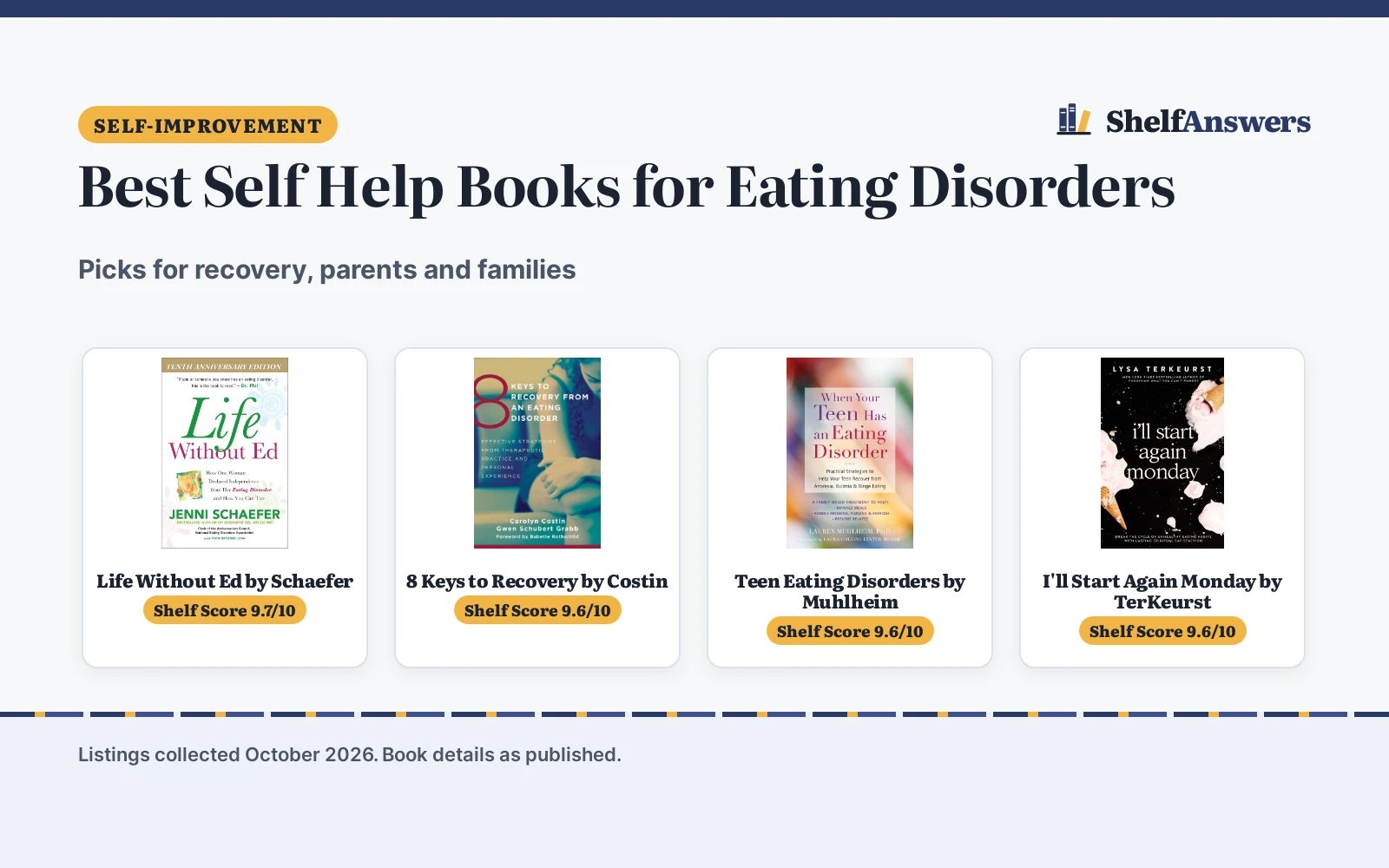
At a glance
Top picks
As an Amazon Associate I earn from qualifying purchases. How we score
If you are searching for the best self help books for eating disorders, start with who will be reading: the person in recovery, a parent, or a clinician. We compared each listing on audience, page count, publication date and edition, and noted where a listing does not state one of them.
ShelfAnswers earns a commission when you buy through links on this page, at no extra cost to you. As an Amazon Associate I earn from qualifying purchases. Affiliate disclosure.
Quick picks
 Best Overall Life Without Ed by Schaefer: Recovery story plus practical exercises, with sections for family and friends Check price on Amazon
 Best for Parents of Teens Teen Eating Disorders by Muhlheim: Family-based treatment approach, with meal and food flexibility topics Check price on Amazon
 Best for Recovery Basics 8 Keys to Recovery by Costin: Co-written by a therapist and her former patient, covering therapy basics Check price on Amazon
 Best for Faith-Based Readers I’ll Start Again Monday by TerKeurst: Spiritual motivation for readers stuck in cycles of dieting Check price on Amazon
 Best for Body Image More Than A Body by Kite: Body image research and self-compassion, not specific to eating disorders Check price on Amazon
The picks
| # | Product | Shelf Score | Buy |
|---|---|---|---|
| 1 | Life Without Ed by Schaefer | 9.7/10 | Buy |
| 2 | 8 Keys to Recovery by Costin | 9.6/10 | Buy |
| 3 | Teen Eating Disorders by Muhlheim | 9.6/10 | Buy |
| 4 | I'll Start Again Monday by TerKeurst | 9.6/10 | Buy |
| 5 | More Than A Body by Kite | 9.4/10 | Buy |

Life Without Ed by Schaefer
Combines one woman's recovery story with practical exercises, for people with an eating disorder and the family and friends who support them.
Pros
- The description says it includes practical exercises for breaking away from an eating disorder
- Separate sections address family and friends, treatment professionals and men with eating disorders
- 192 pages in one volume, a manageable length for a first self-help read
Cons
- The description mentions an abusive relationship and physical harm, which parents and readers may want to check first
- The listing conflicts with itself: the description says 10th anniversary edition, but the spec table lists 1st edition and a 2003 date
- Built on one woman's experience, so readers with a different situation may find it less direct

8 Keys to Recovery by Costin
Written by a therapist and her former patient, this book pairs personal accounts with a guide to what recovery involves.
Pros
- 296 pages in one volume, with a clear focus on the recovery process
- The description covers what therapy involves and the fear, guilt and shame many people feel
- The listing states it is part of the 8 Keys to Mental Health Book Series
Cons
- The listing does not state its book number in the series or its edition
- Both authors share personal accounts of severe eating disorders, which some readers will find heavy
- The description does not mention exercises or workbook tasks, unlike some books here

Teen Eating Disorders by Muhlheim
Written for parents and caregivers of a teen with an eating disorder, built around a family-based treatment approach.
Pros
- The description lists meal management and expanding food flexibility among its topics
- Outlines the principles of family-based treatment and how to involve parents in treatment
- 168 pages, 1st edition, published September 1, 2018, per the listing
Cons
- Written mainly for parents: the description also names mental health professionals, teachers, counselors and coaches as readers
- Centers on one treatment model, so families who want a different approach will need other books
- The listing states no reading age or grade level, as it is aimed at adults, not the teen

I'll Start Again Monday by TerKeurst
A faith-based guide for readers stuck in cycles of dieting and regaining weight, focused on motivation rather than a meal plan.
Pros
- The description says it is not a how-to book or a diet plan, so it can sit alongside another plan
- Focuses on emotional and spiritual motivation for readers who want change to last
- 160 pages in hardcover, with four steps the description lists
Cons
- Faith-based throughout, with the description centering on God and spiritual satisfaction
- Focuses on dieting and weight cycles, and the listing does not describe itself as a book about eating disorders
- The listing calls it a revised, condensed version of Made to Crave, so readers of that book may see overlap

More Than A Body by Kite
A body image guide by twin sisters with PhDs, for readers who want self-compassion; the description does not mention eating disorders.
Pros
- Based on the authors' body image research, as the description states
- Covers media, health and fitness, self-reflection and self-compassion, per the description
- 352 pages, with an action plan the description calls practical
Cons
- The description does not mention eating disorders, so it is less specific to that topic than the other picks
- Deals with body shame and self-objectification, which some readers may find emotionally heavy
- 352 pages is a long read for someone who wants a short starting point
As an Amazon Associate I earn from qualifying purchases.
More picks to compare
 IFS Recovery Guide by GrabowskiFor readers and professionals wanting an inner-parts approach, with chapter-end questions.Check on Amazon
 Radically Open DBT Workbook by HallFor readers who feel isolated and want skills-based exercises for social connection.Check on Amazon
 Binge Eating Workbook by SteinbachFor readers wanting guided exercises on binge eating and emotional eating.Check on Amazon
 Food Addiction Overview by LernerFor readers who want to compare eating disorders with food addiction.Check on Amazon
 Understanding Eating Disorders by MayFor readers, parents and caregivers who want a general overview of eating disorders.Check on Amazon
Compare the picks
| Book | Shelf Score | Author | Pages | Published | Amazon |
|---|---|---|---|---|---|
| Life Without Ed by Schaefer | 9.7/10 | Jenni Schaefer, Thom Rutledge | 192 | December 26, 2003 | Check price |
| 8 Keys to Recovery by Costin | 9.6/10 | Carolyn Costin, Gwen Schubert Grabb | 296 | November 7, 2011 | Check price |
| Teen Eating Disorders by Muhlheim | 9.6/10 | Lauren Muhlheim PsyD | 168 | September 1, 2018 | Check price |
| I’ll Start Again Monday by TerKeurst | 9.6/10 | Lysa TerKeurst | 160 | January 4, 2022 | |
| More Than A Body by Kite | 9.4/10 | Lexie Kite, Lindsay Kite | 352 | December 28, 2021 | Check price |
Book details as published on each listing, collected 17 October 2026.
How we scored them
The Shelf Score weighs fit for the reader, contents and edition, value, and the listed reading age or level where one is given. None of these picks lists a reading age or grade level, so the scores rest on fit, contents and value. How we pick explains the weights.
| Book | Shelf Score | Fit /35 | Contents /25 | Value /25 | Age/level /10 |
|---|---|---|---|---|---|
| Life Without Ed by Schaefer | 9.7 | 30 | 20 | 21 | n/a |
| 8 Keys to Recovery by Costin | 9.6 | 29 | 20 | 20 | n/a |
| Teen Eating Disorders by Muhlheim | 9.6 | 27 | 21 | 20 | n/a |
| I’ll Start Again Monday by TerKeurst | 9.6 | 26 | 20 | 20 | n/a |
| More Than A Body by Kite | 9.4 | 20 | 19 | 20 | n/a |
Scores run from 9.2 to 9.8: each book’s point total is placed on that range, so more points always means a higher score. Reading age or level counts on a list where at least one listing gives one, and a book whose listing gives none then scores zero on it. Where no listing gives one, the score is taken over the other 85 points. Books carry no warranty, so warranty is not scored.
How to choose the best self help books for eating disorders
Start with the reader
Life Without Ed is described for people with an eating disorder and the family and friends who support them, while When Your Teen Has an Eating Disorder is written for parents. If the reader is a teen, see our self help books for teens list.
Check the format and length
Page counts across the full set run from 113 pages to 352 pages, so a shorter book suits a first read. For exercises, the Radically Open DBT Workbook is listed as a workbook with assessments, and our workbook picks compare more formats.
Before you buy
- Check the edition line. The Life Without Ed description mentions a 10th anniversary edition, while its spec table lists a 1st edition, so compare the ISBN and publication date.
- Check the series position. The 8 Keys to Recovery listing says it belongs to a series but gives no book number.
- Check the audience. No listing states a reading age or grade level, so read the description to see whether it addresses the reader or a parent.
Frequently Asked Questions
Where should someone start with a self help book for an eating disorder?
Start with who will read it. Life Without Ed covers people with an eating disorder and the family and friends who support them.
Is there a self help book for parents of a teen with an eating disorder?
Yes. When Your Teen Has an Eating Disorder has 168 pages in a 1st edition published September 1, 2018, and its description outlines a family-based treatment approach.
Do any of these books include exercises?
Some do. The Life Without Ed description mentions practical exercises, and the Radically Open DBT Workbook listing mentions exercises for social engagement.
Related lists
See every Self-Improvement list and all Nonfiction lists.
More lists: binge eating workbooks, beginner self help books and self improvement picks.