Best Books for Quantitative Finance (2026): 9 Compared
Nine quantitative finance books compared by reader, from a plain-English beginner guide to trading, portfolio, risk and interview titles, with dates and page counts.

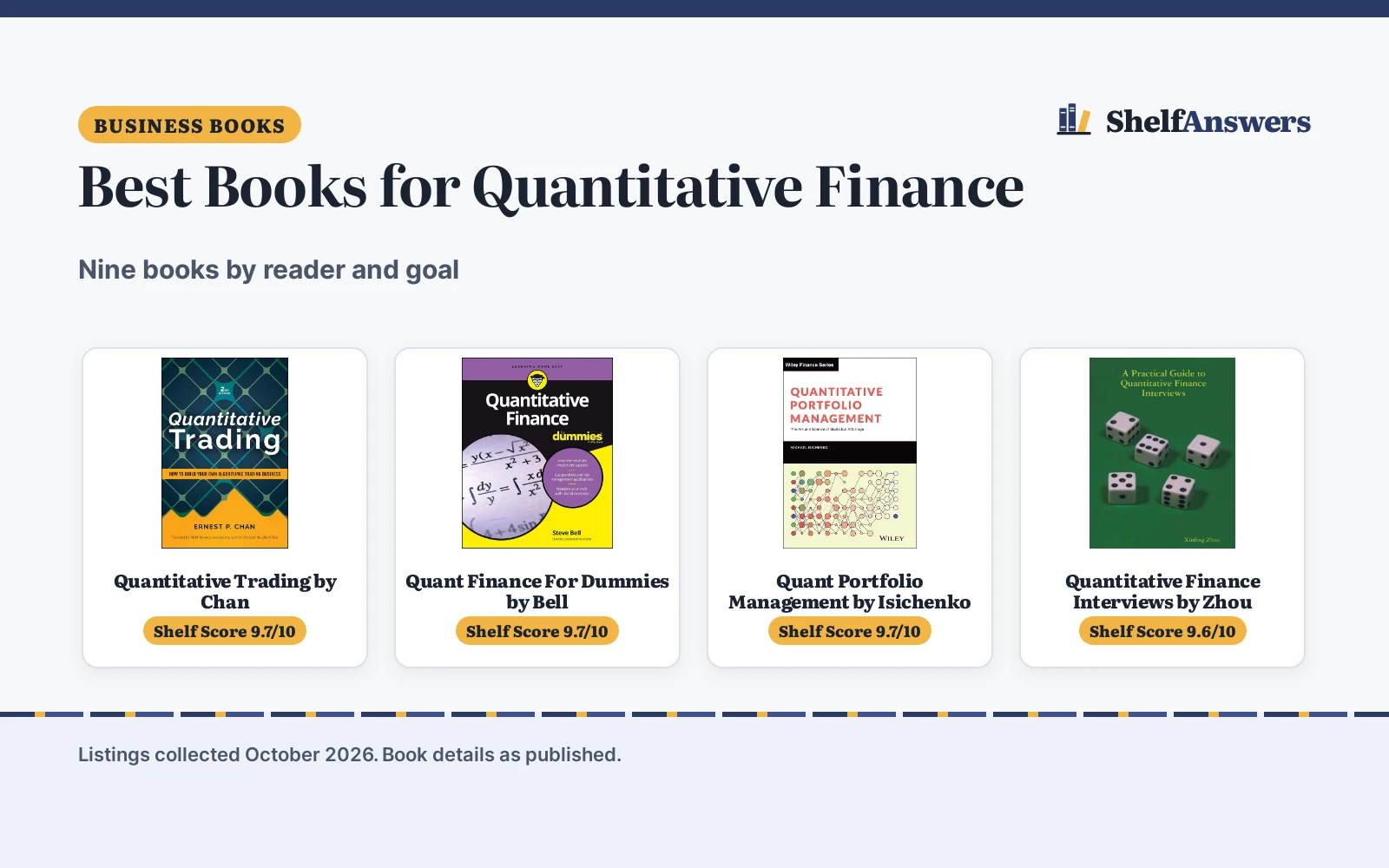
At a glance
Top picks
As an Amazon Associate I earn from qualifying purchases. How we score
A student with a probability course behind them and an interview on the calendar needs different reading than a working portfolio manager, so this list of the best books for quantitative finance matches each title to a reader and a goal. We compared nine books by what each Amazon listing publishes: the description, page count, publication date and the audience it names.
ShelfAnswers earns a commission when you buy through links on this page, at no extra cost to you. As an Amazon Associate I earn from qualifying purchases. Affiliate disclosure.
Quick picks
 Best Overall Quantitative Trading by Chan: Most recent listing, with trading strategies and Python and R code examples Check price on Amazon
 Best for Beginners Quant Finance For Dummies by Bell: Plain-English introduction for readers with no prior finance background Check price on Amazon
 Best for Portfolio Work Quant Portfolio Management by Isichenko: Statistical arbitrage and portfolio construction for equity professionals Check price on Amazon
 Best for Interview Prep Quantitative Finance Interviews by Zhou: More than 200 real interview problems in 209 pages Check price on Amazon
The picks
| # | Product | Shelf Score | Buy |
|---|---|---|---|
| 1 | Quantitative Trading by Chan | 9.7/10 | Buy |
| 2 | Quant Finance For Dummies by Bell | 9.7/10 | Buy |
| 3 | Quant Portfolio Management by Isichenko | 9.7/10 | Buy |
| 4 | Quantitative Finance Interviews by Zhou | 9.6/10 | Buy |

Quantitative Trading by Chan
For independent traders and investors who want to build or assess an algorithmic trading business.
Pros
- The listing describes it as a revised second edition, dated March 3, 2026, the most recent date on this list
- Includes updated analysis of a variety of trading strategies, with Python and R code examples, per the description
- Covers strategy design and a machine learning technique for changing market regimes, per the description
Cons
- The description aims it at independent retail traders and investors, so a student wanting pure theory may find it practical rather than academic
- The listing does not state a reading age or grade level, so the difficulty level is not given
- The description centers on trading strategies, so readers after derivatives pricing will need another title

Quant Finance For Dummies by Bell
For personal investors, finance students and newcomers who want plain-English models and formulas.
Pros
- Plain-English guidance, and the description says no previous experience of quantitative finance is needed
- Covers futures, options, risk and models such as Black-Scholes, per the description
- Includes exercises to build understanding, in a 416 page book
Cons
- The listing shows an August 15, 2016 publication date, the oldest on this list
- At 416 pages it is the longest of the ranked picks, which may feel heavy for a quick overview
- Written for personal investors, students and professionals new to the field, so advanced quants may want a more specialized title

Quant Portfolio Management by Isichenko
For investment professionals and data scientists who want machine learning applied to equity portfolios.
Pros
- Covers machine learning forecasts, combining multiple forecasts and multi-factor risk models, per the description
- Walks through data sourcing, portfolio construction and trade execution, per the description
- The listing gives 304 pages and an August 31, 2021 publication date, published by Wiley
Cons
- Focused on equity statistical arbitrage, so the scope is narrower than a general introduction
- The description names investment professionals and data scientists as its audience, so beginners may find the machine learning sections heavy
- The listing does not state a reading age or grade level, so the difficulty level is not given

Quantitative Finance Interviews by Zhou
For job candidates preparing for quantitative finance interviews with brain teasers and probability problems.
Pros
- Built around more than 200 real interview problems, with solutions analyzed in the book, per the description
- Covers brain teasers, calculus, linear algebra, probability, stochastic calculus and programming
- At 209 pages it is the shortest of the ranked picks
Cons
- Aimed at interview preparation, so it gives less background theory than a full course text
- The publication date is May 5, 2020, older than the 2021 and 2026 listings
- Its focus on interviews makes it less useful for a reader who wants a wider survey of the field
As an Amazon Associate I earn from qualifying purchases.
More picks to compare
 Mathematics for Finance by CapińskiFor students who want the math behind option pricing and portfolio theory.Check on Amazon
 Intro to Quantitative Finance by BlythFor readers with an undergraduate probability course who want derivatives pricing theory.Check on Amazon
 Quantitative Investing by PaleologoFor investors who want the full quantitative investment process, from strategy to post-trade analysis.Check on Amazon
 Quant Basics 101 by SegonneFor students aiming at a career in quantitative trading, not aimed at retail traders.Check on Amazon
 Financial Risk Management by MillerFor students and risk professionals learning value at risk, credit risk and liquidity risk.Check on Amazon
Compare the picks
| Book | Shelf Score | Author | Pages | Published | Amazon |
|---|---|---|---|---|---|
| Quantitative Trading by Chan | 9.7/10 | Ernest P. Chan | 256 | March 3, 2026 | Check price |
| Quant Finance For Dummies by Bell | 9.7/10 | Steve Bell | 416 | August 15, 2016 | Check price |
| Quant Portfolio Management by Isichenko | 9.7/10 | Michael Isichenko | 304 | August 31, 2021 | Check price |
| Quantitative Finance Interviews by Zhou | 9.6/10 | Xinfeng Zhou | 209 | May 5, 2020 | Check price |
Book details as published on each listing, collected 16 October 2026.
How we scored them
The Shelf Score weighs fit for the reader, contents and edition, value, and the listed reading age or level where one is given. None of the ranked picks states a reading age or grade level, so the scores rest on fit, contents and value. How we pick explains the weights.
| Book | Shelf Score | Fit /35 | Contents /25 | Value /25 | Age/level /10 |
|---|---|---|---|---|---|
| Quantitative Trading by Chan | 9.7 | 29 | 22 | 21 | n/a |
| Quant Finance For Dummies by Bell | 9.7 | 30 | 20 | 21 | n/a |
| Quant Portfolio Management by Isichenko | 9.7 | 28 | 21 | 21 | n/a |
| Quantitative Finance Interviews by Zhou | 9.6 | 26 | 21 | 20 | n/a |
Scores run from 9.2 to 9.8: each book’s point total is placed on that range, so more points always means a higher score. Reading age or level counts on a list where at least one listing gives one, and a book whose listing gives none then scores zero on it. Where no listing gives one, the score is taken over the other 85 points. Books carry no warranty, so warranty is not scored.
How to choose the best books for quantitative finance
Start with the math you already have
Quantitative Finance For Dummies is written in plain English for readers with no previous finance background. Quantitative Portfolio Management is aimed at investment professionals and data scientists, and Quantitative Trading includes Python and R code, so both reward existing skills in statistics or programming. If you need a refresher on the algebra and probability behind these books, see our GRE books for the quantitative section.
Check the publication date before you buy
Quantitative Trading has the newest publication date here, March 3, 2026, and its listing describes it as a revised second edition. The other ranked picks date from August 15, 2016, May 5, 2020 and August 31, 2021, so check the date on each listing and look for a newer version before you buy an older copy.
Match the book to the goal
Readers preparing for a quant interview may prefer Quantitative Finance Interviews, which is built around more than 200 real interview problems. Readers who want the risk side can look at Financial Risk Management, one of the other options on this page. Readers who want to start their own trading business can also compare our business and entrepreneurship picks.
Before you buy
- Check the publication date on the listing, since the ranked picks span 2016 to 2026.
- Check the page count against your reading time, since the ranked picks run from 209 to 416 pages.
- Look for exercise solutions: the Interview listing says it analyzes solutions to more than 200 problems, and the Dummies listing mentions exercises without stating answers.
Frequently Asked Questions
Where should a beginner start with quantitative finance books?
Quantitative Finance For Dummies suits readers with no previous experience of the subject, and its listing gives 416 pages of plain-English explanation.
Does any of these books include an answer key?
None of the listings states a separate answer key. The Interview listing says it analyzes solutions to more than 200 problems.
Which edition of Quantitative Trading should I buy?
The listing shows a March 3, 2026 publication date for the revised second edition, the most recent date among the ranked picks. It includes updated analysis of trading strategies and Python and R code examples.
Related lists
See every Business and Money list and all Nonfiction lists.
More lists: leadership books for women, student motivation books and business owner books for women.