Best Japanese Workbooks for Beginners (2026): 5 Picks Compared
Five Japanese workbooks for beginners compared by fit, contents, edition and listed reading level, from handwriting grids to an 840-word vocabulary plan.

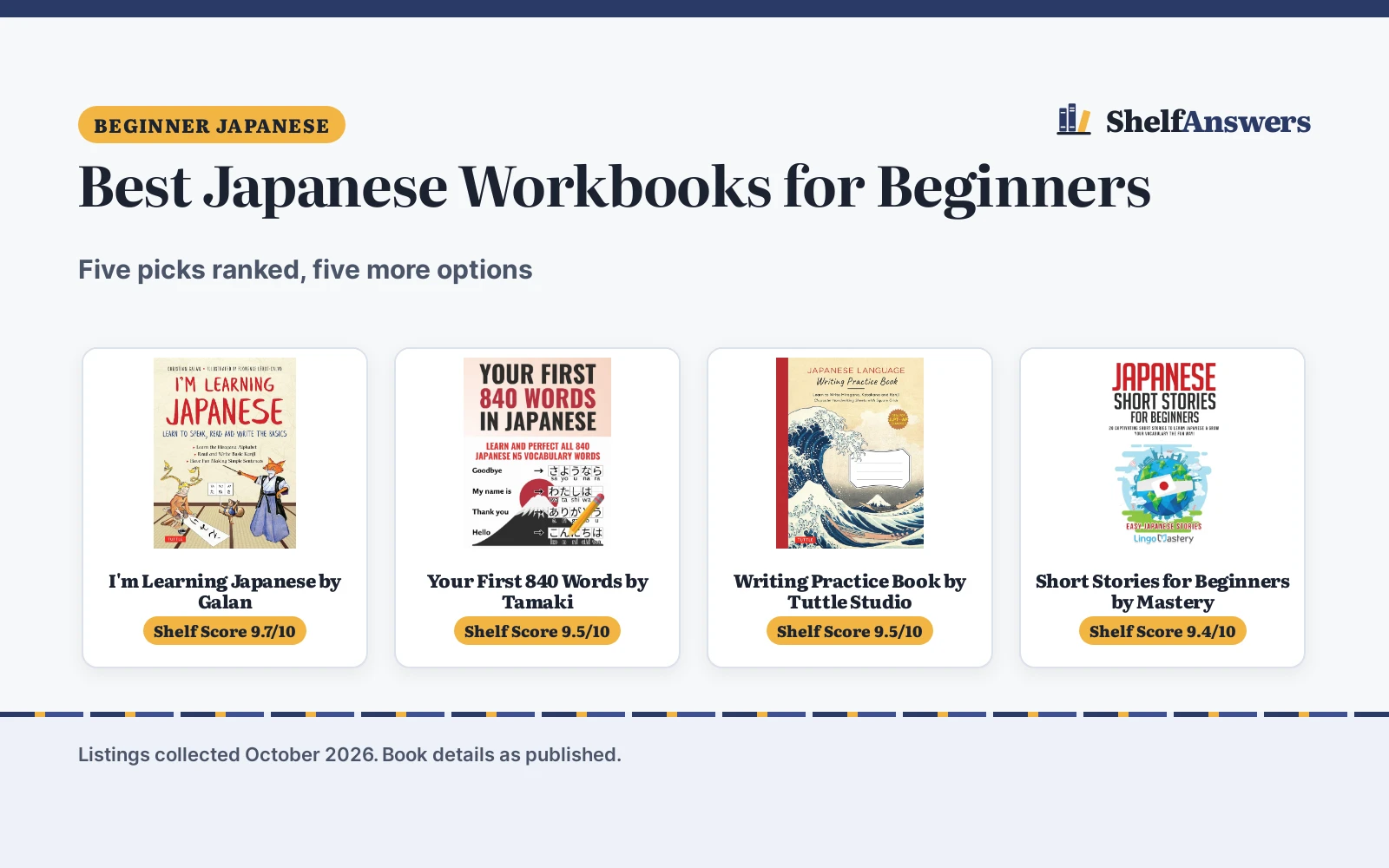
At a glance
Top picks
As an Amazon Associate I earn from qualifying purchases. How we score
A new learner facing hiragana usually needs a workbook with small steps, so the best japanese workbooks for beginners match where the reader starts. We compared these listings on fit, contents, edition and listed reading level for adults, teens and kids starting from zero.
ShelfAnswers earns a commission when you buy through links on this page, at no extra cost to you. As an Amazon Associate I earn from qualifying purchases. Affiliate disclosure.
Quick picks
 Best Overall I’m Learning Japanese by Galan: Speaking, reading and writing basics with a reading age of 9 to 14 Check price on Amazon
 Best for Vocabulary Your First 840 Words by Tamaki: 840 words in a learning plan for a learner with some kana Check price on Amazon
 Best for Handwriting Writing Practice Book by Tuttle Studio: Grids and charts for hiragana, katakana and the 100 most common kanji Check price on Amazon
 Best for Reading Practice Short Stories for Beginners by Mastery: 20 bilingual stories with quizzes for learners who want reading practice Check price on Amazon
The picks
| # | Product | Shelf Score | Buy |
|---|---|---|---|
| 1 | I'm Learning Japanese by Galan | 9.7/10 | Buy |
| 2 | Your First 840 Words by Tamaki | 9.5/10 | Buy |
| 3 | Writing Practice Book by Tuttle Studio | 9.5/10 | Buy |
| 4 | Short Stories for Beginners by Mastery | 9.4/10 | Buy |
| 5 |  Japanese Vocabulary Guide by Uo Japanese Vocabulary Guide by Uo | 9.2/10 | Buy |

I'm Learning Japanese by Galan
A manga-style beginner book that the description says suits readers from age 9 and adults starting from zero.
Pros
- Covers speaking, reading and writing, including the Hiragana alphabet and 23 kanji
- Grade level 3 to 8 and reading age 9 to 14 years are both stated
- Online audio recordings are listed as included
Cons
- Story-driven, with side trips such as sumo and hot springs, so lessons are spread across chapters
- The grade band of 3 to 8 is wide, so it does not pin down difficulty for one child
- A single 128-page volume, so it is a starter rather than a full course

Your First 840 Words by Tamaki
A flashcard-led vocabulary book for a beginner with some hiragana and katakana, aimed at JLPT N5 study.
Pros
- 840 flashcards, one per vocabulary word, plus a learning plan for complete beginners
- Lays out 42 new words per week over 20 weeks, as the listing states
- Published June 27, 2024, with 360 pages in total
Cons
- Recommended for beginners with some kana experience, so kana should come first
- The focus is vocabulary, so grammar and kanji are not its main subject
- Independently published, and the listing names no other publisher

Writing Practice Book by Tuttle Studio
A handwriting notebook with grids for hiragana, katakana and kanji, for a learner who wants to practice by hand.
Pros
- Over 60 double pages alternate note space with squared character practice sheets
- Includes hiragana and katakana charts and a guide to the 100 most common kanji
- Stroke order tips and a 10-page reference section are listed
Cons
- A writing book, so the listing does not mention listening or speaking practice
- The title names JLPT and AP exam prep, but the listing does not say which JLPT level it covers
- Published October 27, 2020, and the listing does not say whether a newer edition exists
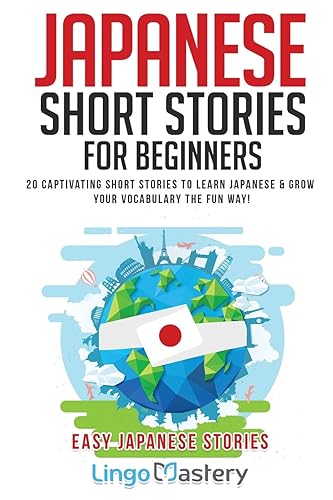
Short Stories for Beginners by Mastery
A bilingual reader of short stories for a beginner who wants to practice reading with English alongside.
Pros
- Each paragraph has an English translation directly below it
- Each story is followed by a synopsis and a comprehension quiz, per the description
- Vocabulary lists are Romanized, and the edition is bilingual
Cons
- The spec table says over 100 conversations, but the description says 20 stories, so the contents are unclear
- Quiz answers appear right after each quiz, so readers have to cover them to self-test
- A reader of stories rather than a writing workbook, so it does not practice handwriting

Japanese Vocabulary Guide by Uo
A 6-page laminated word list for a learner who wants a quick reference rather than a workbook.
Pros
- Groups words by topic, such as numbers, colors, family terms and body parts
- Includes simple sentence patterns, per the description
- Laminated and sized 8.5 by 11 inches, per the listing
Cons
- Published January 1, 2005, the oldest date among the five ranked picks
- The listing does not describe practice exercises or writing space
- A reference card, so it fits a learner who already has a course
As an Amazon Associate I earn from qualifying purchases.
More picks to compare
 Hiragana and Katakana Workbook by GengoBook 1 of 3: kana writing practice and crossword puzzles for beginners.Check on Amazon
 Beginning Japanese Workbook by KluemperCompanion practice for the Beginning Japanese textbook, with dialogues and grammar exercises.Check on Amazon
 Hiragana & Katakana Workbook by WatashiFor beginners who want mnemonic memory aids, writing sheets and online video lessons.Check on Amazon
 Hiragana and Katakana Practice by WorksFor beginners who want cut-out flashcards and genkouyoushi grid practice pages.Check on Amazon
 Kanji Beginner Workbook by KenmotsuFor learners who know kana: first 100 kanji with stroke order and grids.Check on Amazon
Compare the picks
| Book | Shelf Score | Pages | Reading age or grade | Published | Amazon |
|---|---|---|---|---|---|
| I’m Learning Japanese by Galan | 9.7/10 | 128 | Grade 3 to 8; reading age 9 to 14 years | October 29, 2019 | |
| Your First 840 Words by Tamaki | 9.5/10 | 360 | Not stated | June 27, 2024 | Check price |
| Writing Practice Book by Tuttle Studio | 9.5/10 | 128 | Not stated | October 27, 2020 | Check price |
| Short Stories for Beginners by Mastery | 9.4/10 | 221 | Not stated | August 7, 2020 | Check price |
| Japanese Vocabulary Guide by Uo | 9.2/10 | 6 | Not stated | January 1, 2005 | Check price |
Book details as published on each listing, collected 16 October 2026.
How we scored them
The Shelf Score weighs fit for the reader, contents and edition, value, and the listed reading age or level where one is given. One of the five picks lists a reading age and grade level, so the other four are scored on fit, contents and value alone. How we pick explains the weights.
| Book | Shelf Score | Fit /35 | Contents /25 | Value /25 | Age/level /10 |
|---|---|---|---|---|---|
| I’m Learning Japanese by Galan | 9.7 | 29 | 21 | 21 | 9 |
| Your First 840 Words by Tamaki | 9.5 | 28 | 22 | 20 | 0 |
| Writing Practice Book by Tuttle Studio | 9.5 | 28 | 21 | 20 | 0 |
| Short Stories for Beginners by Mastery | 9.4 | 26 | 20 | 19 | 0 |
| Japanese Vocabulary Guide by Uo | 9.2 | 16 | 11 | 10 | 0 |
Scores run from 9.2 to 9.8: each book’s point total is placed on that range, so more points always means a higher score. Reading age or level counts on a list where at least one listing gives one, and a book whose listing gives none then scores zero on it. Where no listing gives one, the score is taken over the other 85 points. Books carry no warranty, so warranty is not scored.
How to choose the best japanese workbooks for beginners
Start with the writing system you need
Kana workbooks such as the Hiragana and Katakana Workbook by Gengo suit the first stage. Kanji Beginner by Kenmotsu assumes hiragana and katakana are already known, so it fits after kana.
Match vocabulary or handwriting to the goal
Your First 840 Words in Japanese is aimed at JLPT N5 study, while the Writing Practice Book by Tuttle Studio is a grid notebook for handwriting. For more self-study options, see our self-study Japanese workbooks list.
Check the series and reading level
Kanji Beginner is Book 2 of 12, so confirm Book 1 first. Where a listing gives a reading age, compare it with the child’s grade, and see workbooks for learning Japanese for other levels.
Before you buy
- Check the publication date and ISBN; the Japanese Vocabulary guide is dated January 1, 2005.
- For a series, confirm the book number, such as Book 2 of 12 for Kanji Beginner.
- Compare the reading level with the learner: I’m Learning Japanese lists grade 3 to 8 and a reading age of 9 to 14 years.
Frequently Asked Questions
Should a beginner learn hiragana first?
Your First 840 Words lists its level as beginners with some hiragana and katakana experience, so the listing expects kana first.
Which edition should I buy?
Check the date: the Writing Practice Book is dated October 27, 2020, and none of these listings states whether a newer edition exists.
Is there an answer key?
Not stated for the workbooks here. The Japanese Short Stories listing says its quiz answers come right after each quiz.
Related lists
See every Homeschool Curriculum list and all Workbooks and Homeschool lists.
More lists: browse Japanese workbooks by level, Korean workbooks for beginners and French workbooks for beginners.